Taking Play Seriously

When I lived in Nigeria, I used to cross the city of Calabar to visit the defunct zoo, taking food for the animals—a constrictor snake, some crocodiles, a male drill monkey—still trapped in cages.  Jacob, a large juvenile chimpanzee, lived in that zoo in a cage roughly ten feet by ten feet.  As I walked onto the zoo grounds, Jacob would greet me with an exuberant pant-hoot and I would respond back (my Intro to Anthro students are endlessly amused when I demonstrate my pant-hooting skills).  Though I carried food for him, what Jacob most wanted to do was play with me. 

Jacob loved to play tag first, swinging back and forth across the front of his thickly barred cage, sticking a hand out to see if I could catch it.  We would rush back and forth together, Jacob generally favoring the role of being chased.  Then we’d settle down for some tickling.  Believe me, being tickled by a chimpanzee is, I am sure, rather what my boys feel when I get overly excited about tickling them. 

Jacob’s fingers were powerful, and his arms more so, but I made myself laugh in the chortling sound of chimpanzees.  If he got too strong, I could simply let out a sound of pain and he’d stop.  Then we’d get started again, because of course I loved to tickle him back.  I remember times, our heads together, pressed against the bars, his hand at the back of my neck, my fingers digging into his ribs.  It was such fun, yet I never could quite shake the thought in that moment that he could crush my head so easily against the bars. 
Continue reading “Taking Play Seriously”

Podcast on the evolution of language

Friend of Neuroanthropology, Dr. Ginger Campbell, has a new podcast up on the evolution of language. It’s free to download (audio mp3 or through iTunes).

Dr. Campbell’s stuff is great. I tend to load the podcasts onto my little iPod shuffle and listen to them while I’m riding around on the tractor (got a new 4-wheel-drive tractor this week!) and while running the ‘whipper snipper’ (what Yanks call a ‘weed whacker’ or, less prosaically, a ‘line trimmer’). We have a 4 cylinder whipper snipper, and it gets to be a rough ride, so I always enjoy listening to a good lecture while I’m I’m tearing through the unruly grass around the farm. Ira Bashkow, my former writing group mate from Chicago, now on the faculty at University of Virginia (and author of the 2007 Victor Turner Award winning, The Meaning of Whitemen: Race and Modernity in the Orokaiva Cultural World), turned me on to the podcast-lecture-listening-while-doing-physical-work when he told me that he works out in the gym to them. I’ve put a bit of a farm-related wrinkle on the whole process. But I digress…

The bottom line is that the Brain Science Podcasts are a great resource for anyone interested in Neuroanthropology. In her interviews, Dr. Campbell reminds me a lot of Anne Fausto-Sterling, one of my intellectual heroes (just her enthusiasm, willingness to learn, and humility in spite of knowledge). As soon as I get the slasher (Yanks: mower) on the back of the new tractor and the pastures dry out a bit, I’ll no doubt have stack of the podcasts I haven’t yet had a chance to listen to loaded on the iPod.

Pets, health and our extended phenotype

There’s a fun piece in The New York Times on The Healing Power of Dogs that discusses a wide range of health effects linked to pet ownership. The article briefly discusses a range of research that has linked pet ownership to health benefits. For example:

One Japanese study found pet owners made 30 percent fewer visits to doctors. A Melbourne study of 6,000 people showed that owners of dogs and other pets had lower cholesterol, blood pressure and heart attack risk compared with people who didn’t have pets. Obviously, the better health of pet owners could be explained by a variety of factors, but many experts believe companion animals improve health at least in part by lowering stress.

This research is fascinating in its own right, especially for a person who’s only recently started to live around animals… a lot of animals (at last count, 8 horses, 1 horse expecting a foal, 2 cats, 2 dogs, innumerable wild birds, kangaroos and wallabies all wandering onto the property). I’ve noticed a huge difference in my health and mood since the change, but it’s hard to separate the effects of having Basil and Roxy (the dogs), Glitz and Glam (the cats), or the bigger monkeys around (the horses). But the research discussed also touches on two issues that I think are of particular importance to those of us interested in neuroanthropology and the biology-culture interface.

Edited version
Continue reading “Pets, health and our extended phenotype”

Will Power as Mental Muscle

Blogging on Peer-Reviewed ResearchThere’s an interesting blog post here about “How to Boost Your Willpower,” which tells us that “researchers are finding is that willpower is essentially a mental muscle, and certain physical and mental forces can weaken or strengthen our self-control.”

 Well, how about a cultural muscle too?  After all, we’re talking about a cultural trait too!  In my research in Colombia, knowing how to manage limits and having reasons to say no help explain lower rates of illegal drug use there, despite plenty of risk factors and access to drugs. 

Continue reading “Will Power as Mental Muscle”

Rex at Savage Minds – berries, pink things & evolution

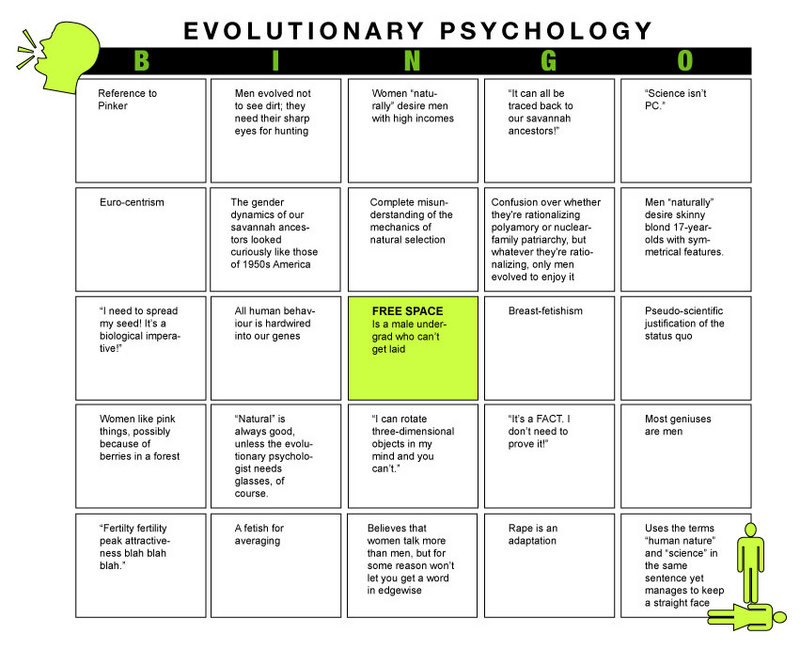
Alex Golub, one of the prime movers at Savage Minds, posted a link to an ‘Evolutionary Psychology’ bingo card that’s worth a chuckle.

Original post here.

I enjoyed the bingo card because it is such a great condensation of the usual hackneyed bits that crop up in conversations involving ‘evolution’ and ‘psychology,’ often with people who have serious interest in and understanding of neither evolutionary theory nor psychology. I’m not surprised that untrained individuals subscribe to evolutionary psychology (‘women like men who are tall because they could see prey farther off in the grasslands…’). After all, people close to me (who will remain unnamed) believe that one must inherit every trait or characteristic, however minor, from some relative, even if they are only related at a distance (‘you must get your love of traveling from your father’s brother…’) and into forms of ethnic personality theory (‘Italians are so expressive; Latins are so passionate…’).

The point of criticizing these trite versions of evolutionary psychology, for me, is not to throw out baby, bath water, and basin, but to really expose when pernicious sloppy thinking is masquerading as ‘science,’ especially under the guise of psychology and evolution. For whatever reason — probably because they have a sheen of ‘naturalness’ and being above criticism — these rubrics have become touchstones for some of the most retrograde thinking about sexuality, gender relations, ‘race,’ and other issues. The only way to truly engage them is to offer better accounts of both evolution and human psychology.

So in the meantime, I’m printing out my bingo card for the next salvo from the evolutionary psychologists.

Political Animals and Anthropological Brains

Today’s New York Times has an article “Political Animals (Yes, Animals),” which recounts the many lines of research on the politics of animal life.  Rhesus monkeys, dolphins, wolves and yes, even humans make their appearance in the article.  Research has increasingly shown that these “nonhuman animals behave like textbook politicians.  In these “highly gregarious and relatively brainy species,” individuals “engage in extraordinarily sophisticated forms of politicking, often across large and far-flung social networks.” 
Continue reading “Political Animals and Anthropological Brains”