Fall prevention in older people — Stephen Lord at HCSNet

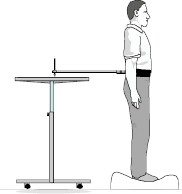
Sway meter, subject on foam
Daniel isn’t the only guy at Neuroanthropology who gets to go to good conferences; last week, while in the throes of a cold brought on by fieldwork with the 15-and-under Sydney city select rugby team, I got to go to the HCSNet Workshop on Speech, Perception and Action held at Western Sydney University.

HCSNet is funded by the Australian Research Council to promote research on human communication. I only got to go to the second day of the two-day conference (because I was cooking meals for 20 hungry rugby hopefuls the first day), but I saw a number of great presentations, including talks by Catherine Best, MARCS Auditory Laboratories, UWS, Beatriz Calvo-Merino, University College London, and Stephen Lord, Prince of Wales Medical Research Institute. I’ll blog soon on Dr. Calvo-Merino, one of the high points of the day, but today I want to make some notes on Prof. Lord’s fascinating research and talk.

Prof. Lord heads the Falls and Balance Research Group. Visit the group’s website for publications and some great information about risk factors for falling. At the conference, Lord discussed the group’s extensive applied research examining different factors that contribute to older people falling and experimental interventions to decrease the contribution of any single factor. The project has created a screening procedure for use by general practitioners to evaluate an older person’s likelihood of falling.

As regular readers know, I’m particularly interested in the way humans maintain equilibrium (see earlier posts, Kids falling down and Equilibrium, modularity, and training the brain-body, and Daniel’s post of some great parkour video, Free Running and Extreme Balance). In the longer of these posts (Equilbrium, modularity…), I specifically discussed how the ‘sense of balance’ is actually a much more complex synthesis of multiple sensory inputs, both exteroception (perception of the world) and interoception (perception of the self).

Continue reading “Fall prevention in older people — Stephen Lord at HCSNet”
Anthropology and Social Design Round Up

John Sherry is an anthropologist who is also chair of the Department of Marketing at Notre Dame’s Mendoza School of Business. I had coffee the other day with John, and was struck by how similar some of our approaches are. What unites us is an interest in behavior, for me behavioral health and for John consumer behavior, and a belief that anthropology can help unite interdisciplinary understandings of behavior and experience.

John has several online papers that focus on experience, embodiment and context. First up is Speaking of Art as Embodied Imagination: A Multi-Sensory Approach to Understanding Sensory Experience (it’s a large pdf, give it a moment).

Another good one is Fruit Flies Like A Banana (Or, When Ripeness Is All): Meditation on Markets and Timescapes. And here’s a short piece on Sporting Sensation. For more, check out his online cv with pdf links.

I’ve also come across a new blog uiGarden, which is about “Weaving Usability and Cultures”. (I covered similar blogs on “anthropology, design, business” back in April). Several posts there at uiGarden caught my attention:

A View of the Future: Trends Research, Ethnography and Design
Why Do People Become Attached to Their Products
Story Telling
Design for Emotion: Ready for the Next Decade?

And now for a more traditional round-up:

Irene Guijt, An “Aha” Moment in the Development Sector
Stories and practical examples, not grand narratives, as making the difference

Jason Palmer, Interview: The Cellphone Anthropology
Interview with Jan Chipchase, bringing anthropology to cellphones everywhere (for more on Chipchase, see our own Cellphones Save the World.)

Dori Tunstall, Design Anthropology: What Can It Add to Your Design Practice?
“Anthropology is engaged with issues of the global flows of people and goods, human rights and social justice, global feminism, technology adoption, the social effects of the environmental degradation, and local sustainability practices—all issues that have become important to designers.”

Continue reading “Anthropology and Social Design Round Up”

Monkeys and robots teaming up — worried?

As Daniel discussed in January in Monkey Makes Robot Walk!, a number of researchers are working on brain-machine interfaces by attaching prostheses to monkeys. Science Daily carries a new story, Mind Over Matter: Monkey Feeds Itself Using Its Brain, about a University of Pittsburgh School of Medicine experiment in which a monkey successfully used a human-like prosthetic limb to feed itself. As the Science Daily story reports:

Using this technology, monkeys in the Schwartz lab are able to move a robotic arm to feed themselves marshmallows and chunks of fruit while their own arms are restrained. Computer software interprets signals picked up by probes the width of a human hair. The probes are inserted into neuronal pathways in the monkey’s motor cortex, a brain region where voluntary movement originates as electrical impulses. The neurons’ collective activity is then evaluated using software programmed with a mathematic algorithm and then sent to the arm, which carries out the actions the monkey intended to perform with its own limb. Movements are fluid and natural, and evidence shows that the monkeys come to regard the robotic device as part of their own bodies.

According to the team, this is the ‘first’ example of the ‘use of cortical signals to control a multi-jointed prosthetic device for direct real-time interaction with the physical environment (’embodiment’)’ (from the abstract to the Nature article) (I’m always dubious about such ‘firsts,’ especially as this team has been announcing work on this project since at least 2004; but the research is still fascinating even if not a ‘first’).

Continue reading “Monkeys and robots teaming up — worried?”

Kids falling down

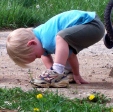
The Appeal of DirtIf, like me, you find the sense of balance and its development fascinating, or if you just want to learn more about toddlers falling over, check out Cognitive Daily’s wonderful piece discussing research on toddlers’ balance. A research team put weighted vests on toddlers to see how they would compensate when they tried to walk, and the poor little folks leaned the wrong way. That is, put a bit of weight on a toddler’s back, and he or she tends to lean backward to try to compensate. Man, little kids are ka-razy!

The piece by Dave Munger is, What backpack-wearing toddlers can tell us about how kids learn to walk. As always, Munger’s discussion is very thorough and gives a great sense for the original research. The work is reminiscent of the research of the late Esther Thelen, one of the psychologists who really opened my eyes to dynamic systems theory and a rethinking of developmental theory.

What makes humans unique?

Photo by JoProf. Michael Tomasello, co-director of the Max Planck Institute for Evolutionary Anthropology, whose work on chimpanzees and human children, on the biological capacity for culture, and a range of other subjects, must place him among the most important contemporary thinkers using comparative primate data, asks ‘How Are Humans Unique?’ in a recent piece for The New York Times‘ Idea Lab.

As Tomasello suggests, many things that we thought once definitively marked the difference between humans and other species, have gradually been found in evidence in other species — tools, deductive learning, language, even certain patterns of anti-social behaviour suggesting war and the like. The result is, for some, an uneasy sense that we might not be so different from other animals, and for others, a satisfaction that humans might be thought about using analytical frames developed with other species.

One thing that Tomasello points out very well is that many of humans’ cognitive advantages over other intelligent animals are ‘products of collective cognition,’ that is, not so much just an individual’s ability as the ability of an individual invested with the collective creativity and mental tricks invented by previous generations of humans.

Continue reading “What makes humans unique?”

Wednesday Round Up #3

Race 

The New York Times, How Race Is Lived In America
Series of articles focused on how race relations are defined by “daily experience, in schools, in sports arenas, in pop culture and at worship, and especially in the workplace”

American Anthropological Association, RACE: Are We So Different?
“Looking through the eyes of history, science and lived experience, the RACE Project explains differences among people and reveals the reality – and unreality – of race.”

The New York African Burial Ground
“Return to the past to build the future”

Also check out the lead researcher’s report, “An Examination of Enslaved Lives, A Construction of Ancestral Ties

Jennifer Eberhardt, Imaging Race (pdf)
American Psychologist article on brain imaging and the “social psychological responses associated with race”

Barack Obama’s Speech on Race
Full transcript here; Video, with comments across the spectrum, here

And for those people coming here, seeking more commentary on Obama’s speech, I now have a post on Obama and Race.

Embodiment & Sense Making

20/20, Blind People Who Interact with the World like Dolphins & Bats
Humans can echolocate!  Absolutely amazing.

Mind Matters, Thinking With The Body
Reading
, Movement, and Embodied Cognition

CF Kurtz & DJ Snowden, The New Dynamics of Strategy: Sense-making in a Complex and Complicated World
Challenging three basic assumptions—order, rational choice, and intent—in decision making

Continue reading “Wednesday Round Up #3”