PTSD and Traumatic Brain Injury: Trauma Inside Out

by Drew Matott and Drew Cameron
By Zoë H. Wool

Jake was fond of saying that even though he had become dumber, he wasn’t quite dumb enough. He knew that the improvised explosive device (IED) in Iraq had mangled his body, brain and self.

Jake (a pseudonym) lost 30 IQ points due to Traumatic Brain Injury (TBI) from that IED blast. According to the military, he was still smart enough to function and hold down a job, so they didn’t plan to include TBI in his disability rating.

He fought them on this, just as he fought them on the decision not to amputate his leg. After countless surgeries and rehabilitation techniques, his leg was almost useless, allowing him maybe 30 minutes of use before it started rebelling against its reconstructed form. The pain that caused was excruciating; he simply couldn’t use it more.

Eventually Jake won his battle to lose his leg. It was the best thing that happened to him during the year I got to know him while doing my dissertation fieldwork at Walter Reed Army Medical Center in Washington, D.C. (yes, that Walter Reed).

Dealing with, or writing about, TBI is rarely as clear as an amputation. The same is true of TBI’s nearly constant companion, Post Traumatic Stress Disorder (PTSD). TBI and PTSD are not injuries that you can see, unlike a lost leg. Despite the high numbers of TBI and PTSD cases from Iraq and Afghanistan, the relationship of these conditions to more obvious forms of combat trauma remains a fraught one: Witness the debate about PTSD and the Purple Heart.

Most people think that the Purple Heart, that most iconic of military honors, is awarded to American military members injured in combat. As with most issues military, it is not quite that simple.

In 2008, after months of consultation, the decision was made not to award the Purple Heart to those suffering from PTSD because, in part, the medal “recognizes those individuals wounded to a degree that requires treatment by a medical officer, in action with the enemy or as the result of enemy action where the intended effect of a specific enemy action is to kill or injure the service member.” PTSD doesn’t count.

Though the decision was officially framed in rather bureaucratic terms, the debate which surrounded it raises much deeper issues about the nature of trauma. Thinking through these issues has led me to think about the Cartesian split between the (internal) mind and the (external) body and the nature of trauma inside and out.

Continue reading “PTSD and Traumatic Brain Injury: Trauma Inside Out”
Gravlee et al: Race, Genetics, Social Inequality, and Health

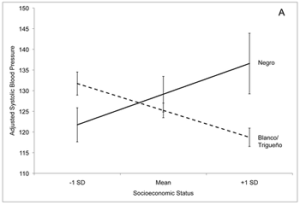
Color SES SBP
Clarence Gravlee, Amy Non and Connie Mulligan have just published an outstanding article in PLoS ONE, Genetic Ancestry, Social Classification, and Racial Inequalities in Blood Pressure in Southeastern Puerto Rico. The abstract opens:

The role of race in human genetics and biomedical research is among the most contested issues in science. Much debate centers on the relative importance of genetic versus sociocultural factors in explaining racial inequalities in health. However, few studies integrate genetic and sociocultural data to test competing explanations directly.

Note how that fits so well into the points just made in Nature/Nurture: Slash to the Rescue. But Gravlee, Non and Mulligan don’t just say we need to overcome the nature vs. nurture dichotomy, they do research that bridges it and even better, test ideas on both sides: “We draw on ethnographic, epidemiologic, and genetic data collected in southeastern Puerto Rico to isolate two distinct variables for which race is often used as a proxy: genetic ancestry versus social classification.”

This type of collaborative research can be crucial to getting the data to answer complicated questions. Connie Mulligan and Lance Gravlee deserve credit for taking the time to discuss how to bring together their respective approaches before going out to do research. In this case, the data come down more on the nurture (or social) side. As they write:

Our preliminary results provide the most direct evidence to date that previously reported associations between genetic ancestry and health may be attributable to sociocultural factors related to race and racism, rather than to functional genetic differences between racially defined groups.

Before someone gets all hot and bothered, Lance has also shown how to bring nurture back to nature. In Gravlee’s recent paper, How Race Becomes Biology: Embodiment of Social Inequality (pdf), he gives us following: “Drawing on recent developments in neighboring disciplines, I present a model for explaining how racial inequality becomes embodied – literally – in the biological well-being of racialized groups and individuals. This model requires a shift in the way we articulate the critique of race as bad biology.”

In the PLoS paper, Lance, Amy and Connie are aiming squarely at the use of race in medicine, where it has become common in some circles to use racial classification as a proxy for genetics. Basically this research destroys the proxy notion, since social classification turns out to be a better predictor of blood pressure than genetic ancestry.

Continue reading “Gravlee et al: Race, Genetics, Social Inequality, and Health”

Lose your shoes: Is barefoot better?

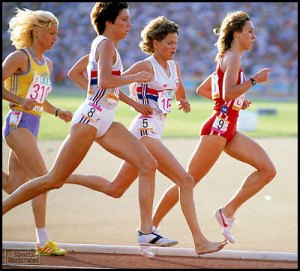
1984 Women's 3000 meter

In 1984 at the Los Angeles Olympics, the women’s 3000-meter final was marred by controversy when American Mary Decker fell after making contact with Zola Budd, a runner from South Africa who represented Britain (due to the boycott of South African sport).

Although Budd had been setting the pace, she faded to seventh in the end and was booed by the partisan LA audience (Decker would later say that she was inexperienced at running in a pack and, as the trailing runner, was responsible for their contact). Maricica Puica of Romania won the event, and Britain’s Wendy Sly took the silver in a final that was seared into my memory by the televised replays of a stricken Mary Decker, hip injured from her fall, shattered and crying on the infield.

In all of the drama, one of the things that left the greatest impression on me as a high school student and sometime athlete was the simple fact that Zola Budd ran without shoes, an almost unimaginable idea to me at the time. Budd was one of a handful of famous barefoot runners, including Abebe Bikila, the Ethiopian marathoner who won his first Olympic gold in 1960 without shoes, Tegla Loroupe, the Kenyan women’s running legend and multiple world record holder, and Ken Bob Saxton, aka ‘Barefoot Ken Bob,’ a marathoner and guru to the shoeless.

I’ve been thinking about barefoot running for a while, oddly enough since I started writing about bare-knuckle punching in no-holds-barred fighting (or ‘mixed martial arts’ like the Ultimate Fighting Championship in its early days). Barefoot running, even more than bare-knuckle boxing, reveals the ways that very simple technologies, if used consistently enough, become part of the developmental niche of the human body, shaping the way that our bones, muscles, tissues, and nervous system develop.

Although this post is not strictly neuroanthropology, I thought I might share some of what I’m working on, in part because I’m interested to hear any feedback people have. In particular, this will focus on how hard it is to sort out what’s ‘natural’ when activity patterns, incredibly variable, are necessary ingredients in the development of biological systems. But also, as it will become clearer in the post, the ways that our nervous system adapt to different situations, such as having heavily padded feet or being barefoot when we run, illustrates well how even unconscious training is a form of phenotypic, non-genetic, adaptation.

Before I go any further, though, if you have anything to say in response to this, I would love to read it. This is my first attempt to put down some thoughts that will be in a chapter of an upcoming book…
Continue reading “Lose your shoes: Is barefoot better?”

Talent: A difference that makes a difference

A young Andre Agassi
Studying sports training and skill acquisition, I often run headlong into the concept of ‘talent.’ When I suggest that athletic achievement demonstrates the extraordinary malleability of the human nervous system, the ability of our muscles to remodel, the refinement of athletes’ perceptual acuity, and even how our skeletons can be reconfigured by training, audience members often respond, ‘Yeah, but what about innate talent?’

Or, confronted by the yawning gap between elite athletes’ performances and the ability of the average person, sceptics still want to focus on the slight differences among elites athletes (for example, Jon Entine’s book Taboo), suggesting that this tiny fraction of difference is the ‘innate’ part, the ‘talent.’ I can describe the years of arduous labour that go into producing elite-level achievement, the countless hours of training and sophisticated coaching, and someone will inevitably say, ‘Okay, but some people are just inherently good at sports, aren’t they?’

But as psychologist K. Anders Ericsson said in an interview in Fast Company (cited here by Dan Peterson), ‘The traditional assumption is that people come into a professional domain, have similar experiences, and the only thing that’s different is their innate abilities. There’s little evidence to support this. With the exception of some sports, no characteristic of the brain or body constrains an individual from reaching an expert level.

Obviously, certain dimensions of the body can affect one’s ability to participate in a sport like basketball or sumo at an elite level, or a genetic abnormality may create an unusual wrinkle in a metabolic or even a neural process, but research like Ericsson’s suggests that these sorts of traits are likely the exception rather than the rule. That is, even if there is a genetic trait that helps some Kenyan runners to excel, or gives an individual with photographic memory, or helps a free diver to endure oxygen deprivation, these cases do not confirm the folk idea that talent is innate (and thus likely genetic).

In this post, I want consider the difference that makes a difference. That is, how the concept of talent itself actually affects the unfolding and compounding of developmental variation, helping extreme ability to emerge (and de-motivating those who don’t demonstrate early ‘promise’). Whether or not ‘talent’ exists—and I’m profoundly skeptical—believing that it does is a good foundation for exaggerating variation in skilled ability.

Continue reading “Talent: A difference that makes a difference”

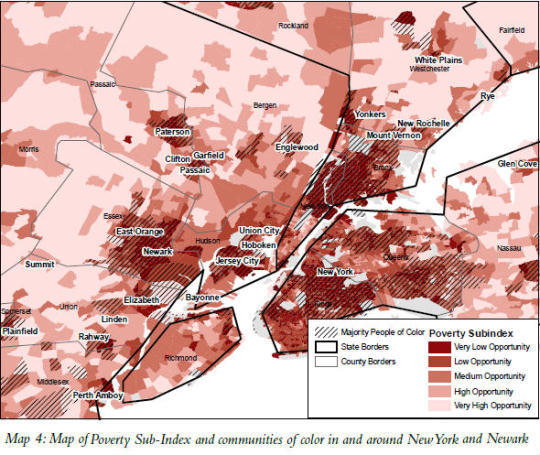
Poverty and the Brain: Becoming Critical

poverty-race-opportunity
Poverty Poisons the Brain was one of our most popular posts last year. Recent research has brought that topic back into public light. It’s good research, but today I will get critical about what really matters in our emerging realization that social disadvantage results in neurological disadvantage.

Gary Evans and Michelle Shamberg recently published a PNAS paper, Childhood Poverty, Chronic Stress and Working Memory (pdf). Here’s the abstract:

The income–achievement gap is a formidable societal problem, but little is known about either neurocognitive or biological mechanisms that might account for income-related deficits in academic achievement. We show that childhood poverty is inversely related to working memory in young adults. Furthermore, this prospective relationship is mediated by elevated chronic stress during childhood. Chronic stress is measured by allostatic load, a biological marker of cumulative wear and tear on the body that is caused by the mobilization of multiple physiological systems in response to chronic environmental demands.

The Evans and Shamberg paper has gotten prominent media attention. Over at Wired, Poverty Goes Straight to the Brain got an enormous number of diggs. Brandon Keim’s opening lines are, “Growing up poor isn’t merely hard on kids. It might also be bad for their brains. A long-term study of cognitive development in lower- and middle-class students found strong links between childhood poverty, physiological stress and adult memory.”

Continue reading “Poverty and the Brain: Becoming Critical”

Thinking to change your brain: Sharon Begley in the WSJ

In January, The Wall Street Journal carried a short excerpt from science writer
Sharon Begley’s excellent, but unfortunately titled book, Train Your Mind, Change Your Brain. The article, How Thinking Can Change the Brain, is excellent, as is the book, which I’d highly recommend, but both engage in a couple of pervasive rhetorics for talking about brain function that I believe make it harder to really theorize about issues like neuroplasticity.

That is, although I like Begley’s work, some of the ways that she writes about the brain puts her readers, if they’re not already neuroscience savvy, two steps backwards before moving toward greater understanding. It’s sad because I think her book is one of the best works for a general readership on recent research, and the brain imaging projects with Tibetan monks which forms the central narrative of the book are fascinating on so many levels. Begley has a brilliant eye for turning research into story-telling and with the meditation research, she’s picked an ideal subject on which to exercise her skills.

If only she would stop carrying on about ‘Mind’ and ‘Brain’ like they were the two primary characters…

Continue reading “Thinking to change your brain: Sharon Begley in the WSJ”