Dopamine and Eating

In an earlier post The Sugar Made Me Do It, I covered recent research by de Araujo, Oliveira-Maia et al. on how food, specifically sucrose, can reinforce eating by activating mid-brain dopamine circuitry, even in the absence of taste. In the accompanying editorial essay by Andrews and Horvath, this great graphic appeared, representing what is known about how eating can act on the hypothalamus and on the mesolimbic dopamine system (ventral tegmental area, nucleus accumbens, and prefrontal cortex).

Here is a much more convincing link to how eating can become appetite-driven, which previous posts on Genetics and Obesity and On the Causes of Obesity had raised as an important issue in the obesity problem.

Just one more note on the graphic: in terms of how taste can affect dopamine function, see some thoughts in the post on the neuropeptide orexin.
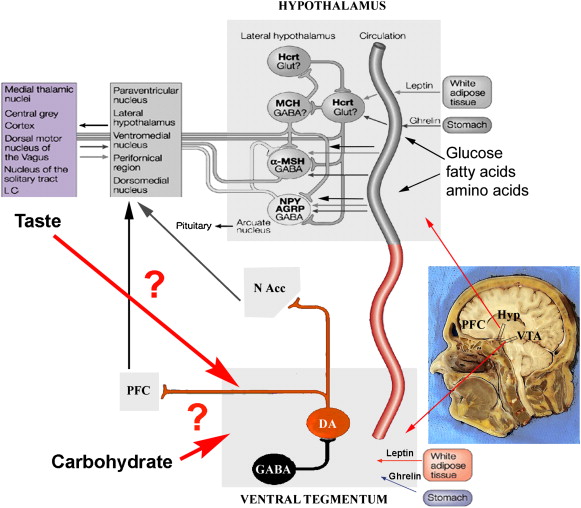
Figure 1. Schematic Illustration Depicting Some of the Major Findings of de Araujo and Oliveira-Maia et al

Taste alone (noncaloric sweetener), taste with caloric value (sucrose solution), or caloric value only (in the absence of taste receptors) can all equally activate the midbrain reward circuitry. To date, major emphasis has been placed on the hypothalamus and its various circuits, including orexin (ORX/Hcrt)- and melanin concentrating hormone (MCH)-producing neurons in the lateral hypothalamus as well as neuropeptide Y (NPY)/agouti-related protein (AgRP)- and -melanocyte-stimulating hormone (-MSH)-producing neurons in the arcuate nucleus, as a homeostatic center for feeding, responding to various peripheral metabolic hormones and fuels. The mesencephalic dopamine system is also targeted by peripheral hormones that affect and alter behavioral (and potentially endocrine) components of energy homeostasis. The results by de Araujo and Oliveira-Maia et al. highlight, however, that without classical hedonic signaling associated with reward-seeking behavior, the midbrain dopamine system can be entrained by caloric value arising from the periphery. While the precise signaling modality that mediates caloric value on dopamine neuronal activity remains to be deciphered, overall it is reasonable to suggest that distinction between hedonic and homeostatic regulation of feeding is redundant. DA, dopamine; GABA, γ-aminobutyric acid; Glut, glutamate.

Wednesday Round Up #8

General

Robert Sapolsky, A Natural History of Peace
Foreign Affairs full-text article: humans, like most primates, make their own peace

Michael Gazzaniga, Are Human Brains Unique?
We’ve got big brains. So what?

Michael Wesch, Anti-Teaching: Confronting the Crisis of Significance
Pdf article bringing together Wesch’s work with digital ethnography, blogging, and participatory research with students—highly recommended

Carl Zimmer, The More We Know about Genes, The Less We Understand
The power of robust regulation: gene networks take the day

Nikhil Swaminathan, Can the Brain Be Rebooted to Stop Drug Addiction?
Brain pathways, neural plasticity, and searching for a reset switch

Arthur Caplan, Intelligent Design Film Far Worse Than Stupid
“Ben Stein’s so-called documentary ‘Expelled’ isn’t just bad, it’s immoral”

Happiness

Sue Halpern, Are You Happy?
New York Review of Books piece on the recent batch of happiness pop sci books

Continue reading “Wednesday Round Up #8”

How well do we know our brains?

Blogging on Peer-Reviewed ResearchMaking the rounds of neuro-related sites on the web is a recent story from Wired, Brain Scanners Can See Your Decisions Before You Make Them, by Brandon Keim. It’s an interesting short piece on an even more interesting research paper by Chun Siong Soon, Marcel Brass, Hans-Jochen Heinze and John-Dylan Haynes forthcoming in Nature Neuroscience (abstract here). But like so much in the science writing about neurosciences, the piece leaves me feeling like either I don’t get it or science writers really don’t understand the significance of basic brain research. I won’t dwell too much on my issues though with the science writer because I want to really consider the relationship between brain activity and experience, or what role phenomenology might serve in neuroanthropology (besides, I’ve been railing at science writers a bit too much of late…).

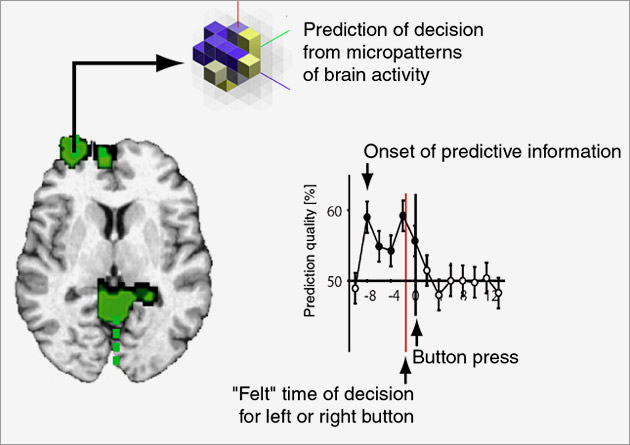
Brain areas that predict decisions.  By John-Dylan Haynes.  Wired.
From Keim’s article, we have this explanation of Haynes’ work:

Haynes updated a classic experiment by the late Benjamin Libet, who showed that a brain region involved in coordinating motor activity fired a fraction of a second before test subjects chose to push a button. Later studies supported Libet’s theory that subconscious activity preceded and determined conscious choice [I have a problem with that phrase, especially ‘determined’] — but none found such a vast gap between a decision and the experience of making it as Haynes’ study has….
Taken together, the patterns [in frontopolar cortex and then parietal cortex] consistently predicted whether test subjects eventually pushed a button with their left or right hand — a choice that, to them, felt like the outcome of conscious deliberation. For those accustomed to thinking of themselves as having free will, the implications are far more unsettling than learning about the physiological basis of other brain functions.

The Libet research is a classic piece (I don’t know if it makes any top 100 lists, but it’s especially important to those of us interested in motor action). The problem seems to be forcing Haynes’ data — which confirms Libet’s older research about the subconscious activity that precedes conscious awareness of ‘choice’ — through a folk theory about ‘free will’ being a necessarily conscious activity setting in motion a chain of mind events leading up to action. Folk understandings posit the existence of ‘The Decider’ in the brain, a kind of uncaused cause, the prime neural mover, which is conscious.

Bottom line, as far as I’m concerned: the research can’t be proving whether or not we have ‘free will’ because ‘free will’ is fundamentally about constraints on ‘will’ (itself a fuzzy concept when you’re looking at brain imaging). That is, the research would have to examine not what the brain does when it makes a choice, but whether that brain activity was constrained by something external to the person. After all, if we say that a person’s ‘free will’ is limited by their brain, that doesn’t really make sense now, does it? Presumably, acts of a ‘free will’ would also be determined by the brain, wouldn’t they? For the brain to ‘constrain’ our own ‘free will,’ it would have to be a thing separate from us.

What the research is showing, however, is something fascinating about the relationship of phenomenology and native categories of mind and how they might intersect with brain science research.
Continue reading “How well do we know our brains?”

Jeff Lichtman’s Brainbows

Take a genetically-engineered mouse and add color. That is what Jeffrey Lichtman, Jean Livet, and Joshua Sanes have done. Start by inserting genes that turn neurons fluorescent hues of yellow, red and cyan. Then add some more DNA that randomly expresses those three genes. Presto, rainbow brains.

As a Harvard Science piece reports, “By activating multiple fluorescent proteins in neurons, neuroscientists at Harvard University are imaging the brain and nervous system as never before, rendering their cells in a riotous spray of colors dubbed a ‘Brainbow.’ This technique… allows researchers to tag neurons with roughly 90 distinct colors, a huge leap over the mere handful of shades possible with current fluorescent labeling.”

So many colors in something as complex and elegant as a neuron produces striking images, and I have included many here. These images also permit the study of fields of neurons, from the life course of one neuron to the patterns of connections between neurons. Hence the emerging field of “Connectomics” which “attempts to physically map the tangle of neural circuits that collect, process, and archive information in the nervous system.”

I stumbled across Lichtman’s images in two publications recently. Harvard Magazine features his work, along with five other Harvard scientists, in this month’s feature article, Shedding Light on Life: Advances in Optical Microscopy Reveal Biological Processes as They Unfold. The magazine also provides an online collection of short video clips called Lights! Microscopes! Action! Across the Charles River, MIT’s Technology Review features Lichtman’s work as one of its Ten Emerging Technologies of 2008, complete with an accompanying video featuring Lichtman.

Continue reading “Jeff Lichtman’s Brainbows”

Craving money, chocolate and… justice

Image by Lou Beach of The New York Times.A while back, I got really hacked off about a piece of really pathetic science reporting about some brain-related research in the post, Bad brain science: Boobs caused subprime crisis. And now, as if sent from heaven (or the Benevolent Goddess That Pokes Holes in Bad Evolutionary Psychology), this news release from UCLA, Brain reacts to fairness as it does to money and chocolate, study shows, by Stuart Wolpert. All caveats in place — including that I haven’t seen the reviewed piece that backs this up — we have some nifty data with which I can continue to pile scorn on those who think images of women’s cleavage dancing before them is what made the ‘financial titans’ leverage the US economy into subprime disaster.

The human brain responds to being treated fairly the same way it responds to winning money and eating chocolate, UCLA scientists report. Being treated fairly turns on the brain’s reward circuitry.

“We may be hard-wired to treat fairness as a reward,” said study co-author Matthew D. Lieberman, UCLA associate professor of psychology and a founder of social cognitive neuroscience.

That’s right — if you recall the sex-money-chocolate ‘hub’ in the brain that we discussed (well, snickered at) in the ‘Bad Brain Science’ post, now it also looks like this part of the brain is also involved in being treated fairly. So now it’s the ‘sex-money-chocolate-justice hub’ (they’re sure beer and pizza isn’t in there, too?).
Continue reading “Craving money, chocolate and… justice”

The Sugar Made Me Do It

Neuroscientifically Challenged had a great post awhile back, Every Sweet Hath Its Sour, reporting on research that basically equates modern, processed food with drugs.

Why? As the Duke Health news release tells us, “Researchers at Duke University Medical Center have discovered that the brain can respond to the calorie content of food, even in the absence of taste.” An even better title summarizing this research is “Tasteless Food Reward.”

This March 2008 Neuron paper “Food Reward in the Absence of Taste Receptor Signaling” by Ivan de Araujo, Albino Oliveira-Maia and colleagues shows that high-calorie food can directly reinforce the mesolimbic dopamine system. This result overturns that common assumption that what we eat relies on conditioned preference, pairing taste with the ingestion of a particular substance, say, cops and their donuts. This assumption has been used to great effect in evolutionary medicine research—we evolved in a fat-, sugar- and salt-limited environment, and today our evolved tastes drive our excessive consumptions of fast food in the modern world.

Now the modern situation appears even more dire, for calories alone can also reinforce food consumption, at least in mice “which lack the cellular machinery required for sweet taste transduction.” The Tasteless Food Reward editorial by Zane Andrews and Tamas Horvath tells us that “de Araujo et al. show that mice lacking functional ‘sweet’ taste receptors (trpm5−/−) develop a preference for sucrose by activating the mesolimbic dopamine-accumbal pathway, solely based on calorie load.”

Continue reading “The Sugar Made Me Do It”