Best of the rest 2009

Daniel and I get some help on Neuroanthropology.net, not least of all from Paul Mason, but also from a whole host of other folks, including colleagues, students, long-distance collaborators, and completely innocent bystanders who do absolutely nothing to warrant inclusion. So here’s the most popular posts from 2009 that neither Daniel nor I wrote.

The majority of the posts on this list come from Daniel’s students at the University of Notre Dame. He has been doing award winning community-based research (see posts here and here), and one thing that makes it distinctive is that he gets the students to publish reports of their work online, where people from the community and others can read it. It’s a great use of this sort of virtual platform to promote serious undergraduate research, and to open up the doors of the classroom to let others peer in on what we’re doing. Daniel’s done a workshop at the American Anthropology Association on the subject as well, so I’m hoping he’ll continue to share this sort of work and his reflections on it through Neuroanthropology.net.

1. Cosleeping and Biological Imperatives: Why Human Babies Do Not and Should Not Sleep Alone by James J. McKenna — While technically from the very, very tail end of 2008, this post by our colleague at Notre Dame just keeps generating traffic. It’s a well-written, deeply important consideration of the neuroanthropological dynamics of mother-child co-sleeping (that’s in the same bed or very close by, for those of you non-parents out there). Well worth a look, especially if you’ve got a very little one in the family, or soon will have.

2. What’s the Dope on Music and Drugs? by John Barany, Abby Higgins, Melissa Lechlitner, and Joanna Schultz. Some of Daniel’s students look into the controversy about the effect of references to drugs in the lyrics of popular music. The authors point out the radically different sales figures for ‘cleaned up’ versions of the most explicit popular recordings and whether or not Michael Phelps’ problems with marijuana might have had anything to do with listening to Lil’ Wayne on his headphones before swimming for gold.

3. The Encultured Brain: Why Neuroanthropology? Why Now? by Greg Downey and Daniel Lende — Alright, but technically, it belongs somewhere because it is one of our most widely read posts. The statement we wrote for The Encultured Brain conference as an attempt to try to articulate the Big Picture. We’re still working on it, but it’s already pretty hefty.

Continue reading “Best of the rest 2009”

Greg Downey’s top 10 of 2009


At the risk of being accused of self promotion (but, of course, what else is blogging?), I’m going to offer my own top 10 list of myself for 2009. These are the most read posts I wrote during the course of the year. Of course, by ‘most read’ I mean that people clicked through to them. In a few cases, I’m fairly certain that a substantial majority never actually read the longer ones through to the end.

That said, I’m pleased that some of my longest, most substantial posts seemed to attract the most readers. I think it bodes well for Neuroanthropology.net and the willingness of people to consult serious work on line, or at least as serious as I can manage here. Thanks for all your support in the past year, and I’ll keep trying to produce the goods in 2010.

1. What do these enigmatic women want? — Right after the new year, in a fit of irritation with a piece about women’s sexuality research in The New York Times, I dashed off this snide little piece, and it’s had great legs (no gender-related pun intended). Every once in a while, some other blogger notices it and links to it, so it keeps getting little bumps up in the standings.

2. Lose your shoes: Is barefoot better? — In July, I test drove a chapter from the sports book I’m working on, exploring the pitfalls of barefoot running and the effects of shoes on our feet. A few barefoot running advocates and podiatry websites have linked to this posting, which I think is more about the intertwining of biology, culture and behaviour than about condemning shoes or anything. But then again, as an anthropologist, I should be suspicious about authors’ claims to authority over what they write.

3. Fear of Twitter: technophobia part 2 — I spent way too much time putting this post together, inspired mostly by a cartoon about Twitter and irritated yet again by the Baroness Lady Susan Greenfield, PhD, serial technophobe and media addict. Although I have zero vested interest in Twitter, I wound up defending what is likely an annoying social networking technology by arguing it was no more vapid or shallow than most human communication.

Continue reading “Greg Downey’s top 10 of 2009”

Daniel Lende’s top 10 of 2009


Daniel’s been a busy boy this year, and he’s snowed under right now, so it falls to me to do a few year-end house-cleaning type chores. One of the easier ones (thanks to WordPress) is for me to compile a brief list of our top posts for the year. Rather than put them into a single posting — and thereby reveal that Daniel’s probably got way more of the more popular posts than I do — I’m going to take the liberty to do at least two separate 2009 lists with a bit of commentary, in case you missed these the first time around. I’m also going to leave out the posts that Daniel put up that were written by his students (they’ll be on another list); these were some of our most popular of the year.

My statistics may be slightly distorted by the fact that I’m a few days pokey getting around to doing this, but here’s Daniel’s most popular posts of 2009, starting with the one that got the most traffic:

1. Wednesday Round Up #47 — Leading off in January 2009 in high style, Daniel put up our second most popular post of all time (second only to Jim McKenna’s widely read piece on Mother-Child co-sleeping, an article that draws constant readership). The normal Wednesday Round Up was extraordinary because it focused on the inauguration of Barack Obama, providing an extraordinary wealth of links to posts about many aspects of his life, thought, and character. This post still ticks over constantly due to the depth of the list that Daniel provided.

2. Encephalon #71: Big Night — Daniel can’t take all the credit for this one, as the moving feast that is Encephalon came to Neuroanthropology.net, but he did all the heavy lifting on this blog carnival, offering a really remarkable edition of the blog carnival of the brain.

3. Trance Captured on Video — One of the more startling postings on Neuroanthropology.net, Daniel’s posting provided a single place to find a series of videos of trance states discussed on the Medical Anthropology listserv, as well as his own notes. If you haven’t checked it out, you should – there’s some great stuff on the list! It’s become a point of reference online for those interested in the anthropology of altered states of consciousness.

Continue reading “Daniel Lende’s top 10 of 2009”

Thoughts on conference organizing

There have been a couple of interesting posts I’ve run across in my attempts to find out what happened at the 2009 AAA conference (see especially Lorenz’s run-down at antropologi.info). These discussions of conferences in general have encouraged me to write something about my own experiences organizing and attending conferences over the past year (see also, Lorenz’s What’s the point of anthropology conferences?, Kerim’s What’s Your Favorite Anthropology Conference? and Strong’s How to attend a conference in a couple hours). I thought I’d add a different perspective; that of the amateur, I’ll-never-do-it-again (dis-)organizer.

I will cross-post this at both Neuroanthropology.net and Culture Matters, something I do not usually do, because I think that it’s worth putting up at both places, and both sites are intimately tied to the content of the post. Apologies if you run across this twice; I won’t make it a habit.

Although I’ve probably been to a few score academic conferences since my first in 1992 (the Society for Ethnomusicology), I’ve never really organized anything substantial until this year, when Daniel and I organized our first Neuroanthropology conference, ‘The Encultured Brain,’ and I agreed to chair the annual meeting of the Australian Anthropological Society (the AAS). I also was on the ‘program committee’ for the Australasian Society for Cognitive Science annual meeting, but they realized I was up to my neck in other planning so didn’t ask too much of me. It was probably a monumental act of stupidity to agree to do this, but at least I get this blog post out of it! (Yes, that’s bitter irony you read…)

Before I get into the good bits though, I have to admit that I do enjoy conferences, although less and less, primarily because traveling always seems to leave me worn out, and my travel distances have gotten egregious now that I’ve moved to Australia. I had a hoot changing into my presentation suit in a cab on the way to the AAAs in DC about a decade ago, arriving half-way through my panel but in time to give my paper after United stranded me overnight in Pittsburgh or somewhere like that (it was snowing around the Great Lakes so, of course, United was taken completely off-guard by this freakish, never-before-seen weather). I once did a single panel at the Guadalajara meeting of LASA, spending the rest of the time sight-seeing, eating really well, and searching unsuccessfully for a second-hand accordion. And I met my wife at a Council on International Educational Exchange conference in Santa Fe, our ice breaker consisting of a slightly off-colour joke during the panel set-up that ONLY an Australian woman would find endearing.

So don’t get me wrong; I’m a big fan of the good conference, but I’ve also been traumatized at academic conferences, especially during the FOUR YEARS when I tried to nail down a permanent position. They can be very lonely, especially for the jobless, and I’ve wandered around the AAAs trying to find someone, anyone, to talk to when everyone else looked like they were having stimulating (or at least drunken) conversations. One of the low points was in the cattle pens for an interview with an institution in NY that had a 5-4 teaching load:

Continue reading “Thoughts on conference organizing”

Richard Dawkins on ‘Elders’

I haven’t been blogging for a while because I’ve just finished organizing the national meeting of the Australian Anthropological Society and my wife, Tonia, got kicked by our (soon-to-be-former-) stallion. But I had to put down some thoughts having watched a lengthy interview with Richard Dawkins, recently retired Oxford professor, the other night. Andrew Denton, one of the more skillful interviewers on Australia’s ABC, tried to get Prof. Dawkins to talk about a range of issues, personal insights, and life lessons as part of ‘Elders’, a series of interviews with older individuals who might theoretically offer some sort of insight from their longer and accomplished lives.

You can watch the video in three parts on YouTube, starting with this segment:

Dawkins discussed, among other subjects, his childhood in Africa, Wikipedia, the influence of his parents on his scientific worldview, his sense of wonder in the face of evolution and the natural world, as well as his feeling that the belief in a divine creator actually belittles our sense of the universe. Dawkins expressed again his views on human problems with perceiving beyond a humanist scale, a topic he had done at greater length in his talk on the ‘queer’ universe at TEDs. You can also watch the ‘Elders’ video and video extras on the ABC website, or read the transcript.

The interview was painful toward the end, I found (I’m not alone — see the discussion on Reddit). Dawkins is brittle and prickly at his best, and when he doesn’t like the way things are going, he can be positively obtuse and testy. Denton, in contrast, can be gentle and funny when someone is working with him, but he doesn’t hold up well, it seems, with such a challenging subject. There were moments when it felt like a soft-focus celebrity interview of a high-functioning but affectively flat android (note: to all the Dawkins fans, this is a metaphor, I don’t actually think Dawkins was grown in a vat of nutrient fluid). In other words, I’m not sure this was a shining moment for either of them, although it definitely starts out better than it ends.

Continue reading “Richard Dawkins on ‘Elders’”

Thinking through Claude Lévi-Strauss

Clevistrauss
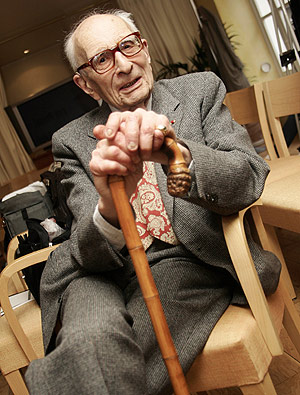
Claude Lévi-Strauss, 1908-2009

Claude Lévi-Strauss, one of the true giants of anthropology, passed away this past week on 30 October, just shy of 101 years old.

As Maurice Bloch writes, Lévi-Strauss was ‘the last survivor of these great beasts such as Sartre, Foucault and the sociologist Pierre Bourdieu,’ the theorists who have given contemporary anthropology, and social theory around the world, a French accent and Gallic cadence.

Excellent obituaries appeared in a number of places, two of my favourites being the one by Bloch in The Guardian, and another by Edward Rothstein in The New York Times (thanks, Jovan!).

I’m not going to retread the substance of these obituaries, nor will I repeat what was better (and more quickly) written by other commentators online such as Rex at Savage Minds, Marshall Sahlins at the AAA website (for the 100th birthday), Richard Price, a student of Lévi-Strauss, and Robert Mackey at the NYTimes website, The influence of Claude Lévi-Strauss (a piece that links to a number of video clips in English and French, including interviews with other scholars). Instead, I’m going to write briefly about the relation of Lévi-Strauss to the study of brain and culture from my perspective.

I’ve been wanting to write a post on Lévi-Strauss for a while, and even started it once, because I’ve been grappling with the question about how neuroanthropology aspires to produce theoretical and empirical projects that are distinct from what is typically called ‘cognitive anthropology.’ Lévi-Strauss’ work is crucial to the foundation of cognitive anthropology, as a range of authors have argued (see Sperber 2008, for example), so he’s a critical point of departure for neuroanthropology.

Although I admire Lévi-Strauss, and I’m perfectly content to be considered close classificatory kin to cognitive anthropology, there are some characteristics of Lévi-Strauss’s thought, structuralism (the theoretical school Lévi-Strauss dominated, but which did not encompass all of his work [see Doja 2008]), and contemporary cognitive anthropology with which I fundamentally disagree. So although this post is written in respect, it has elements of opposition, perhaps even the false binarism that arises whenever one is trying to highlight distinctiveness in the midst of significant overlap. Beware the theoretical belligerence of small difference!
Continue reading “Thinking through Claude Lévi-Strauss”