Trained as a cultural anthropologist at the University of Chicago, I have gone on to do fieldwork in Brazil and the United States. I have written one book, Learning Capoeira: Lessons in Cunning from an Afro-Brazilian Art (Oxford, 2005). I have also co-authored and co-edited several, including, with Dr. Daniel Lende, The Encultured Brain: An Introduction to Neuroanthropology (MIT, 2012), and with Dr. Melissa Fisher, Frontiers of Capital: Ethnographic Reflections on the New Economy (Duke, 2006).
My research interests include neuroanthropology, psychological anthropology, sport, dance, human rights, neuroscience, phenomenology, economic anthropology, and just about anything else that catches my attention.
The juxtaposition of Florida Governor Rick Scott’s recent comments about anthropology and the fact that Graeber is offering what may be among the most penetrating and accessible analyses of an important dimension of the current global debt crisis is striking. Of course, maybe clear-eyed analysis of our current economic situation, and the ability to point out that other societies do perfectly well with other sorts of economic and political systems, is precisely the sort of academic work that Gov. Rick Scott thinks universities should give up. After all, no one needs to understand why US firms are shedding jobs, or take a sober look at the current financial regime in the light of the 5,000-year history of debt. Students should just put their heads down and do the sorts of degrees that will give them technical jobs. Pay no attention to The Man behind the curtain! Continue reading “David Graeber: anthropologist, anarchist, financial analyst* (originally 2011)”
If you follow Neuroanthropology, either here or on Facebook, you may have noticed something new. We’ve had a bit of a facelift to this site and added a page: Anth 207 Neuroanth 101. This new venture is an effort to generate open educational resources for people interested in psychological anthropology: students, teachers, researchers, the curious…
The first video for Anth 207 Neuroanth 101 is already posted: WEIRD psychology.
We’ll be adding more videos slowly, as well as suggested readings, other related resources, reflection questions, and notes. The goal is to start building an open resource for those who want to start learning about neuroanthropology.
UPDATE: After a quick consultation with partner-in-online Daniel Lende, we’ve decided to go whole hog with the new look, new feel, and all-neuroanthropology message. I’ve done a quick rename to ‘Neuroanthropology 101’ with the goal of making it clear what we’re doing, and hopefully making a space to which other neuroanthropologists will want to contribute.
How does language affect thought and perception? It’s a question we’ve looked at here at Neuroanthropology.net on a number of occasions, but Prof. Guy Deutscher, offers a nice general survey of the current state of play in the research over at The New York Times in ‘Does Your Language Shape How You Think?’ Posts on language tend to attract a lot of traffic, so I’d encourage you to take a look.
Prof. Deutscher is an accomplished linguist, who has written a number of general works as well as specialist works, including research on Akkadian, the language of ancient Babylon and Assyria. Deutscher is honorary research fellow at the School of Languages, Linguistics and Cultures at the University of Manchester, and the article is adapted from his forthcoming book, Through the Language Glass: Why the World Looks Different in Other Languages, to be published by Metropolitan Books.
Deutscher lays out a number of different areas of research that suggest language affects thought, especially in the areas of gender, spatial perception, time, and colour perception, and suggests some areas where profound linguistic differences offer tantalizing possibilities for studying the subtle ways that linguistic practice can influence cognition.
Although I feel Deutscher is unreasonably harsh on Whorf, in part because some contemporary understandings of Benjamin Whorf paint him as a more radical linguistic determinist than I find him to be, the research Deutscher discusses is well worth considering, and it’s a nifty piece to share with our regular readers.
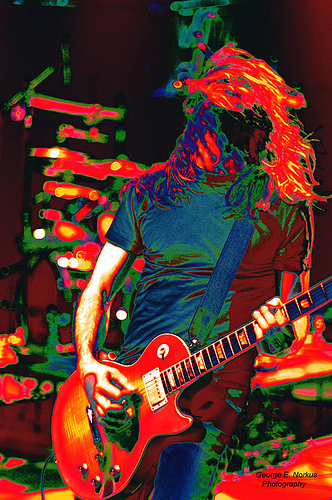
Photo by George E. Norkus
Over at The Immanent Frame, a website on religion, secularism and society supported by the Social Science Research Council (USA), Jim Robertson reflects on the presence of religion in Death Metal after a trip to Wacken Open Air (in Germany), the world’s largest music festival and ‘loud as hell’ according to its website.
Robertson’s piece, Death metal: A “pipeline to God”?, is well worth the read, if for no other reason that it will be an eye-opener for the non-metalhead to what these guys are screaming through the din. (One personal disclosure: Although I went through a phase of fascination with Canadian power trios with front-man shriekers that sounded like modern castrati — Rush, Triumph — and developed a now-mildly-embarrassing love of Supertramp, Aerosmith, and the Who, I was never really a native metalhead, so I can’t talk about these genres from any deep affection.)
I won’t rehearse all of Robertson’s arguments, but he basically asks why Death Metal and related genres are so obsessed with religion, from Satanic album covers to song lyrics that drip with Apocalyptic motifs to echoes of everything from neo-paganism to blatant anti-Christianism. It’s a great question because not every popular music genre, even iconoclastic subcultural genres, features religious imagery so heavily. One would probably have to move to something like gospel or 1970s reggae to find genres that were more saturated with spiritual symbolism (I have no statistics on this, only my own fleeting engagement with these genres).
Robertson explains:
What is fascinating here is the consistency with which black metal has pursued religious forms. Satanism is replaced, not by a basic materialist atheism but with almost anything else: Occultism, Nietzsche, paganism, mystical nazism. Such religious pluralism begs the question as to whether these are just new and interesting attempts at youth rebellion, or whether something more is playing itself out.
Robertson finds several reasons for the dominance of religious themes in Death Metal:
1) ‘Metal’s rebellious streak’ led to a backlash against attempts to censor or criticize these musical genres, most prominently efforts by the Parents Music Resource Center (PMRC) in the mid-1980s. According to Robertson, the criticism actually hardened the resolves of many musicians to criticize mainstream religion, sparking very explicit anti-religious themes.
2) Extreme lifestyles among the musicians, a character of many Western popular artist communities, but featuring some extraordinary acts of violence, self-destruction and nihilism, especially among proponents of Scandinavian ‘Black Metal’ in the 1990s, Robertson discusses. In this sense, ‘Metal’s obsession with religion is part of its obsession with living at the limit.’ Robertson goes on to explain: ‘This concern with limit experiences explains metal’s obsession with religion. In its aspirations, metal parallels a kind of religious mysticism.’
3) Competition with mainstream religion to provide similar experiences, such as community belonging, emotional transcendence, and mystical experience, what one participant refers to as a ‘pipeline to God.’
4) Shifting philosophical and religious commitments within the community of Metal musicians, including a move away from Satanism toward various forms of paganism, ecological mysticism, and Nietzschean nihilism, reflect a groping to find a language to talk about these profound emotional-mystical experiences: ‘The constant grasping for new ideologies amongst the black metal scene, then, is an attempt to give this transcendental path discursive form.’
Robertson’s discussion is both colourful and insightful, but there are several dimensions I might add just to bring it into the Neuroanthropological fold. Borrowing some ideas from Simon Frith’s piece, ‘Towards an Aesthetics of Popular Music,’ I want to argue that Metal, like many musical genres, has a special role in educating emotion and moods among young people when they are trying to understand social interaction and their own emotions.
Evolutionary theorists have long recognized that the domestication of animals represented a major change in human life, providing not just a close-at-hand food source, but also non-human muscle power and a host of other advantages. Penn State anthropologist Prof. Pat Shipman argues that animal domestication is one manifestation of a larger distinctive trait of our species, the ‘animal connection,’ which unites and underwrites a number of the most important evolutionary advances of our hominin ancestors.
LouisShipman’s proposal is discussed in a recent forum paper in Current Anthropology and is the subject of her forthcoming book, The Animal Connection. The paper is interesting to us here at Neuroanthropology.net because Shipman indirectly poses fascinating questions about the evolutionary significance of human-animal relationships, including the cognitive abilities of both and how they interact.
As Shipman puts it in the Penn State press release about the research, if we only think about what domesticated animals do for us as a species, we miss the truly curious thing about our relationship to them:
No other mammal routinely adopts other species in the wild — no gazelles take in baby cheetahs, no mountain lions raise baby deer…. Every mouthful you feed to another species is one that your own children do not eat. On the face of it, caring for another species is maladaptive, so why do we humans do this?
Although researchers working on symbiotic inter-species relationships might highlight that the support of other species hardly requires adopting their young and feeding them canned kitten food (a critique Travis Pickering levels in his comments), Shipman’s statement highlights nicely that human-animal inter-species relationships seem to extend beyond merely treating them as tameable prey or means to a human end. But then again, this super-instrumentality could be ascribed to a large number of human traits.
The domestication of animals wasn’t merely about capturing a buffet-on-the-hoof, from Shipman’s perspective, but the continuation of a long-term evolutionary project by our species to study animals, first when we were prey for them, and later as predators ourselves.
Daniel and I exchanged emails about the recent piece in The New York Times, ‘Outdoors and Out of Reach, Studying the Brain,’ by Matt Richtel. We both responded strongly to the article; although we liked the discussion of technology’s effects on cognition and the positive benefits of being in nature (and away from digital technology), getting down to thinking through the various points left us both feeling pretty cranky (maybe not enough time in nature, eh?). Daniel’s already taken on some of the issues that could be raised with the piece, but I just wanted to pick up a few other threads.
The article discusses a river trip including five neuroscientists who took time away from their typical routine of digital interaction, dwelling in built environments, and conducting research to float down a river valley in Utah and spend some quality time with bats and cliffs as well as each other. To be honest, this sounds pretty idyllic to me, and I think far more conferences should be held outdoors in tents rather than in rented hotel meeting rooms with PowerPoint slides, 15-minute papers and cellophane-wrapped muffins. A whole new industry of Adventure Academic Meetings could allow physicists to discuss new breakthroughs while spelunking or philosophers to reflect on Continental theory while snowshoeing. Sign me up for the Anthropologists Hike the Appalachian Trail conference, but count me out of International Neuroanthro-Bungee 2012!
The participants in the white-watering brain sciences tête-à-tête seem to share my enthusiasm for a change in conference formats:
“There’s a real mental freedom in knowing no one or nothing can interrupt you,” Mr. Braver says. He echoes the others in noting that the trip is in many ways more effective than work retreats set in hotels, often involving hundreds of people who shuffle through quick meetings, wielding BlackBerrys. “It’s why I got into science, to talk about ideas.”
One of the first things that irritated me in the NYTimes piece, however, was the conflation of living the ‘life uninterrupted’ — having a small, intimate retreat with a handful of people — and being ‘in Nature,’ as if the two were inherently inextricable. Of course, one wouldn’t have to invite hundreds of people to the hotel for a conference, and the conversations would likely be a lot more intimate and less distracted, even if your small group was at a spa or dude ranch. Likewise, you can go to Nature at an outdoor music festival and feel completely over-stimulated, even though you have no access to electricity or indoor plumbing.




 Neuroanthropology