Auditory neurons learning to hear

The Biotechnology and Biological Sciences Research Council’s recent business report (January 2008) had an interesting research report on auditory neurons and the perception of complex sounds. (Science Daily has a short report on the longer piece available here). (The BBSRC is the UK’s principal funder of basic biological research.)

As the BBSRC piece discusses, sound perception is extremely difficult because similar objects often make quite different sounds, and the medium (typically air) through which we hear does not allow for the spatialization or easy decomposition that, say, light allows in vision. The Oxford-based research team is using neural imaging to try to figure out how the brain makes sense of sound, and one thing that they’re finding is that background noise appears to be extremely important to sound processing. The auditory cortex does not simply respond to isolated qualities of specific sounds but to variations in the statistical properties of the entire sound scape. As the article reports: ‘Cortical neurons appear to anticipate this particular level of statistical regularity, and respond best to sounds that vary in pitch and intensity according to this natural rate of ebb and flow, which is found in many natural scenes and most musical compositions.’
Continue reading “Auditory neurons learning to hear”

Pets, health and our extended phenotype

There’s a fun piece in The New York Times on The Healing Power of Dogs that discusses a wide range of health effects linked to pet ownership. The article briefly discusses a range of research that has linked pet ownership to health benefits. For example:

One Japanese study found pet owners made 30 percent fewer visits to doctors. A Melbourne study of 6,000 people showed that owners of dogs and other pets had lower cholesterol, blood pressure and heart attack risk compared with people who didn’t have pets. Obviously, the better health of pet owners could be explained by a variety of factors, but many experts believe companion animals improve health at least in part by lowering stress.

This research is fascinating in its own right, especially for a person who’s only recently started to live around animals… a lot of animals (at last count, 8 horses, 1 horse expecting a foal, 2 cats, 2 dogs, innumerable wild birds, kangaroos and wallabies all wandering onto the property). I’ve noticed a huge difference in my health and mood since the change, but it’s hard to separate the effects of having Basil and Roxy (the dogs), Glitz and Glam (the cats), or the bigger monkeys around (the horses). But the research discussed also touches on two issues that I think are of particular importance to those of us interested in neuroanthropology and the biology-culture interface.

Edited version
Continue reading “Pets, health and our extended phenotype”

Rex at Savage Minds – berries, pink things & evolution

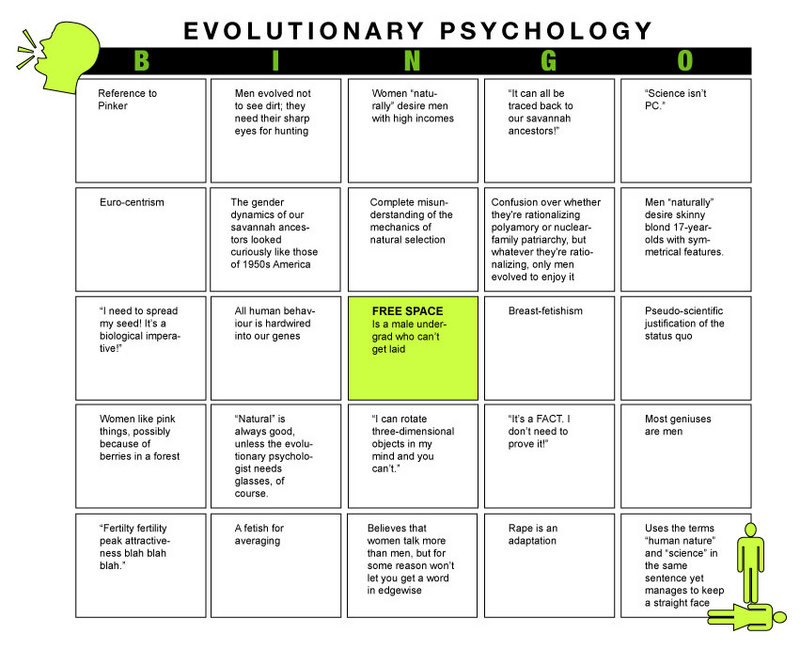
Alex Golub, one of the prime movers at Savage Minds, posted a link to an ‘Evolutionary Psychology’ bingo card that’s worth a chuckle.

Original post here.

I enjoyed the bingo card because it is such a great condensation of the usual hackneyed bits that crop up in conversations involving ‘evolution’ and ‘psychology,’ often with people who have serious interest in and understanding of neither evolutionary theory nor psychology. I’m not surprised that untrained individuals subscribe to evolutionary psychology (‘women like men who are tall because they could see prey farther off in the grasslands…’). After all, people close to me (who will remain unnamed) believe that one must inherit every trait or characteristic, however minor, from some relative, even if they are only related at a distance (‘you must get your love of traveling from your father’s brother…’) and into forms of ethnic personality theory (‘Italians are so expressive; Latins are so passionate…’).

The point of criticizing these trite versions of evolutionary psychology, for me, is not to throw out baby, bath water, and basin, but to really expose when pernicious sloppy thinking is masquerading as ‘science,’ especially under the guise of psychology and evolution. For whatever reason — probably because they have a sheen of ‘naturalness’ and being above criticism — these rubrics have become touchstones for some of the most retrograde thinking about sexuality, gender relations, ‘race,’ and other issues. The only way to truly engage them is to offer better accounts of both evolution and human psychology.

So in the meantime, I’m printing out my bingo card for the next salvo from the evolutionary psychologists.

The Boston Globe on embodied cognition

How often do you read a piece in the newspaper that explicitly makes reference to Maurice Merleau-Ponty? Can’t say that I ever had until I stumbled across this article, ‘Don’t Just Stand There, Think,’ on embodied cognition by science writer Drake Bennett in The Boston Globe. It’s all over the map, making brief references to a host of different research projects, some of them more obviously anti-Cartesian than others. The piece might make an excellent entry point for people wanting to introduce others to the significance of embodiment for human cognition.

In particular, the article discusses a number of examples that highlight the ways in which cognition makes use of motor capacities and perceptual abilities, rather than simply being just some disembodied form, such as logic, signification, or recall. Aside from more obvious cases where embodiment affects thought, Bennett briefly touches on some of the more counter-intuitive cases:

A few [neuroscientists, linguists, and philosophers] argue that human characteristics like empathy, or concepts like time and space, or even the deep structure of language and some of the most profound principles of mathematics, can ultimately be traced to the idiosyncrasies of the human body. If we didn’t walk upright, for example, or weren’t warm-blooded, they argue, we might understand these concepts totally differently. The experience of having a body, they argue, is intimately tied to our intelligence.

Bennett makes references to mirror neurons, research by Sian Beilock and Lauren Holt suggesting that athletes’ perceptions are shaped by their expertise, Susan Goldin-Meadow’s work on gesture and thought, and a number of other intriguing research projects. There’s no links to the original research reports or articles, but the interested reader could easily track them down.

In particular, one quote reminded me of Daniel’s earlier post on cultural differences in puzzle solving. Beilock, after doing research on hockey players’ ability to quickly understand photographs of hockey, came to the conclusion that, ‘People with different types of motor experiences think in different ways.’ This is a consequence of embodied cognition, and it may help to explain certain types of differences in reasoning, perception, or cognition.

The article hardly breaks new ground, but it is a very good quick summary of a lot of relevant research. I’d highly recommend it; and it will be a great one to share with friends and colleagues and anyone else who wonders what you’re on about when you mention embodied cognition.

Mice brains on stress

Blogging on Peer-Reviewed ResearchIn February 2006, a research team at University of Texas and Tufts University published a piece in Science on how experience could modify the structures in the brain that affect the production of dopamine through brain-derived neurotrophic factor (BDNF) (abstract here). The research team used ‘social defeat’ to explore ‘the neurobiological mechanisms through which psychosocial experience alters the activity of the mesolimbic dopamine pathway’; in other words, the malleable system that can induce structural changes in the brains of mice in response to persistent patterns of social interaction.The abstract, while a little thick, suggests all sorts of intriguing possibilities:

Mice experiencing repeated aggression develop a long-lasting aversion to social contact, which can be normalized by chronic, but not acute, administration of antidepressant. Using viral-mediated, mesolimbic dopamine pathway–specific knockdown of brain-derived neurotrophic factor (BDNF), we showed that BDNF is required for the development of this experience-dependent social aversion. Gene profiling in the nucleus accumbens indicates that local knockdown of BDNF obliterates most of the effects of repeated aggression on gene expression within this circuit, with similar effects being produced by chronic treatment with antidepressant. These results establish an essential role for BDNF in mediating long-term neural and behavioral plasticity in response to aversive social experiences.  

Continue reading “Mice brains on stress”

Beyond Bourdieu’s ‘body’ — giving too much credit?

Blogging on Peer-Reviewed ResearchA while back, Daniel recommended to me that I check out an article by Mauro Adenzato and Francesca Garbarini in Theory & Psychology. It’s a great piece, and there’s a lot of positive things I could say about it. For example, Adenzato and Garbarini’s principal point is that the model of ‘mind’ as the workings of organic brain systems is inconsistent with much social theory, built instead on a treatment of mind as a kind of dis-embodied amalgamation of logical and cognitive processes. This recognition that phenomenological and cognitive mind and biological brain are inextricably linked is part of what makes neuroanthropology possible, or rather, necessary. As they write:

The embodied cognition perspective views the mind no longer as a set of logical/abstract functions, but as a biological system, which is rooted in body experience and interwoven with action and interaction with other individuals. Action and representation are no longer interpreted in terms of the classic physical–mental dichotomy, but have proven to be closely interlinked. Specifically, embodied cognition means that acting in the world, interacting with the objects and individuals in it, representing the world, perceiving it, categorizing it and understanding its meaning are merely different levels of the same relationship that exists between an organism and its environment. (Adenzato and Garbarini 2006:748) 

Adenzato and Garbarini point out that cognitive science has become increasingly concerned with grounding theories about thought and the mind in observable workings of the organic brain. Although I agree, following Clark (1997), I would refer to this movement as ‘third generation,’ rather than ‘second generation’ (as the authors do), as the first two over-arching waves in cognitive science might be termed the ‘logic machine’ and ‘connectionist’ models.I have some niggling problems with their argument, such as the ‘merely different levels’ off-handed comment, which I would dispute, and the tired technique later in the article of dragging a folk term from an ethnographic case study and showing how it’s like one’s new theoretical term, as if the natives having a word for a phenomenon is proof you’re on to something. Nevertheless, this passage is a very coherent statement, as is the whole article, of the need to incorporate more sophisticated models of the brain’s working into cultural theory.

Continue reading “Beyond Bourdieu’s ‘body’ — giving too much credit?”