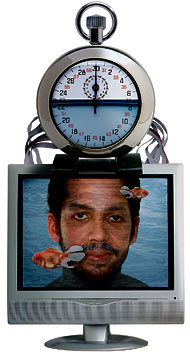
Blaine breaks world record for breath-holding

Graphic by Viktor KoenI’ve been waiting to hear how David Blaine went in his attempt to break the world record. John Tierney reports in David Blaine Sets Breath-Holding Record on The New York Times website that, in fact, Blaine was successful. On Oprah Winfrey’s show, he held his breath for 17 minutes 4 seconds, a world record for the activity with the use of pure oxygen before making an attempt.

As Tierney reports, Blaine was successful in spite of the fact that he couldn’t control his heart beat like he had on previous breath holding:

After he filled his lungs with pure oxygen, his heart rate remained at 130 during the second minute of the breath-hold and then stayed above 100 for much of the time. It was 124 in the 15th minute. The higher the heart rate, the more quickly oxygen is consumed, and the more painful the carbon dioxide buildup. But apparently his CO2 tolerance training (repeated breath holds every morning) was just enough to compensate. In the last minute his heart rate became erratic and he got concerned enough to start rising from the bottom of the water-filled sphere, but he kept his head underwater more than a half minute longer than the old record of 16:32.

Tierney reports that during training, Blaine was able to keep his heart rate down into the range of 40 to 60 beats-per-minute, but being on television apparently made it difficult to keep his pulse down.

Continue reading “Blaine breaks world record for breath-holding”

Face recognition training and stereotyping

Stimuli from McKone et al. 2008Dave Munger has just put of a great post over at Cognitive Daily, one of the sites I read pretty religiously: With a little training, we can recognize other races as well as our own. Dave discusses a recent article in Perception by a team led by Elinor McKone in which subjects were trained to recognize faces from ethnic groups other than their own and then subjected to very difficult recognition tasks. Turns out that people can get pretty good at this task, which many of us don’t do very well if we’re not ‘trained.’

I’m not going to go over the same turf that Munger does (not least of all because I won’t do it as well as he does), but I will copy his conclusion:

In other words, memory for different-race faces can be trained to work in the same way it does for same-race faces, even in a difficult peripheral-vision test, in a relatively short period of time. It doesn’t take years of immersion in a foreign culture, just an hour or so studying pictures (albeit hundreds and hundreds of them!).

This suggests that humans have a general pattern for recognizing faces that is adaptable even to unfamiliar faces. McKone et al. argue that we recognize same-race faces holistically, instead of feature by feature. Initially when we see a different-race face, we attempt to remember it using individual features, much the same we remember a animal or other object. But after some training, we learn to recognize even different-race faces holistically, which can be more accurate, but which doesn’t work as well when faces are upside-down.

Briefly, the research runs against the tendency to see the psychological or neural effects of social conditioning (like living in socially segregated environments) as the cause of social conditions. That is, there’s a tendency to want to argue that humans are innately racist, sexist, biased, hostile to those different, hierarchical, or whatever…. This kind of research tends to be essentialist and usually appeals to some sort of ‘genetic programming,’ but typically with no genetic evidence or even a plausible account of this social attitude might emerge from the genes, neural chemistry or any other biological mechanism.

Continue reading “Face recognition training and stereotyping”

Review of Marcus’ ‘Kluge’

There’s a short review of Gary Marcus’ new book, Kluge: The Haphazard Construction of the Human Mind, on The New York Times website. The review, ‘Patch Job’ by Annie Murphy Paul, argues that the book is a good central idea that doesn’t have enough development to carry the weight of every chapter.

Marcus, it seems, has a problem: an appealing and intriguing idea that isn’t quite as big as he claims. To solve it, he reaches for that rhetorical kluge, the straw man, setting up and then sweeping aside the notion that the human mind is infallible.

Apparently, Marcus sets up a series of straw men to knock down — human thought as perfect and infallible — to oppose the kluge (rhymes with ‘huge’) model of the human brain.

Continue reading “Review of Marcus’ ‘Kluge’”

A softer ‘neo-Whorfianism’

At Neuroanthropology, we’ve had a number of posts about language and the brain (such as here, here, and here); it’s a issue of lasting importance in anthropology, linguistics, cognitive science, and psychology. There’s a really nice piece in The New York Times about it though, and for once, I just want to do a summary and reflection rather than a critique of one of their pieces. The article is When Language Can Hold the Answer by Christine Kenneally.

Daniel recently mentioned this piece in his post, A Times Trifecta, but I wanted to add a comment on it. Daniel relays the quote that the article uses to sum up the debate around the Sapir-Whorf hypothesis: ‘Does language shape what we perceive, a position associated with the late Benjamin Lee Whorf, or are our perceptions pure sensory impressions, immune to the arbitrary ways that language carves up the world?’ He’s just providing a thumbnail sketch, so he doesn’t include the next paragraph, which I think helps to elevate this article above the usual either-or, black-or-white dross that happens in public press about the role of language in thinking:

The latest research changes the framework, perhaps the language of the debate, suggesting that language clearly affects some thinking as a special device added to an ancient mental skill set. Just as adding features to a cellphone or camera can backfire, language is not always helpful. For the most part, it enhances thinking. But it can trip us up, too.

Continue reading “A softer ‘neo-Whorfianism’”

Red meat, Neandertals were meant to eat it

The Meat and Livestock Association (MLA) of Australia has these great television commercials featuring actor Sam Neill (and by ‘great,’ I don’t mean ‘scientifically accurate’). They’re all about how we humans were ‘meant’ to eat red meat. They’re obviously meant to counteract growing concern about red meat in our diet, in the environmental impact of livestock, and other issues, and they use evolutionary arguments to try to get Australians to ‘beef up’ the amount of red meat in their diet, because of course, Australians don’t eat enough meat (trust me if you’re not in Australia — that’s probably not the biggest health issue here, ‘lack’ of red meat in the Aussie diet). For more information on the campaign, check out the MLA’s webpage, ‘Red Meat. We were meant to eat it.’ (You can download the video of the ads from that site if, like me, you want to incorporate it into your lecture on human evolution and diet.)

Especially interesting is the third ad in the campaign, ‘Evolution.’ The text of that ad is:

‘Evolution’ set the scene for the story of red meat and its role in human evolution. It also highlights the bundle of nutrients in red meat making it a foundation food essential for brain development and function. Red meat. We were meant to eat it.

But an article by M. P. Richards and colleagues soon to appear in the Journal of Human Evolution suggests that the evolutionary prize for red meat-eating should have gone, not to Homo sapiens sapiens but to Homo sapiens neanderthalensis (or H. neanderthalensis). Richards and the research team examined carbon and nitrogen ratios in Neandertal bone collagen to figure out what the Neandertals were eating.

Continue reading “Red meat, Neandertals were meant to eat it”

You can lead a horse to water

I’m not sure what to file this thought under, but I figure I may as well share it. I was holding a couple of my wife’s horses today while our farrier, Chris, shoed them, and we got to talking about horses instincts. I think I was asking about horses hooves in the wild, how they responded to injury or heavy use. He joked that the only reason we really needed to clip their hooves was that we kept them in overly-soft paddocks, fed them high energy feed, and thus they didn’t cover the miles and miles that wild horses would have to in order to get enough to eat. In other words, the ecological niche we created for our horses was so unusual that the whole horse physiology was different.

He also pointed out that most domestic horses, unless they are trained to, will not drink from natural water sources. If they’re accustomed to drinking from troughs or buckets, some will die of thirst before drinking out of a creek or lake. They may recognize that it’s water on some level, but they don’t trust the source unless they’re used to encountering water in this way. Obviously, they might be socialized early in order to become acquainted with water in a wider variety of forms.

I don’t have any information on whether or not a horse has ever died from thirst in the presence of lakes or streams, so I can’t confirm this. (I’ll look it up and report back.) If it is true — and I have no reason to doubt Chris as he’s a deeply knowledgeable guy on the subject of horses — it would be a fascinating case of a very useful ‘instinct’ not being inevitable. It also explains the ‘You can lead a horse to water…’ proverb, which I didn’t really understand until today, in retrospect.