On-line coaching paper available: shameless self-promo

Apologies in advance, but ignore this post if you’re not interested in anthropology. I just had a paper come out in an online conference proceedings, and I don’t think it’s going to get too much notice unless I do a bit of self promotion. So, at the risk of being accused of narcism (or worse), I’ll just post a brief notice and link to the paper:

Continue reading “On-line coaching paper available: shameless self-promo”

Live healthy, turn on your genes

For all those out there who still think that ‘it’s all in the genes,’ here’s a recent news story on the way that changes in lifestyle can affect genetic activity. Will Dunham at ABC News brings us, Healthy Lifestyle Triggers Genetic Changes: Study (I also pulled it off the Reuters feed). The study was small, and I doubt that it was nearly as rigorous as really necessary, but the findings are interesting.

In a small study, the researchers tracked 30 men with low-risk prostate cancer who decided against conventional medical treatment such as surgery and radiation or hormone therapy.

The men underwent three months of major lifestyle changes, including eating a diet rich in fruits, vegetables, whole grains, legumes and soy products, moderate exercise such as walking for half an hour a day, and an hour of daily stress management methods such as meditation.

As expected, they lost weight, lowered their blood pressure and saw other health improvements. But the researchers found more profound changes when they compared prostate biopsies taken before and after the lifestyle changes.

After the three months, the men had changes in activity in about 500 genes — including 48 that were turned on and 453 genes that were turned off.

Continue reading “Live healthy, turn on your genes”

Genomics and ‘Post-Neo-Darwinism’

Blogging on Peer-Reviewed ResearchI’ve been trying to put together my reader for a new unit (class) on human evolution at Macquarie University that I’ll be doing next semester. As usual, I’m doing this at the 11th hour, but this should be my last completely new, never-before-taught-at-my-university class for at least a year (I hope). In the process of checking out the most recent edition of my favorite human evolution journals, I happened across an odd and really thoughtful piece by Prof. Kenneth Weiss, who’s at Penn State. In the past, I’ve remarked about ‘post-neo-Darwinism,’ a term that I’m sure causes grimaces and eye-rolling, but that I think is worth discussing (I can’t take credit for the term; I think I heard it from Prof. Emily Schultz of St. Cloud State University at the last meeting of the American Anthropology Association).

By the way, Daniel posted a great ‘Evolution Round Up’ just recently with a whole lot of interesting material (I especially enjoyed Mo’s piece at Neurophilosophy on ‘Synapse proteomics & brain evolution’). We’re not really an evolution theme website, but it’s obvious how important it is to locate brain development in frameworks consistent with evolution. (I’ll come back to why being overly persuaded by evolutionary frameworks can be pernicious in a second, and it’s broader than my recent rant about memetics.)

Unfortunately, because the Weiss piece is more of an essay, in his recurring column entitled ‘Crotchets & Quiddities,’ there’s really no abstract of it, so I can’t link through to a nice concise summary of the piece. So, more than usual, I’m going to copy blocks of text from his essay, ‘All Roads Lead to… Everywhere?: Is the genetic basis of interesting traits so complex that it loses much of its traditional evolutionary meaning?’, before I get into my own commentary. Obviously, if you have access through a good research library, you should be able to get your hands on the original article. (More on Weiss’s columns can be found here — they’re quite good.)

The set-up for Weiss’s discussion is the idea that it doesn’t make sense to talk about ‘THE road’ to any particular place in a complex systems of highways and secondary roads because there are many routes:

With such choices, it doesn’t make much sense to ask, ‘‘What is the road to Rome?’’ In a somewhat similar way, rapidly growing knowledge about the nature of genomes and what they do suggests that what’s good for the Romans is good for biology as well. Instead of a gene for this and a gene for that, we face the possibility that all genes lead to everywhere, which may have important
implications with regard to our understanding of the genetic basis or evolution of traits like the shape of the skull, a skull, or this skull. If all real roads lead to the Circus Maximus, do all our craniofacial genetic roads lead to the foramen magnum?

Continue reading “Genomics and ‘Post-Neo-Darwinism’”

Monkeys can learn symbols

Ah, crap, now I have to change another lecture slide… No, this is cool. From Science Daily, The Symbolic Monkey? Animals Can Comprehend And Use Symbols, Study Of Tufted Capuchins Suggests discusses research that appeared in PLoS ONE. Some theorists refer to humans as ‘the symbolic species,’ but like so many distinctions that used to seem so clearly differentiating of ‘human nature,’ we find that the distinction is more of degree than kind. For example, studies of chimpanzees and gorillas taught manual or token languages have shown that great apes are capable of using symbols to communicate; whether or not monkeys could was less clear.

In this experiment, the researchers used the equivalent of ‘food standard’ money with monkeys to see how they understood the value of tokens which were equated to different types of food. The Science Daily article explained:

In the experiment, five capuchins engaged in “economic choice” behavior. Each monkey chose between three different foods (conventionally referred to A, B and C), offered in variable amounts. Choices were made in two different contexts. In the “real” context, monkeys chose between the actual foods. In the “symbolic” context, monkeys chose between “tokens” (intrinsically valueless objects such as poker chips) that represented the actual foods. After choosing one of the two token options, monkeys could exchange their token with the corresponding food.

Turns out that the monkeys’ choices were ‘transitive,’ that is, they demonstrated the same preferences whether they were transacting in real food or in intrinsically meaningless tokens that represented the food. It turned out that tufted capuchins preferred Cheerios to parmesan cheese (dumb bastards); however, when transacting in tokens, the rate of exchange between foods became more pronounced. They held out for more parmesan cheese for their Cheerios when using tokens; in actual food, the exchange rate was one Cheerio for two pieces of cheese, but this inflated to one Cheerio for four pieces of cheese (for example) in tokens.

Continue reading “Monkeys can learn symbols”

We hate memes, pass it on…

Vaughn at Mind Hacks has a short post, Memes exist: tell your friends (clever, Vaughn, very clever), which links to a couple of meme-related talks at TED. Daniel linked to a lot of the TED talks back in April (TED: Ideas Worth Spreading), but Vaughn focuses on videos of Daniel Dennett and Susan Blackmore, both of whom are ardent meme advocates.

I’ve watched both talks, more than a half hour of my finite lifespan that I will never get back (okay, I’ve wasted part of my finite life doing worse… I think), so I need to unburden myself. I think ‘memetics’ is one of the bigger crocks hatched in recent decades, hiding in the shadow of respectable evolutionary theory, suggesting that anyone who doesn’t immediately concede to the ‘awesome-ness’ of meme-ness is somehow afraid of evolutionary theory. Let me just make this perfectly clear: I teach about evolutionary theory. I like Charles Darwin. I have casts of hominid skulls in my office. I still think ‘memetics’ is nonsense on stilts on skates on thin ice on borrowed time (apologies to Bentham), as deserving of the designation ‘science’ as astrology, phrenology, or economic forecasting.

What’s hard for me to understand is that I LIKE some of Daniel Dennett’s work, and I can’t cite Dennett’s other work confidently when he has picked up a ‘meme franchise,’ and is plugging away with the ‘meme’ meme, making it appear that I’m down with this later material. Blackmore, on the other hand, is a reformed para-psychologist, so she’s, at worst, made a lateral move in terms of respectability. I get particularly irritated during her talk because I think she does an enormous disservice to Darwin’s Origin of Species, but I will try not to late my irritation show too much (even though our regular readers know I won’t be able to manage). I wasn’t going to really heap scorn on Blackmore until I read her own account of TED on the Guardian’s website; gloves are now off.

But I digress, back to the content of the concept and Vaughn’s comments…

Continue reading “We hate memes, pass it on…”

More on the human ‘super-organism’

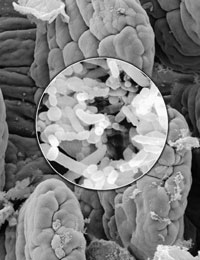
Intestine and gut microbeThere’s a good short piece, Humans Have Ten Times More Bacteria Than Human Cells: How Do Microbial Communities Affect Human Health?, in Science Daily, picks up on some of the themes we discussed in The human ’super-organism.’ The overwhelming majority of cells in human bodies belongs to microbes — the article says 10 bacteria cells for every human body cell (does it make you feel tired to think how much bacteria you’re carrying around?). Recognizing that we are a shambling micro-cosmos of oraganisms (or ‘microbiome’) suggests new understandings of all sorts of things, including disease. The Science Daily article points out that ‘changes in these microbial communities may be responsible for digestive disorders, skin diseases, gum disease and even obesity.’

There’s one passage in particular that I thought was worth posting, even if I don’t have too much to add:

“This could be the basis of a whole new way of looking at disease. In order to understand how changes in normal bacterial populations affect or are affected by disease we first have to establish what normal is or if normal even exists,” says Margaret McFall Ngai of the University of Wisconsin, Madison.

The microbiome research is particularly interesting to us at Neuroanthropology, even though it’s not strictly about the brain or nervous system, because it’s a particular compelling demonstration that the human body is a dynamic system; that is, the body is a system of different forces and processes, at a number of scales, that together continually produce the whole, sometimes in equilibrium and sometimes in ways that produce dysfunction.

Continue reading “More on the human ‘super-organism’”