Daniel interviewed at Scientific American

Daniel should flag it, but he might not out of a fear of self-promotion (I have no such qualms), so I’m going to post a link to an interview that our own Daniel Lende did with Jonah Lehrer, the editor of Mind Matters at Scientific American: Getting Hooked on Sin. Daniel discusses some of the general principles, but he also gives an accessible introduction to the work he’s been doing on addiction (see his recent postings here, Wanting to Craving: Understanding Compulsive Involvement with Drugs and Craving and Compulsive Involvement Scales, for more on that subject). As the subtitle describes: ‘A neuroanthropologist explains what Colombian teenagers can teach neuroscientists about addiction.’ Well worth checking out in the original, even if some of the comments get WAAAAY off the point with a discussion of ‘sin.’

It’s interesting: anthropologists have little problem switching between indigenous (emic) concepts used by our informants, and our own analytical constructs. Perhaps because we’re not overly attached to either, we don’t really feel a strong need to defend any particular set of theoretical constructs (well, some of us don’t, at least). For example, when I taught ‘anthropological theory’ to majors, one of the crucial points was that, depending on one’s analytical perspective, a different set of theoretical constructs made sense — outside that framework, the theoretical terms often lost a lot of their usefulness. So I have no trouble when Daniel switches to talking about ‘sin’; in fact, as a (mostly) recovered Catholic, it’s like a welcome switch to my native tongue. But clearly, not everyone reading Scientific American is quite as willing to work in a sort of agnostic discussion space…

Great to see Daniel getting his ideas out there in all sorts of places — I’ve always liked Scientific American’s Mind & Brain site. Hopefully, he’ll continue to fill out more of his thinking on the neuroanthropological dimensions of addiction. Looking forward to San Francisco for the American Anthropology Association.

Cognition and Culture Institute website


Olivier Moren just got in touch to tell us that the International Cognition and Culture Institute has just opened a new website/blog at http://www.cognitionandculture.net. I just surfed over to check it out, and there’s already plenty of stuff happening. Although it’s a new site, there’s a lot of good content already, and a formidable group of writers, from the sound of it. The writers used to have the AlphaPsy blog on humanities and human nature, but that site hasn’t had any new postings in a while, so it’s nice to have the group back with new material.

The International Cognition & Culture Institute comes out of the Department of Anthropology and apparently the Department of Political Science of the London School of Economics and Political Science with support from the Institut Jean Nicod (ENS, EHESS, CNRS) in Paris. Their website also includes a section for job listings (excellent!) and an intriguing note about a grant competition coming up in 2009:

Sometime in 2009, we will hold a small grant competition. Successful applicants will be funded to carry out the same research task in a variety of cultural settings, thus generating a body of comparable data

I’ll be interested to see what they come up with and the resulting data.

Although I’m fascinated by cognitive anthropology, cross-cultural psychology, and the field that we might describe as ‘culture and cognition,’ I often feel that some of the stuff that we do at Neuroanthropology doesn’t sit well within the ‘cognition’ category. I’ve been thinking about this a lot as I put together thoughts for a book proposal, but I worry that — nifty alliterations aside — the term ‘cognition’ puts front and centre certain qualities of the brain, body, and nervous system, and (even unintentionally) marginalizes other qualities, some of which I’m particularly interested in. Of course, the term ‘neuroanthropology’ has problems, too, as we’re just as interested in the effects of culture on the skeleton, muscle tissue, endocrine system, and other viscera as we are upon the neural wetware.

All reservations aside, I’m really happy Olivier contacted me. I’ll be putting their site on our blogroll (if Daniel hasn’t beaten me to it) and keeping a close eye on what they produce. Looking forward to the online seminars and more about the comparative projects that the Institute is able to sponsor.

‘Party on, dude,’ pre-Columbian style

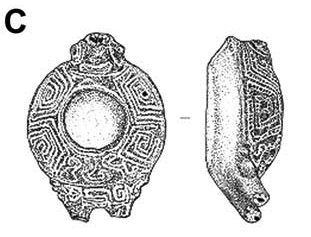
Red fine-walled ceramic snuff bowl from Puerto Rico
The UK Telegraph has run with a story, ‘Stone Age man took drugs, say scientists,’ about recent discoveries by a research team led by Quetta Kaye, of University College London, and Scott Fitzpatrick, of North Carolina State University. The drug taking ‘paraphernalia’ were dated to approximately 400 to 100 BCE, and were found in the Caribbean island Carriacou, 400 miles from where they probably originated on the South American continent. Daniel’s usually the one covering the posts on drugs (see, for example, his recent Drugs Round Up and the older Addiction Round Up), but I thought I’d put in my two cents on this one.

According to the Telegraph, the best guess for the mind altering substance involved is cohoba, a psychedelic substance produced from the ground seeds of the cojóbana tree. According to a quick surf around the web, cojóbana is likely a common name for Anadenathera peregrina, a tree native to both the Caribbean and South America, which also happens to be a good source of dietary calcium (the miracles offered by Mother Nature never cease).

Continue reading “‘Party on, dude,’ pre-Columbian style”

Neuroplasticity on the radio

Dr. Norman Doidge
Dr. Norman Doidge
Stephanie West Allen, who runs the blog Brains On Purpose, alerted me to the fact that the Australian ABC has posted audio files of a couple of interviews with Dr. Jeffrey Schwartz and Dr. Norman Doidge, the author of The Brain That Changes Itself (see her post, NeuroMediators: Understanding the brain is a critical key to resolving conflict (both within a culture and between cultures)). Dr. Doidge has been in Australia, attending several writers’ festivals and a workshop on ‘neuro-leadership.’ My wife caught his interview on The 7:30 Report, one of the better in depth news analysis programs on ABC TV, but I have not been able to attend any of the events where he spoke (what can I say? It’s a really really bad semester here…).

The original radio shows, audio recordings and transcripts (!) are available on the ABC All in the Mind website:
Part 1 of 2: The Power of Plasticity
Part 2 of 2 – The power of plasticity
See especially Part 2 as there are links to a host of other resources, such as the video of an interview Dr. Doidge did on ABC television while he was here in Australia, and discussions of the work of Prof. Paul Bach-y-Rita, one of the pioneers in work on neuroplasticity, including his research on technological prostheses for missing sensory information.

The material is great, and I’m nearly finished with Doidge’s book, but I still have several reservations about it even though I share the fascination with neuroplasticity and enthusiasm for Doidge’s work:
Continue reading “Neuroplasticity on the radio”

Is evolutionary psychology really rational choice theory?

I recently came across a couple of postings on a Psychology Today blog, Remaining puzzle #7 solved: Why children may love their parents, and Stump the evolutionary psychologist: Remaining puzzles, both by Satoshi Kanazawa. Dr. Kanazawa is a self-proclaimed ‘evolutionary psychologist’ (by that, I just mean that I’m not the one applying the label — he is) who is affiliated with Management at the London School of Economics and Political Science, the Department of Psychology at University College London, and the Department of Psychology at Birkbeck College, University of London. Listed as one of his primary qualifications is his co-authorship, with the late Alan S. Miller, of Why Beautiful People Have More Daughters.

In the first of the posts, ‘Stump the evolutionary psychologist,’ Dr. Kanazawa writes about his blog, The Scientific Fundamentalist:

Regardless of the particular topic at hand, the consistent theme in my blog has been to illuminate the power of evolutionary psychology to explain human cognition and behavior — what we think, how we feel, what we want, and what we do. The range of topics covered in this blog reflects my belief, shared by all evolutionary psychologists, that evolutionary psychology provides the best and the most ultimate (as opposed to the proximate) explanations of human behavior.

The fact that evolutionary psychology can explain so much of human behavior, however, does not mean that it can explain everything. Yet. Although I have absolutely no doubt that evolutionary psychology (along with behavior genetics and cognitive neuroscience) can eventually explain all of human cognitions and behavior some day, the day is still far ahead. There is still so much that we do not know.

Continue reading “Is evolutionary psychology really rational choice theory?”

Slides on brain evolution and diet

I just gave a lecture on hominin brain evolution, and it’s left my own brain kind of fried. So no clever posting from me (‘Is there ever?’ I hear the skeptics asking…). I’ll just share these slides. All the graphics have been captured from different online sources — I’ve done my best to put in appropriate credits, but that’s sometimes been difficult (or I’ve just been working so late that I forgot to do it). If I’ve included something you’d prefer I don’t, and if you’re the one who has the rights to something, just drop me a line and I’ll quickly cease and desist. My goal is only to share around the resources, not to take credit for anyone else’s work.

5-2braindiet
It’s a big file (about 3 mb), so it might take a minute depending on your connection.

A word of warning: I made this in Keynote on a Mac, so the animations and transitions might not do well on Microsoft Powerpoint. The video is no longer embedded. Here it is from Youtube:


Obviously, I don’t take the video at face value. Not just the claims about meat but also assuming that humans are the ‘most developed species’ on the planet. But it’s a great jumping off point for a discussion of diet and evolution. I did an earlier piece on this subject at: Red meat, Neandertals were meant to eat it.

If you’re interested in the whole course I’m teaching, I have previously posted the unit syllabus: Human evolution syllabus.