Top 100 Anthropology Blogs

Christina Laun has just posted the Top 100 Anthropology Blogs [edit: link removed at request of Open Universities because of their link seeking practices] over at Open Universities.com. We’re at #11 (arranged by subfield and several other groupings, not according to any particular metric) and our friends at Culture Matters are at #22 (if by ‘friends’ I can mean ‘the other collective anthro blog I belong to’).

What was interesting to me about this list though was the sheer number and variety of things happening out there, the range of anthropology weblogs, and the realization that there were many of these that I have visited but don’t look at regularly enough. There’s a lot of good ideas getting posted and discussed online, and some pockets of creative discussion that would be invisible (to me at least) if it were not for online publishing.

UPDATE:
Around the anthro internets, there’s been some discussion of this list, so I should update. First, there’s some serious oversights. For example, I had to amend this posting when it was brought to my attention that, somehow, Greg Laden’s Blog didn’t make this list (Great Googly-Moogly, man, what were they thinkin’!?). Three others that I’m less familiar with, but shouldn’t have been left off because they’re both quite active are Archaeoastronomy, Abnormal Interests, and Museum 2.0. I’m not going to look it up, but I’m particularly surprised that the first was left off because I seem to recall regular contributions at Four Stone Hearth from Archaeoastronomy.

All of these three blogs are very active, with substantial original material, so I’m not sure how they escaped the net for pulling in the Top 100. I’m not one to judge, but I think they might be more influential and well read than a few on the list. So don’t miss these three if you’re out looking for anthropology online.

h/t: Coturnix and Afarensis at A Blog Around the Clock for the update.
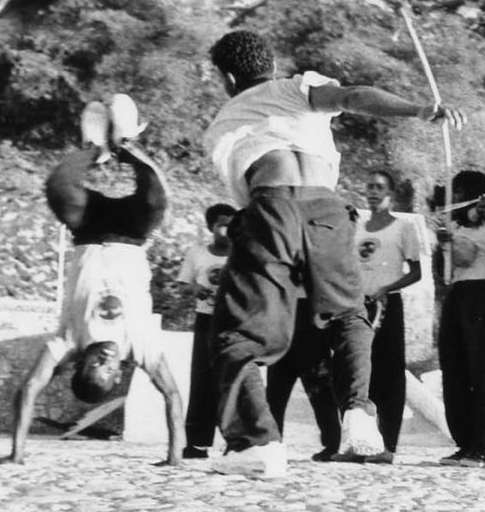
Balance between cultures: equilibrium training

Way back in January, I posted ‘Equilibrium, modularity, and training the brain-body.‘ At the American Anthropology Association annual meeting, I presented my current version of this research, significantly updating it with ethnographic material from Brazil, a comparative discussion of different techniques for training balance, and a series of graphics that I hope help to make my points. The title of that paper was ‘Balancing Between Cultures: A Comparative Neuroanthropology of Equilibrium in Sports and Dance.’

I’ve decided to post a version of this paper here, with the caveat that it’s still a work-in-progress. I’d be delighted to read any feedback people are willing to offer.

Introduction

Boca d' Rio does a bananeira
As a cultural anthropologist interested in the effects of physical training and perceptual learning, I see ‘neuroanthropology’ as a continuation of the cognitive anthropology advocated by Claudia Strauss and Naomi Quinn (1997).

The new label, however, reflects engagement with a new generation of brain research, what Andy Clark (1997) refers to as ‘third wave’ cognitive science, or work on embodied cognition.1 Much of the ‘third wave’ does not focus strictly on what we normally refer to as ‘cognition,’ that is, consciousness, memory, or symbolic reasoning. Rather embodied cognition often highlights other brain activities, such as motor, perceptual and regulatory functions, and the influence of embodiment on thought itself; this is the reason I’m thrilled to have endocrinologist Robert Sapolsky as part of this panel, as his work is part of the expanded engagement of neuroanthropology with organic embodiment.2.

My own entry into neuroanthropology results from three influences: a phenomenological interest in cultural variation in human perception, anthropological study of embodiment, and apprenticeship-based ethnographic methods. This method posed an odd question during my field research on the Afro-Brazilian martial art and dance, capoeira. Simply put, as a devoted apprentice-observer, I failed to maintain hermeneutical agnosticism and started to ask, ‘Is what my teachers and peers report — and I too seem to be experiencing — plausible?’

Continue reading “Balance between cultures: equilibrium training”

Andy Clark & Michael Wheeler: Embodied cognition and cultural evolution

The Cognition and Culture website has posted a link to the new edition of the Philosophical Transactions of the Royal Society B on ‘cultural transmission and evolution of human behaviour.’ I wanted to comment on just one piece on embodied cognition and cultural evolution, by philosophers Michael Wheeler and Andy Clark (unfortunately, Philosophical Transactions B is behind a subscription wall, although there’s a one-page ‘free preview’ [ouch] here). The Cognition and Culture website has the table of contents posted here. I was vaguely familiar with Michael Wheeler’s work before this piece, but Andy Clark (it’s not much of a profile) has written some of the work that’s most influenced my thinking about the effects of varied skill acquisition on cognition, especially his remarkable book, Being There: Putting Brain, Body and World Together Again (Amazon listing).

A ream of Clark’s papers can be found here. A review of Michael Wheeler’s book, Reconstructing the cognitive world: The next step, written by Leslie Marsh can be downloaded here. We’ll come back to Andy Clark’s work again in later posts.

I must admit a certain morbid fascination with how one of my favorite streams of thought — embodied cognition — would fare combined with cultural evolution — an area of scholarship that, well, to put it nicely, is uneven (before you get all defensive, let me just stop you with one word: mimetics). It’s sort of like watching one of your good friends get hit on by a sleazy guy at a bar. She looks happy, but you’re sort of cringing at the chance that she might actually take him home. In spite of this instinctual cringe, this special edition of Philosophical Transactions has some really interesting work on cultural evolution, especially because many of the pieces focus tightly on the enormously problematic issue of cultural transmission.

Continue reading “Andy Clark & Michael Wheeler: Embodied cognition and cultural evolution”

Neuroanthropology best anthro blog not ending in ‘Matters’

Like Daniel, I’m at the San Francisco meetings of the American Anthropology Association, where we’ve been busy plotting the future of this site and other projects (more on these soon). But I wanted to stop to thank you all for your support in the voting for the First Annual Anthropology On-line Awards (or whatever the title officially was). Last night, in an awards ceremony that can only be described as soulful and heartfelt, in a hotel lobby surrounded by people who were unaware what was going on, the very good folks from Savage Minds, the ‘papa bear’ of anthropology blogs, gave out their first annual awards. The winners were:

Most Excellent Blog
Runner up: Anthropologi.info
Winner: Culture Matters

Most Excellent OA Journal
Runner Up: Cultural Analysis
Winner: Anthopology Matters

Most Excellent Blog or Journal that does not end in “Matters” (The Category formerly known as Most Excellent Unclassifiable Digital Thingamajob)
Runner Up: Digital Anthropology
Winner: Neuroanthropology

I can’t tell you how proud Daniel and I are (mostly because I don’t really know how proud Daniel is), but my heart swelled to receive the Spinning Pen and to feel the love, especially knowing that we had single-handedly moved the category name itself by our failure to use the word ‘Matters’ in our title (We are considering fixing that and going head to head with the ‘-Matters’ crowd…).

Thanks to you all, our readers, for stuffing ballot boxes, hacking Diebold voting machines, intimidating supporters of our rival blogs, and everything else that you did in our support. I think it’s fair to say that the surge in late voting that came about when Paul posted a brief note about the voting impressed (or ‘mortified’ might be more accurate) the international election observers sent in to make sure that the process was fair.

In all seriousness, I’m really glad that Savage Minds is doing this. They’re taking a really crucial role in promoting on-line anthropology, open access publishing, and a host of other efforts. A lot of our readers wander over from psychology, brain sciences, and other fields, and we welcome you all, but we’re also really pleased to get noticed by other anthropologists. Thanks to Savage Minds for their contribution to the future health of our field and to helping us get more widely noticed within it.

Robert Logan on the Extended Mind

extendedmind1

Prof. Robert Logan, the author of The Extended Mind: The Emergence of Language, the Human Mind and Culture, got in touch with me, offering to provide a synopsis of his book. I thought it was well worth putting up, even if frequent readers of this blog will recognize from the things I’ve written — well, not lately — that I disagree with Prof. Logan on a couple of things (like the fact that I think Chomsky’s idea of innate grammar doesn’t help us to deal with culture). I find Prof. Logan’s way of talking about language and culture really intriguing and productive. He is in the Physics Department at the University of Toronto (his university homepage is here), but his writing ranges over a wide variety of topics. This posting is really his contribution (except for this part in the block quote box).

Logan started using the phrase ‘extended mind’ independent of Andy Clark and Andy Chalmers (for more on the concept, here’s Wikipedia’s discussion of ‘extended mind’). If you’re interested in his book, it was published in 2007 from the University of Toronto Press (here’s a preview on Google Books, the book’s listing at U of Toronto Press, and Amazon).

By Robert Logan

The origin and evolution of human language is one of the great mysteries confronting contemporary scholarship and science. I became interested in this problem because of my work in media ecology in which I studied the evolution of notated language, namely, writing, mathematics, science, computing and the Internet. In a book entitled The Sixth Language (2004 Blackburn) I showed that speech, writing, mathematics, science, computing and the Internet form an evolutionary chain of six languages. The thesis that was develop was that a new form of language emerged as a bifurcation from an older form of language each time an information overload was created that the older form of language could not handle.

That study in which it is posited that the notated forms of language emerged from speech led naturally to the question of how speech, the first form of verbal language, emerged. So I must confess that I virtually stumbled into the origin of language field as a result of my earlier research with notated language within the context of media ecology, a field of study pioneered by Marshall McLuhan with whom I collaborated.

My goal in the book was threefold. First, I presented the model I developed, the Extended Mind model, to explain the emergence of language. Secondly, I supplemented my simple model with other models that I felt were consistent with my approach. In achieving the second goal I reviewed the extensive literature that had emerged in the past 15 years critiquing it from the perspective of my approach. I believe that the Extended Mind model sheds some light on a number of controversies raging in evolution of language field. Finally my third goal was to use the insights in my work and that of others to draw parallels between language and culture and develop the notion of Universal Culture, which is to culture what Chomsky’s Universal Grammar is to language.

Continue reading “Robert Logan on the Extended Mind”

Call for cultural neuroscience papers for SCAN

Daniel already posted a link to this announcement in his recent biography of Rebecca Seligman, but Prof. Joan Chiao of Northwestern University has asked if I could make sure that the announcement gets out. Prof. Chiao is editing a special edition of Social Cognitive and Affective Neuroscience (SCAN) on cultural neuroscience, and the call for papers can be found here. The announcement describes:

The aims of the Special Issue on Cultural Neuroscience are two-fold. The first aim is to highlight recent empirical advances using human neuroscience and population genotyping techniques to investigate how culture influences neurobiological processes underlying a wide range of human abilities, from perception and scene processing to memory, emotion and social cognition, as well as how genetic and neural processes give rise to culture. The second aim is to review the theoretical and methodological issues with integrating anthropology, cultural psychology, human neuroscience and population genotyping approaches to the study of cultural neuroscience. By providing examples of the different kinds of bidirectional interactions between cultural, neural and genetic processes across multiple time scales (e.g., phylogeny, ontogeny, situation), the collection of articles in this special issue will serve to highlight the promise and progress of cultural neuroscience research.

We’ll be watching for the special edition, but in the meantime, if you’re interested, Dr. Chiao’s work can be found in a number of places (her website at Northwestern U.) but the easiest way to get it is through the website of the Social and Cultural Neuroscience Lab. The list of papers is extensive, but I particularly liked:

Chiao, Joan Y. and Nalini Ambady. 2007. Cultural Neuroscience: Parsing Universality and Diversity across Levels of Analysis. In Handbook of Cultural Psychology. S. Kitayama and D. Cohen, eds. Pp. 237-254. New York: Guilford Press. (download the pdf here)

Chiao, Joan Y., Zhang Li and Tokiko Harada. 2008 (forthcoming). Cultural Neuroscience of Consciousness: From Visual Perception to Self-Awareness. Journal of Consciousness Studies 15(10-11). (download the pdf here)

If you’re out there sitting on the ‘next big thing’ in cultural neuroscience, you should surf over to the SCAN special issue announcement and submit an abstract for review.