Jean-Pierre Changeux, Gerald Edelman, and How the Mind Works

The nature of the brain’s “representations”—if there is such a thing—of the world, the self, the past and present, remains puzzling, as the very different approaches we have described suggest: Changeux’s view of “long-lasting global representations”; Edelman and Tononi’s view of memory as constructive recategorizations, and Rizzolatti’s stunning discovery of mirror neurons, suggesting that we know and understand others, to some extent, through neural imitation. And as these differing views show… we are still far from a full understanding of the nature of memory, perception, and meaning.

So Israel Rosenfield, a doctor and historian, and Edward Ziff, a biochemistry professor, conclude their review How The Mind Works: Revelations in a forthcoming New York Review of Books piece. What I liked about this essay is its clear statement on starting points to think about our brains and its insightful summaries and critique of recent work. But in the end I was still left with a “So what?” Their hints at subjective psychology, the acting brain, and relational representation remained the side dishes, rather than the main course. I’ll deal with that main course later this week, and in this post cover Changeux and Edelman.

Rosenfield and Ziff give us a quick historical summary of work on the neuron as a cell that uses electrochemical signaling. Early research by Hermann von Hermholtz and Santiago Ramon y Cajal contributed to defeating the notion that neurons functioned in a similar fashion to the dominate communication technology of that time, the telegraph. Neurons are slow in direct contrast to the speedy telegraph.

Today we still draw on an equally speedy but wrong view, the computer analogy. Jean-Pierre Changeux helped overturn the computer view using both basic research and basic biological theory, evolution by natural selection. (Still, I was left asking myself, why couldn’t we have learned from the failure of the telegraph model in the first place…)

As Rosenfield and Ziff note, Changeux’s research showed that “the human brain therefore does not make optimal use of the resources of the physical world; it makes do instead with components inherited from simpler organisms… that have survived over the course of biological evolution.”

Continue reading “Jean-Pierre Changeux, Gerald Edelman, and How the Mind Works”

Free Running and Extreme Balance

Mostly this is an excuse to link to these great videos of free running and parkour, unusual because they show much of the full sequence rather than mash-ups. But to go all scholarly on you, Cognitive Daily had a recent piece on learning to walk and children’s sense of balance. Leaning with backpack weights was a learned process, not an intuitive one, even with toddlers who knew how to walk.

These videos also give me the chance to plug Greg’s early piece on our sense of balance. Rather than an innate module gifted to us by evolution, “The evidence seems very clear that the sense of balance (again, with all the caveats of calling it ‘a’ single ‘sense’) can be trained to wide range of different challenges and to operate more efficiently or from different sets of information depending upon the task constraints. The variability of equilibrium was driven home to me in my research on capoeira, an Afro-Brazilian martial art and dance.”

Similarly with “l’art de displacement” through mixing balance, jumping, climbing and running. Wow!

Just like elite runners, I bet they stay focused on the task on hand, and not on the pain of a misstep or the fear over a missed jump—dissociation from risk and worry through expert technique. And this focused and skilled activity also relies on significant sensory integration of balance, vision, and touch. In turn, sensory integration, plenty of training and experience, and focus on the task help make free running predictable, understandable and controllable, and thus integrated into the person’s everyday interactive design.

Anyways, here’s a couple popular YouTube videos in the mash-up music video style:

The Neuroanth Hangover

A Few Too Many? Joan Acocella gives us the low-down on hang-overs, offering us hope (what little there is), science, anthropology, and even some morality! It’s a great article in The New Yorker, a neuroanth mash best enjoyed with a beer or a whiskey.

She covers the theories of why we have hang-overs in the first place, going through withdrawal, dehydration, inflammation (particularly due to cytokines), and congeners (impurities from the fermentation process). To these particularly bodily reactions, Acocella adds the role of genetics. Some people have a greater toxic response, often due to less alcohol dehydrogenase, an enzyme which breaks down alcohol. Others feel less of a withdrawal effect, building up tolerance more quickly.

Beyond the genetics, she also highlights an interesting theory to help explain hangovers. Wayne Jones has proposed that the liver process alcohol in two stages, first the ethanol (the alcohol) and then the methanol (a secondary ingredient in many wines and liquors). Methanol breaks down into formic acid, which is quite toxic. The main recipe to deal with this? Delay the move to methanol (drink some more) or distract yourself, say with spicy foods, to “divert the body’s attention away from coping with alcohol.” Or try comfort foods, again, to deal with the stress, inflammation, and toxins.

Continue reading “The Neuroanth Hangover”

Wednesday Round Up #14

Memory

Philosophy of Memory, The Effect of Collaboration on False Memory Reduction
Memory as more than rote recording—narrative construction and social validation on false memory tasks

Shankar Vedantam, When We Cook Up a Memory, Experience Is Just One Ingredient
Why Friday are always better: “When a conflict arises between meaning and memory, meaning usually wins”

Tom Jacobs, Total Recall… Or At Least the Gist
Two separate systems of memory, and things that never happened

Prefrontal Cortex

Developing Intelligence, Prefrontal Organization: Attentional Networks for Filtering and Orienting
Great review of a recent piece advancing the importance of attention to prefrontal cortex function

Deric Bownds, Models of Cognitive Control in Prefrontal Cortex
Two great graphics

Developing Intelligence, Impulsivity Due to Distortions in Time: Hyperbolic Discounting and Logarithmic Time Perception
Does hyperbolic discounting exist? Probably not—might just reflect a “systematic ‘skew’ in the way people perceive time.” Or, the mind perceives time in a non-linear fashion.

Consumer Life

Regina Lynn, Social Media Eat Porn’s Lunch (Again)
Or, how sex even runs Christian dating

Vaughan Bell, In the Midst of the Video Game Fury
Mind Hacks on the latest good/bad arguments over gaming

Continue reading “Wednesday Round Up #14”

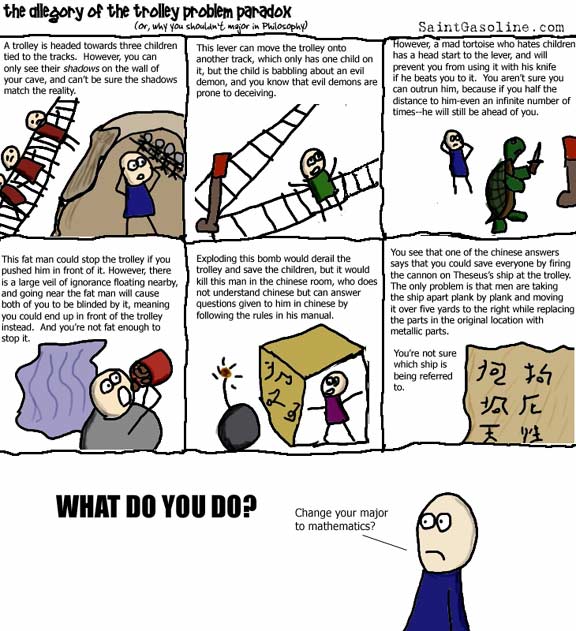
The Allegory of the Trolley Problem Paradox

Back in January we discussed the trolley problem when considering Pinker’s proposal for a moral instinct. But here’s a much funnier take on the whole issue! (Click on the image to make it larger if you can’t read the small lettering.)

The hat tip goes to the very cool Bioephemera, or biology + art (also see the old version here for more art & biology). That led me to Saint Gasoline, or a fine mixture of intellectualism and fart jokes, and their discussion of the trolley problem.

Morris vs. Hauser, or What’s Universal about Morality?

Seed Magazine featured this debate/discussion between the evolutionary psychologist Marc Hauser and the documentary film maker Errol Morris in a recent Seed Salon. The two sat down to discuss morality, given Hauser’s recent book Moral Minds: The Nature of Right and Wrong and Morris’ recent film Standard Operating Procedure on Abu Ghraib. So they are coming at the question from a wee bit different angle…

Hauser wants to argue for a universal moral module (or at least emotions) while Morris is the relativist. Hauser mentions the categorical imperative and selfish genes. Morris mentions social psychology and interpretations. In their explanations they talk past one another.

But what’s interesting is that the best part of their conversation revolves around the conjunction of people and context. This people/context conjunction is a universality both miss. Given how people and contexts and their interactions vary, it’s also relative.

I think Morris and Hauser miss understanding what they agree upon because we haven’t built a very good framework to give people like Hauser and Morris other ways to talk and to think.

Continue reading “Morris vs. Hauser, or What’s Universal about Morality?”