
By Casey Bouskill and Daniel Lende
In June, Jan Hoffman of the New York Times wrote “When Thumbs Up Is No Comfort,” reflecting on Ted Kennedy’s diagnosis with cancer and the ways in which the public obliges cancer patients to remain hopeful and strong while they ‘battle’ the ubiquitous and relentless disease.
Senator Kennedy presented an unfailingly upbeat attitude throughout his bout with a brain tumor, aided by such media images of him flashing a ‘thumbs-up’ to a crowd after a recent sailing race.
“Whether you’re a celebrity or an ordinary person, it’s obligatory, no matter how badly you’re feeling about it, to display optimism publicly,” said Dr. Barron H. Lerner, the author of “When Illness Goes Public.”
That optimism reassures anxious relatives, the public and doctors, regardless of whether it accurately reflects the patient’s emotional state. “If Ted Kennedy wanted to stick up his middle finger,” Dr. Lerner added, “that would be the more appropriate finger, but he’s doing what he is supposed to.”
Our ethnographic research with breast cancer patients here in South Bend, Indiana suggests that women are also fighting back against this so-called tyranny of optimism. Not by flashing the middle finger but by laughing!
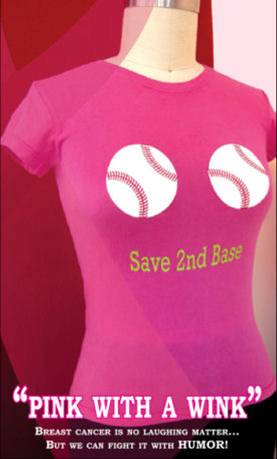
Ostensibly, this humor seems to reflect that patients are cheerful and hopeful, just as the public obliges for women ‘battling’ breast cancer. But after thirty interviews and multiple participant observation sessions, we discovered that the use of humor among breast cancer patients extends far deeper. Essentially it is a covert rejection of these cheerful expectations ascribed to breast cancer patients.
In fact, these ‘bad gals’ of breast cancer described how personalized and often crude humor, relating to everything from hair loss to hot flashes to breast reconstruction, is a proud way of asserting one’s individuality and personality. It also forces others to acknowledge that cancer is a painful reality, and one that deserves recognition.
Breast cancer patients arguably have to deal with the expectation of cheeriness more than any other group. For the last fifteen years, it has been virtually impossible not to drive a car, enter a supermarket, or live through the month of October without feeling entangled in a web of pink ribbons. The arsenal of the pink ribbon acts as the unanimous symbol of support, as unwavering as the marches and speeches that go along with it. And this pink ribbon campaign consistently portrays the image of a middle-aged, white, beautiful woman whose life has been tragically put on hiatus while she valiantly fights the disease.
Somewhere between the ribbons on yogurt lids and rear bumpers of cars, society has lost touch with the reality of breast cancer and who suffers from it. In the United States breast cancer is affecting women (and men!) of all races, ages, socioeconomic statuses, and sexual orientations, leaving the many who do not fit the pink ribbon mold to have to reassert their personal identities and disavow themselves from society’s false pretenses.
How does humor act to reverse this growing trend?
Continue reading “When Pink Ribbons Are No Comfort: On Humor and Breast Cancer”
 Neuroanthropology