
Sharp Brains is hosting the 50th edition of Encephalon, the brain and mind carnival. Like compulsive collecting and Dungeons and Dragons? Then check Encephalon out for those and much more at its mid-century.
Pop Goes the Media
At the Critical Neurosciences meeting in Montreal, Laurence Kirmayer brought up a great example of how research gets transformed and bastardized by the popular media. Here we have sociological research on the complex dynamics behind delinquency becoming the “biology-causes-everything” story.
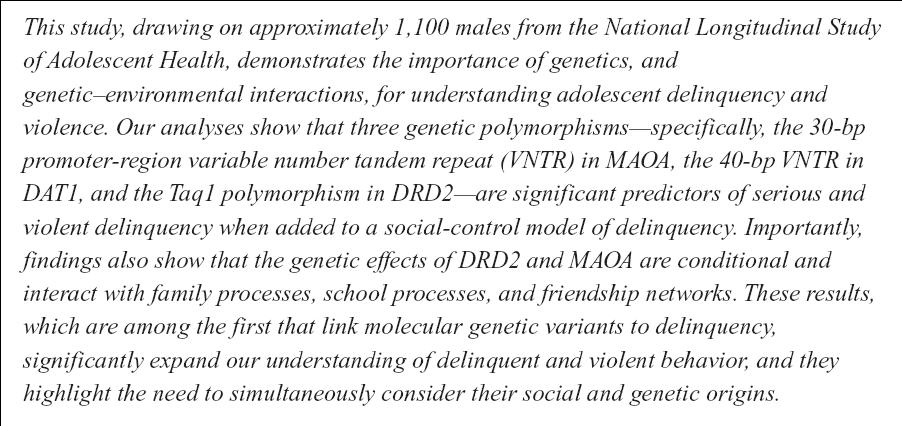
The original article is entitled “The Integration of Genetic Propensities into Social-Control Models of Delinquency and Violence among Male Youths” (big pdf; supplementary methods materials here) by Guang Guo, Michael Roettger and Tianji Chi at the University of North Carolina – Chapel Hill.
As a featured article in the American Sociological Review, the flagship journal of the American Sociological Association, this article had both a press release and an abstract prepared specially for the media. In other words, there were already digested materials ready for the media! No “misreading” of the original paper allowed.
The press release reads “Sociological Research Shows Combined Impact of Genetics, Social Factors on Delinquency,” with a minor highlight that indicates “Study is among first to tie molecular genetic variants to male delinquency.” The first sentence goes: “[this] sociological research… identifies three genetic predictors—of serious and violent delinquency—that gain predictive precision when considered together with social influences, such as family, friends and school processes.”
The media abstract is even clearer: “[The] genetic effects are conditional and interact with family processes, school processes, and friendship networks. ‘A stronger social-control influence of family, school, or social networks,’ the authors explain, ‘reduces the delinquency-increasing effect of a genetic variant, whereas a weaker social-control influence of family, school, and social networks amplifies the delinquency-increasing effect of a genetic variant’.”
Guang Guo goes on in the ASA media release: “Positive social influences appear to reduce the delinquency-increasing effect of a genetic variant, whereas the effect of these genetic variants is amplified in the absence of social controls. Our research confirms that genetic effects are not deterministic. Gene expression may depend heavily on the environment.”

So how does Reuters, one of the premier reporting services in the world, present the article? “Study finds genetic link to violence, delinquency” reads the title. I’ve included the accompanying photo that comes directly below the title. The Reuters piece got posted at Scientific American, Yahoo and other places, while an even worse photo appears at a “European descent” site.
Psychopharma-parenting
Ah, Stephen Colbert with his Word. This very funny and, as always, deadpan accurate video came up at the Critical Neurosciences conference I just attended in Montreal. Kelly McKinney, in her talk about the pop phenomenon of the Teen Brain (see PBS and Time), deserves all the credit for finding it!
Vodpod videos no longer available.
more about "Psychopharma-parenting", posted with vodpod
Here’s the transcript of this segment as well as the NY Times article Colbert mentions.
Update: Mind Hacks has provided a good discussion of “psychopharmaparenting”, in particular the alarming rise in the use of antipsychotics and Ritalin with children (often just to pacify them). As Vaughan writes, “The official line is that these drugs are the last resort, because behavioural interventions – specific programmes that teach parents to manage children’s behaviour in a more effective way – are remarkably effective with a large evidence base to back them up.”
Four Stone and Grand Rounds Carnivals
This week the new Four Stone Hearth, the best of anthropology, is out over at Remote Central. Another great edition! A extensive and wide-ranging round up, including some quite relevant brain-related stuff.
And for the medically inclined, go check out Grand Rounds at Unprotected Text! This one is presented in a very accessible fashion, so much appreciated!
Wednesday Round Up #20
Brain Health and Illness
Ed Yong, Is Sudden Infant Death Syndrome Caused by a Serotonin Imbalance?
Mice with SIDS, extra serotonin, and environmental stress—a deadly package. Good take from Ed. To see the media’s coverage, here’s a short piece from Yahoo.
John Grohol, Surprise! Mental Health Parity Is Inexpensive
Results in from Massachusetts. Matching the coverage of physical health is very affordable
Alvaro at Sharp Brains, A Multi-Pronged Approach to Brain Health
Interview with Dr. Larry McClearly. Not McDreamy, but he does know his “brain health public education” and what you need to do to keep that brain running smoothly
Alvaro at Sharp Brains, Brain Evolution and Why It Is Meaningful Today to Improve Our Brain Health
The evolutionary rationale for why McDreamy, I mean McClearly, is right
Jonah Lehrer, How Prozac Really Works
“Prozac is simply a bottled version of other activities that have a similar effect, such as physical exercise. They aren’t happy pills, but healing pills.”
Anne Harding, Study Uncovers How Ritalin Works in the Brain
“when groups of neurons in the prefrontal cortex were working in well-organized networks, the small doses of Ritalin enhanced this activity, but suppressed the activity of less organized networks”
Vaughan Bell, Mental Illness: In with the Intron Crowd
The genetics of mental illness from a big, new Nature paper
Shrink Rap, Sunday Morning Coffee Links
One psychiatrist’s round up of the blogosphere—plenty of cool stuff
Tara Parker-Pope, Dance Even If Nobody Is Watching
Dancing helps with depression, anxiety and Parkinson’s—plus the Matt Harding worldwide dance video
Michael Wesch and Media Literacy
Michael Wesch is an anthropologist who focuses on digital ethnography, student learning, and how new media and technology are changing the way we interact with each other and the world. He has a new lecture covering Media Literacy, an hour from a “master teacher” as one review says. So enjoy:
The hattip goes to Savage Minds. For more on Wesch, we featured his two most famous videos back in April in Digital Ethnography. He also has his own YouTube channel now and an academic website Mediated Cultures covering his and his students’ work. Wired even gave him a Rave Award in 2007, supplemented by lots of video snippets from him talking with Wired.
 Neuroanthropology