Magic and Mind Tricks

Benedict Carey has a NY Times article today, While a Magician Works, the Mind Does the Tricks. Cognitive neuroscience and magic has been receiving a lot of attention lately. Mind Hacks has written extensively on magic and Neurophilosophy has a more general post.

Carey covers much the same ground, beginning with the recent paper “Attention and Awareness in Stage Magic: Turning Tricks into Research” (full paper) by Stephen Macknik and colleages in Nature Neuroscience Reviews. Carey writes about the visual and tactile tricks of magic, of a red flash that lingers in vision to hide the stripping away of a white dress or gripping the wrist to leave a “somatosensory afterimage” before neatly stealing a man’s watch.

Carey also links to an extensive collection of videos that accompanied the Nature article. That’s one of the things I definitely want to highlight. These are videos of magicians doing their tricks, as well as some talks at a recent conference.

Magic would make a great neuroanthropology research project, similar to the placebo effect or video games. Anthropologists have long studied “magic, witchcraft and religion” (a typical course title), and are well placed to understand the techniques and training of magicians, the cultural knowledge and biases that magic seems to subvert or surprise, and how audiences read intentions into actions by the magician.
Today in the NY Times: Interactions or Causes?

One can take the New York Times today to illustrate a basic dichotomy we frequently discuss on this site. To understand ourselves and the world, is it better to examine complex interactions and the mixing of human action and natural cause, or to draw on simpler explanations and the old cause-effect scientific model?

Given that this site is neuro-anthropology (which the Times has nicely illustrated), we obviously favor interdisciplinary over one-field approaches. Given today’s world, that matters.

Handle with Care by Cordelia Dean takes on technology, science and ethics. She specifically examines planet-level environmental engineering or “geoengineering”, but also mentions robotics and nanotechnology. We could add gene therapy and increasingly sophisticated pharmaceuticals to that list. Her basic point?

This technology might be useful, even life-saving. But it would inevitably produce environmental effects impossible to predict and impossible to undo. So a growing number of experts say it is time for broad discussion of how and by whom it should be used, or if it should be tried at all.

As Dean notes, it is an extremely difficult proposal, contravening the way many scientists approach their work, highlighting necessity of global systems to manage our increasing technical power, and raising the specter of “knowledge-enabled mass destruction.”

Just one example of this appears in today’s Times with Surpassing Nature, Scientists Bend Light Backwards which points both to the potential impact on microscopes and on invisibility cloaks.

In Handle with Care, Dean highlights that science for science’s sake is not the answer. Rather, Prof. Sheila Jasanoff argues that the “first step was for scientists and engineers to realize that in complex issues, ‘uncertainty, ignorance and indeterminacy are always present.’ In what she described as ‘a call for humility’ [in her Nature essay], she urged researchers to cultivate and teach ‘modes of knowing that are often pushed aside in expanding scientific understanding and technological capacity’ including history, moral philosophy, political theory and social studies of science — what people value and why they value it.”

David Brooks in Harmony and the Dream brings us directly into that debate of what people value. He argues that “The world can be divided in many ways — rich and poor, democratic and authoritarian — but one of the most striking is the divide between the societies with an individualist mentality and the ones with a collectivist mentality.”

Continue reading “Today in the NY Times: Interactions or Causes?”

ARC and BIOS

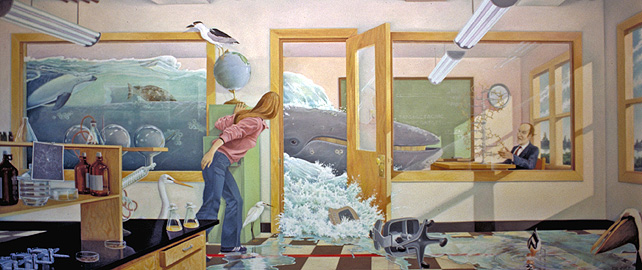
ARC\'s Splash Mural
ARC's Splash Mural
ARC is the Anthropology of Contemporary Research Consortium, focusing on the “human sciences” with the aim “to develop techniques of collaboration, modes of communication, and tools of inquiry appropriate to an anthropology of the contemporary.”

ARC has three main projects, one on vital systems security, another on biopolitics, and the final one covering synthetic biology and nanotechnology. This synthetic anthropos (“artful design and composition of the human thing”) is the most relevant to this site, and is run by Paul Rabinow.

ARC also has a collection of on-line “concept” papers, alongside working papers and web documents within each project. Chris Kelty, one of the directors of ARC, also posts on Savage Minds and wrote recently that “ARC Seeks Passengers and Drivers.” So check that out.

BIOS is the “international centre for research and policy on social aspects of the life sciences and biomedicine.” As another consortium, they have a wide-ranging set of research themes including biopolitics, neuroscience and society, and biomedicine and identity.

There is also a podcast available, “Beyond the Genome: the Challenge of Synthetic Biology“, based on a distinguished panel discussion on “Synthetic biology is heralded as the next frontier. But what is synthetic biology and how do we imagine its future directions?”

BIOS also gave me this link to the affiliated European Neuroscience and Society Network, “a multidisciplinary forum for timely engagement with the social, political and economic implications of developments in the neurosciences.” Check out the publications list by ENSN members, with quite a few articles that you can download. One interesting one that jumped out at me is Folk Neurology and the Remaking of Identity.

Cultural Evolution Round Up

I have not been the biggest fan of cultural evolution research—treating culture in too biological a fashion, a lot of theory without a lot of mechanism, not enough consideration of the brain, difficulties with ideas about progress and direction. But the field has slowly advanced, and there has been some interesting blogging and research lately.

I also think cultural evolution, done right, has direct implications for how to think about neuroanthropology. If brain and culture interact (with camping caveats), then how they came to interact plays a central role in understanding neuroanthropological dynamics. So, with that brief introduction, here’s the latest topical round up.

Canoe Design

Deborah Rogers and Paul Ehrlich, Natural Selection and Cultural Rates of Change
Open access article from PNAS on how the functional and aesthetic design of Polynesian canoes change at different rates. Basically Rogers & Ehrlich arguing that the functional parts (i.e., that interact more significantly with the environment) go through stabilizing selection and thus are more conserved, while aesthetic aspects tend to get elaborated locally and exhibit faster rates of change.

For those of you looking for something briefer, here’s the overview in the press release, which also includes praise from Jared Diamond and Nina Jablonksi.

John Skoyles had his critical response published in PNAS, but without open access, so here’s Anthropology.Net discussing Skoyles’ reaction to the Rogers & Ehrlich article.

For additional commentary, see Gene Expression and Anthropology.Net’s initial reaction to proposals about canoe design and natural selection.

And don’t forget Malinowski’s original chapter on Polynesian canoes!

Projectile Points

R. Lee Lyman and colleagues have a Journal of Archaeological Science article entitled “Variation in North American dart points and arrow points when one or both are present.”
The paper argues that projectile points are subjected to experimentation and selection, and thus an optimizing design. For the press release, click here.

Continue reading “Cultural Evolution Round Up”

Camping on the Brain

A week of camping in Michigan, and I did not think of the brain once. I was too physically active, too impacted by my senses, too involved with my family.

We all slept in one tent. We shared our meals, went to the beach together, and followed each other on hiking trails. Conversation, laughter, flare ups, it was all non-stop between us. No one off at work or at school. All the time, us.

The noises of the night surrounded us through the fabric walls of the tent, the wind amid the leaves, the lap of waves, a nightly fight between two raccoons, the birds in the morning. Smoke from our campfire filled our nostrils and stung our eyes, the warm and slightly acrid smell of burnt wood clinging to our clothes and our hair. The sun poured down on us, turning my boys nut brown and myself a reddish brown. No walls to shut nature away; my first night back I woke up feeling odd, realizing that it was too quiet, too enclosed, too soft.

I walked from the moment I woke to the moment I went to bed. Every morning I took our dogs through the campsite. We had to move to get to the bathroom or to go for fresh water. The beach was down a long boardwalk, the fallen firewood in the nearby woods. But walking was only the background. I ran down 400 foot sand bluffs with my boys and then made the agonizing climb back up in the shifting sand, pay back for the exhilarating speed down. I swam in crisp and clear waters, rollicking around near shore or diving to investigate shells and fish skeletons in deeper water. No sitting at the computer, not too much driving, no need to set aside special time to “exercise.” It was all the time there, part of what I was doing.

Continue reading “Camping on the Brain”

Sports Round Up

Science

Dan Peterson and his blog Sports Are 80 Percent Mental: A Look Inside the Mind of the Athlete
Here are some representative posts: Winning Olympic Gold with Sport Science, Federer and Nadal Can See the Difference, See the Ball, Be the Ball—Vision and Sports, Does Practice Make Perfect?

Natalie Angier, Learning from a Muddy Muscle Master
Lessons on strength training and muscle from the master of excessive muscular activity, the male toadfish

Bryant Park Project, Do Top Athletes See the World Differently?
NPR show on vision and athletes

Gina Kolata, Is Stretching All It’s Cracked Up to Be?
Studies of stretching collide with conflicting goals for stretching—an update from two ongoing studies

David Edwards and colleagues. Intercollegiate soccer: Saliva cortisol and testosterone are elevated during competition, and testosterone is related to status and social connectedness with teammates
Abstract for a 2006 Physiology and Behavior article, looking at social status, athletic prowess, and hormone levels

Training

Gretchen Reynolds, Faster, Higher, Stronger: An Olympic Cyclist’s Level-Headed Advice
Christian Vande Velde provides training tips, including substituting interval training for hills through “power bursts”

Arianne Cohen, The Making of an Olympian
Triathlete Andy Potts tops his rivals through an “unorthodox, highly scientific training regimen”

Continue reading “Sports Round Up”