Wednesday Round Up #40

This week we have world affairs, anthropology, mental health, and the brain. Thanks to Paul for some very worthy additions.

Top of the List

A Blog around the Clock, The Open Laboratory 2008 – All the Submissions Fit to Print
The list of nominees for the best science blogging of 2008. Enjoy!

Neil Scheurich, Time Out of Joint
“I’ve always been interested in the way psychology has struggled to deal with the hulking fact of human depravity.”

Open Anthropology, UAE’s The National on the Human Terrain System (2.0)
Maximilian gives us a well-written critical reflection on the Human Terrain System – as the last entry for the foreseeable future, this is a great one to read

Kylie Sturgess, Is This A Superstition I See Before Me?
The theater and superstition. Worth it for the funny Black Adder clip alone.

Norman Doidge, Re-evaluating the Basis of the Brain
Plasticity rather than localization from the author of The Brain That Changes Itself

World Affairs

IBNLive, Blogging from India
Indian bloggers address the terror in Mumbai

CNN, The World’s Most Heinous Crime
The 60th anniversary of the UN Genocide Convention, a timeline of genocides since then, and questions about how and if genocide will stop

Anthropology

Hannah Fearn, The Great Divide
Social vs. evolutionary anthropology! Biology vs. culture makes a good story, even though there is some “reaching out” moments in the second half of the piece. For some critical reaction, see Michael Stewart’s post

Continue reading “Wednesday Round Up #40”

Body Swapping

Do psychotherapists now have a new trick? Or is it all smoke and mirrors? The New York Times reports today on Standing in Someone Else’s Shoes, Almost for Real, where neuroscientists have shown that “the brain, when tricked by optical and sensory illusions, can quickly adopt any other human form, no matter how different, as its own.”

The article “If I Were You: Perceptual Illusion of Body Swapping” by the Swedish researchers Henrik Ehrsson and Valeria Petkova appears this week in PLoS ONE, and is ably summarized over at Neurophilosophy. You can also read Ehrsson’s previous article on the virtual arm illusion and his Science piece on the experimental induction of out-of-body experiences.
out-of-body-illusion
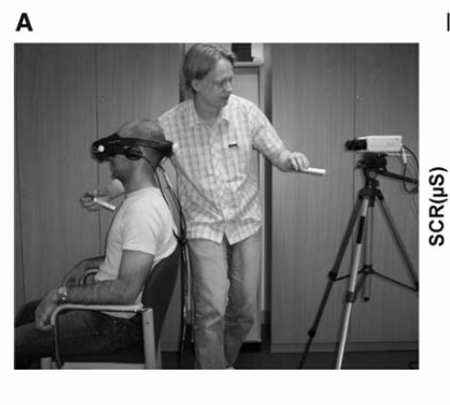
The approach in all of this research is rather simple. You can see the out-of-body experiment design pictured to the right. Body swapping adds another person with goggles.

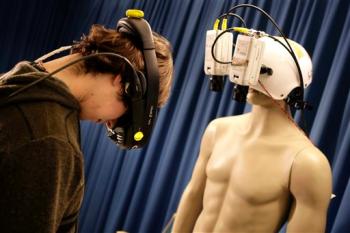
A subject stands or sits opposite the scientist, as if engaged in an interview.. Both are wearing headsets, with special goggles, the scientist’s containing small film cameras. The goggles are rigged so the subject sees what the scientist sees: to the right and left are the scientist’s arms, and below is the scientist’s body. To add a physical element, the researchers have each person squeeze the other’s hand, as if in a handshake. Now the subject can see and “feel” the new body. In a matter of seconds, the illusion is complete.

body-swap-by-niklas-larsson
This “switching” happens because the brain is literally embodied – after growing up with this particular body, it’s a fair assumption to assume that one’s eyes and one’s hand are getting feedback about the same interactive phenomenon. For a first-person view of this, see Karl Ritter’s AP article today on the body-swap illusion, which includes this photo of the two-goggle set-up.

Ehrsson is excited about being able to trick the brain in this way: “You can see the possibilities, putting a male in a female body, young in old, white in black and vice versa.” The NY Times article pushes the uses body swapping can have in therapy.

Continue reading “Body Swapping”

MetaCarnival #2

The second edition of the MetaCarnival, a round up of some of the best carnivals out there, is now up at Emergiblog. The MetaCarnival is the brainchild of Alvaro Fernandez of Sharp Brains fame, and Sharp Brains features the archives, calendar and basic info. The basic format is for carnival administrators to submit 1 or 2 picks from their respective carnivals, and those get gathered together in the “carnival of carnivals.”

Emergiblog’s MetaCarnival features stuff from the bran/mind carnival Encephalon and the anthropology carnival Four Stone Hearth, but also goes further afield into classic science papers, academic life, surgery, medicine, and nursing.

The December 29th edition will be hosted at Science Roll. Carnival administrators can send submissions to berci.mesko at gmail dot com.

Monday Morning Artist: Chow Martin

So this starts a new and occasional series, the Monday Morning Artist. I just came across Chow Martin’s work through We Heart It, a new image sharing site that was featured in a recent NY Times article. The two drawings here come from Martin’s 1.5 Exhibit on his Behance Network site. Martin also has his own website. You can reach him at chow [at] chowmartin [dot] com.

Here is the image that caught my eye:

Gorilla Market by Chow Martin

Another striking illustration comes after the fold. Continue reading “Monday Morning Artist: Chow Martin”

The Encultured Brain – Part One on the San Francisco AAA Conference

Our double session on the Encultured Brain: Neuroanthropology and Interdisciplinary Engagement was quite a success. The room was full, the papers well delivered, the discussants provided both constructive criticism and encouragement. Greg and I even got congratulations from people who heard about the session through meeting buzz. Never had that happen before!

So all that was great. But it’s not what I plan to dicuss here. The session, and ensuing conversations, pushed my own thinking, and I want to provide my general take on the session.

The place to begin is with the end, I think. In his comments Robert Sapolsky highlighted two important points. First he emphasized our changing view of the brain, with the main emphases in neuroscience now being the twin concepts of plasticity and connectivity. Genetic programming and innate modules are relics of past thinking. How neurons connect up and how neural function is shaped by other parts of the brain and by the environment now play a central role in understanding what our brains do. Not including these two basic concepts – with clear links to development, activity, experience, and culture – means missing the boat on where neuroscience is at and the potential lessons it carries for other fields.

Sapolsky’s second point was to not get caught up by the technical brilliance (or mirage, depending on your perspective) of neuroscience. Its technical prowess also carries large constraints, such as being limited to animal models or neuroimaging, extreme cost, and being confined to the laboratory. These technical aspects are largely problems of neuroscience, and should not carry over to anthropology (neuroanthropology or otherwise). Our focus on behavior, our work with people and primates in natural settings, our ability to focus on how people actually live – these are our strengths. We can flesh out what plasticity and connectivity – the interactive brain – mean for people and primates.

In her comments on the session, Naomi Quinn pointed out that we as anthropologists still have some way to go in this new endeavor. She highlighted the eclectic nature of the panel as one demonstration of that (who us, all over the board?). But the more serious point she had was our lack of a common language. Without a common set of ideas and a core set of references, we risk continuing to be all over the board rather than building the innovative research program that appears in our rose-colored dreams. Part of adding flesh to brain research means developing some shared meaning among ourselves about the different parts in play. Quinn’s challenge is an important one.

So that’s part one of my reflections. I’ll link to other parts here as I build on specific talks to discuss how to think more specifically about plasticity, connectivity, and common language. As a whole, the talks themselves present some powerful synergies – if we can just see our way to that.