I love traveling in Colombia – one of the best places I’ve ever visited, with so much to do and see. And a nice place to make home as well! So here are some travel articles to whet your appetite!
The beautiful photo to the right was taken by Carlos Andres Rivera, and is a shot of Popayán, Colombia – that’s where I taught for a semester a few years back. Sr. Rivera has an entire Flickr site of his photos on Popayán.
Seth Kugel, In Colombia, Pillories and the Lonely Planet People
Next Seth heads to Popayán (one of my favorite Colombian cities, of course) and its beautiful surrounding region, from visiting the Guambiano indigenous people to the magnificent archaeological site San Agustín
Anand Giridharadas, Love and Cartagena
A guide to a weekend trip to Colombia’s best known tourist city, a spectacular coastal city complete with fortified walls. And if you want to know where to eat, see For Foodies, Cartagena Is Now on the Map
Kevin Gray, Before Night Falls
A long meditation on a trip to Bogotá, going from a Cold Play concert to Sunday brunch in Usaquén while nursing a hangover
Juan Forero, Ex-Rolling Stones Manager Emerges In South America
From Rolling Stones to Ratones Paranoicos! Andrew Loog Oldham now works in Bogotá – nice piece from NPR, complete with the radio segment, online video, and more
Matthew Fishbane, Above the Clouds in a Secret Colombia
El Cocuy National Park – a place I’ve always wanted to visit. The roof of the Andes, including peaks above 17,000 feet
I just posted the latest Wednesday round up. Since coming back from a summer hiatus, I’ve tried to mix things up a little bit. Well, really added more features – a photo at the beginning, video in the middle, a personal note, a poem or some literary tidbit at the end. Do you like these additions? Have any other suggestions for the Wednesday round ups?
Also, how important is the Wed round up for you? It takes a fair amount of work to put together, rarely posts huge numbers… I guess my question is whether it’s too long. Would you prefer to have shorter round ups? Or any other ideas?
Please leave a comment, or send me an email if you want. daniel.lende over at gmail dot com
This week the top, then anthro, mind, and alcohol and drugs as a chaser. I stuck the mini-reflection piece after the top. And there’s a little poetry at the end.
Floyd Bloom et al., A Judge’s Guide to Neuroscience: A Concise Introduction
Can the field of neuroscience help the legal system in determining a defendant’s culpability? This question along with others is explored in a comprehensive introduction to neuroscience.
Philip Swift, The Octopus: Eight Footnotes
Tentacles galore! Octopus references in Japanese culture, anthropological theories, and the World Cup.
Melody Dye, Don’t Bite: In Sum, Dear Readers
Irresistible discussion of “self control” based on research with children and their ability to refrain from eating cookies. Really, you need to give in and go read it!
Jef Akst, I Hate Your Paper
Ever had a paper rejected by a journal for unfair reasons? In this article, Akst examines problems with the peer review system and possible solutions.
Impact Lab, Top 10 Photos of the Week
Some funny pictures of cowboy training, a “green” RV, stadium seating in North Korea, and more… I needed that after the rejection.
Neuroantropologia
Get your neuroanthropology in Italian, flavored towards the neuro side.
Bill Yates, Neuroscience of Murder and Aggression: Part 1
A commentary on the TEDs talk by Jim Fallon, the neuroscientist who found that he had neurological traces of a pattern found in murderers. It provides a nice discussion of multiple causation, cultural reinforcement and cultural buffering.
Livia Blackburne, How Language Affects Thought — plus book giveaway!
Discusses two recent studies where studies in which subjects’ natal language affected ability to answer time related questions after answering spatial ones (English v. Mandarin Chinese) and gender-related associations with words that had grammatical gender in Spanish and German.
Rob Mitchum, The Disparity of Pills
Covers a recent study that explored disparity in medication use by patients based on ethnic group. The take-away: even allowing for income, education and access to insurance, the statistical difference between majority and minority populations persisted, suggesting that pharmaceutical access is affected by other, possibly harder to quantify, factors
Interlude
I woke up too early, thoughts of my class, posts, emails, and articles cluttering my mind. I sat at the computer, no coffee, and soon after got the Blue Screen of Death. Would that my mind could suffer that same crash, rebooting against the clutter, or at least finding sleep. But such design is not my or Microsoft’s strength. But at the least I can wish for purity of purpose.
That’s a more accurate title, but I really wanted to call this post, Tenure Online?
First off, I wanted to ask the question, what do professors out there think? Can peer-review be open sourced? Is online work getting any credit, or is it still all about traditional peer reviewed articles?
The grueling process of subjecting work to the up-or-down judgment of credentialed scholarly peers has been a cornerstone of academic culture since at least the mid-20th century.
Now some humanities scholars have begun to challenge the monopoly that peer review has on admission to career-making journals and, as a consequence, to the charmed circle of tenured academe. They argue that in an era of digital media there is a better way to assess the quality of work. Instead of relying on a few experts selected by leading publications, they advocate using the Internet to expose scholarly thinking to the swift collective judgment of a much broader interested audience.
The Shakespeare Quarterly is leading the charge over in the Humanities. They handled the open comment process through Media Commons Press, which has the tagline: “Open Scholarship in Open Formats.”
The larger point comes later in the article, and it’s one I hope to hear people’s opinions about:
Today a small vanguard of digitally adept scholars is rethinking how knowledge is understood and judged by inviting online readers to comment on books in progress, compiling journals from blog posts and sometimes successfully petitioning their universities to grant promotions and tenure on the basis of non-peer-reviewed projects.
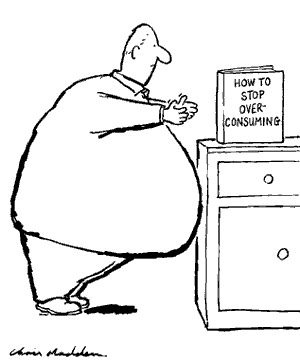
WHY are Americans getting fatter and fatter? The simple explanation is that we eat too much junk food and spend too much time in front of screens — be they television, phone or computer — to burn off all those empty calories.
One handy prescription for healthier lives is behavior modification. If people only ate more fresh produce. (Thank you, Michael Pollan.) If only children exercised more. (Ditto, Michelle Obama.)
Unfortunately, behavior changes won’t work on their own without seismic societal shifts, health experts say, because eating too much and exercising too little are merely symptoms of a much larger malady. The real problem is a landscape littered with inexpensive fast-food meals; saturation advertising for fatty, sugary products; inner cities that lack supermarkets; and unhealthy, high-stress workplaces.
In other words: it’s the environment, stupid.
The main idea, as stated by Dr. Dee Edington, “If you change the culture and the environment first, then you can go back into a healthy environment and, when you get change, it sticks.”
A little anthropology would be nice here, along with the economic prescriptions such as food pricing, advertising and availability. Inequality makes fast food, which is cheap, quite appealing to people without a lot of cash. Rich people also have dedicated spaces for exercise and the like, since our environment does little to make us move. Food also means something – simply declaring it “unhealthy” and labeling the number of calories are appeals directed at an audience assumed to be rational: cost/benefit analysis should win out, right?
For those who want a little anthropology, you can go to the Food, Obesity and Eating page, which rounded up a lot of the writing I did on this early on. For some relevant pieces, go directly to:
Susan Blackmore is up to her usual shenanigans, promoting memes like the red in her hair, following fashion when it’s just not good science.
She has an essay over at the New York Times, The Third Replicator, and will also be engaged in debate with other folks at On the Human, the online project of the National Humanities Center. The entire essay and further discussion are available there at Temes: An Emerging Third Replicator.
Blackmore’s basic argument is that information is multiplying, and the resulting evolutionary process – due to variation, inheritance, and internet success – is best understood through the concepts of “memes” and “temes”:
All around us information seems to be multiplying at an ever increasing pace. New books are published, new designs for toasters and i-gadgets appear, new music is composed or synthesized and, perhaps above all, new content is uploaded into cyberspace…
It is perhaps rather obvious to attribute this to the evolutionary algorithm or Darwinian process, as I will do, but I wish to emphasize one part of this process — copying. The reason information can increase like this is that, if the necessary raw materials are available, copying creates more information. Of course it is not new information, but if the copies vary (which they will if only by virtue of copying errors), and if not all variants survive to be copied again (which is inevitable given limited resources), then we have the complete three-step process of natural selection (Dennett, 1995). From here novel designs and truly new information emerge…
When our ancestors began to imitate they let loose a new evolutionary process based not on genes but on a second replicator, memes. Genes and memes then coevolved, transforming us into better and better meme machines…
[I]n the early 21st century, we are seeing the emergence of a third replicator. I call these temes (short for technological memes, though I have considered other names). They are digital information stored, copied, varied and selected by machines. We humans like to think we are the designers, creators and controllers of this newly emerging world but really we are stepping stones from one replicator to the next.
The basic analysis is two-step: (a) like so many spectacular failures before, slot humans into a reductive evolutionary analysis – eugenics, selfish-gene sociobiology, and now the memes/temes team (and damn, it makes me mad because this really hampers people’s understanding of how to do good evolutionary analysis!); (b) come up with a categorical concept and apply it everywhere – the replicator (genes, memes, and temes) – even after the complexities of actual genetic “copying” reveal a dynamic and incomplete process, not a prime mover and essentialist causal force (and damn, it makes me mad because this really hampers people’s understanding of how to do neural/anthropolological analysis!).
The great advantage of this is that most people can follow a two-step analysis, a one-two punch, a back-and-forth dance move. It’s easy, often appealing, and doesn’t require a lot of practice or skill to ape.
Let me go back to my initial play on words, off McLuhan’s “the medium is the message.” Here’s a part of the Wikipedia entry on just that phrase which reveals the immediate downfall to Blackmore:
McLuhan describes the “content” of a medium as a juicy piece of meat carried by the burglar to distract the watchdog of the mind. This means that people tend to focus on the obvious, which is the content, to provide us valuable information, but in the process, we largely miss the structural changes in our affairs that are introduced subtly, or over long periods of time. As the society’s values, norms and ways of doing things change because of the technology, it is then we realize the social implications of the medium. These range from cultural or religious issues and historical precedents, through interplay with existing conditions, to the secondary or tertiary effects in a cascade of interactions that we are not aware of.
The content of “memes” or “temes,” the simplistic juicy idea, really distracts us from two messages: what the social implications of Ms. Blackmore’s ideas are (and she sure has plenty to say there, and does so often), and how technology actually drives wholesale transformations in ways that makes the the concept of “temes” seem so inadequate, so antiquated. Why are a search engine, a social connector, and a video uploader the three top sites in the world? It’s not because of temes – it’s because people use them.
I could go on and on, but there’s not much point. I’ll let Greg speak for me in his post, We Hate Memes, Pass It On:
So, why do I hate the concept of ‘ideas replicating from brain to brain.’ After all, I work on physical education and imitative learning; shouldn’t I be happy that memetic theory places such a premium on imitative learning? What is my problem!? Ah, let me count the problems… I’ll just give you 10 Problems with Memetics to keep it manageable.
Greg starts with (1) Reifying the activity of brains, (2) Attributing personality to the reification of ideas, (3) Doesn’t ‘self-replicating’ mean replicating by one’s self?, (4) The term ‘meme’ applied to divergent phenomena, and another six gems for you.
In the meantime, here is someone who actually does work on YouTube and other Internet phenomena, anthropologist Michael Wesch.

 I love traveling in Colombia – one of the best places I’ve ever visited, with so much to do and see. And a nice place to make home as well! So here are some travel articles to whet your appetite!

 Neuroanthropology