Cognition and Culture Institute website


Olivier Moren just got in touch to tell us that the International Cognition and Culture Institute has just opened a new website/blog at http://www.cognitionandculture.net. I just surfed over to check it out, and there’s already plenty of stuff happening. Although it’s a new site, there’s a lot of good content already, and a formidable group of writers, from the sound of it. The writers used to have the AlphaPsy blog on humanities and human nature, but that site hasn’t had any new postings in a while, so it’s nice to have the group back with new material.

The International Cognition & Culture Institute comes out of the Department of Anthropology and apparently the Department of Political Science of the London School of Economics and Political Science with support from the Institut Jean Nicod (ENS, EHESS, CNRS) in Paris. Their website also includes a section for job listings (excellent!) and an intriguing note about a grant competition coming up in 2009:

Sometime in 2009, we will hold a small grant competition. Successful applicants will be funded to carry out the same research task in a variety of cultural settings, thus generating a body of comparable data

I’ll be interested to see what they come up with and the resulting data.

Although I’m fascinated by cognitive anthropology, cross-cultural psychology, and the field that we might describe as ‘culture and cognition,’ I often feel that some of the stuff that we do at Neuroanthropology doesn’t sit well within the ‘cognition’ category. I’ve been thinking about this a lot as I put together thoughts for a book proposal, but I worry that — nifty alliterations aside — the term ‘cognition’ puts front and centre certain qualities of the brain, body, and nervous system, and (even unintentionally) marginalizes other qualities, some of which I’m particularly interested in. Of course, the term ‘neuroanthropology’ has problems, too, as we’re just as interested in the effects of culture on the skeleton, muscle tissue, endocrine system, and other viscera as we are upon the neural wetware.

All reservations aside, I’m really happy Olivier contacted me. I’ll be putting their site on our blogroll (if Daniel hasn’t beaten me to it) and keeping a close eye on what they produce. Looking forward to the online seminars and more about the comparative projects that the Institute is able to sponsor.

The Encultured Brain at the AAAs

One month from today, on November 20th, Greg and I will convene our panel “The Encultured Brain: Neuroanthropology and Interdisciplinary Engagement” at the 2008 American Anthropological Association annual meeting. The meeting is being held at the Hilton San Francisco, right in the heart of the city, and our session kicks off at 8:00AM and runs to 11:45AM. We hope some of you will come!

Here is what our panel will address:

As a collaborative endeavor, neuroanthropology aims to better integrate anthropology, social theory, and the brain sciences. In this panel, we explore the implications of new findings in the neurosciences for our understanding of culture, human development, and behavior. Neuroanthropology can help to revitalize psychological anthropology, promote links between biological and cultural anthropology, and strengthen work in medical and linguistic anthropology. However, recent anthropology has not engaged neuroscience to produce the sort of synthesis that began when Franz Boas built cultural anthropology from psychophysics.

Neuroscience has increasingly produced basic research and theoretical models that are surprisingly amenable to anthropology. Rather than “neuro-reductionist” or determinist approaches, research has increasingly emphasized the role of environment, body, experience, evolution, and behavior in shaping, even driving organic brain development and function. At the same time, the complexity of the brain makes a mockery of attempts to pry apart “nature” from “nurture,” or to apportion credit for specific traits. Research on gene expression, endocrine variability, mirror neurons, and neural plasticity all beg for comparative data from across the range of human variation — biological and cultural.

Neuroscientists and other social scientists are already actively working on these sorts of integrated models; books like Wexler’s Brain and Culture and Quartz and Sejnowski’s Liars, Lovers and Heroes actively incorporate anthropological materials. In the social sciences, books like Turner’s Brains/Practices/Relativism aim to bring neuroscience into social theory, often with critical intent.

However, these works often leave out the best of anthropology. Although our research is being borrowed, we are being left out of the conversation precisely at a time when we should speak with authority. In the present round of integration, simplistic understandings of culture dominate, and, at times, outside authors read our research through unsettling ideological lenses. And, given the emphasis on experience, behavior, context and development, the absence of ethnographic research and insight into precisely those domains that impact our neural function is startling.

Anthropology has much to offer to and much to learn from engagement with neuroscience. An apt model is just how important genetics has become in anthropology, cutting across the entire discipline. A similar revolution is waiting with neurobiology, if we can draw on our strengths and build neuroanthropology on inclusion, collaboration and engagement, both within and outside anthropology. To this end, this session explores areas of anthropological research related to the brain where heredity, environment, culture and biology are in complex relations, with human variation emerging from their nexus rather than being determined by a single variable. Participants explore addiction, motor skill, autism, mental disability, and other brain-related phenomena that can only be explained by dynamic models including both “bottom-up” (biological, neural, and psychological levels) and “top-down” (cultural, social, and ideological) factors. Participants highlight that no single model of the biological-cultural interface holds for all cases. The papers in this panel also suggest ways in which anthropologists might intervene in public discussions of crucial human characteristics and make our concerns more persuasive for other academic disciplines exploring the complexity of the human brain.

We have a great group of presenters. This is the order, complete with talk titles. Greg and I will post more information about each talk in the days to come, so stay tuned for that.

Daniel H. Lende (University of Notre Dame) Ethnography and the Encultured Brain: Design, Methods and Analysis.

Peter Stromberg (University of Tulsa) Exploiting Autonomic Processes to Shape Ideas: An Example from Early-phase Tobacco Use.

Rachel S. Brezis (University of Chicago) Autism and Religious Development: A Case for Neuroanthropology.

Harold L. Odden (Indiana University-Purdue University, Fort Wayne) Ethnopsychologies and Children’s Theory of Mind: Finding Common Ground between Anthropology, Psychology, and Neuroscience.

Christina Toren (University of St Andrews, Scotland) Inter-subjectivity and the Development of Neural Processes.

Ryan Brown (Northwestern University) The Brain in Culture: Emotional Responses to Social Threats.

Katherine C. MacKinnon (Saint Louis University) and Agustín Fuentes (University of Notre Dame) Primate Social Cognition, Human Evolution, and Niche Construction: A Core Context for Neuroanthropology.

Cameron Hay-Rollins (Miami University of Ohio) The Relevance of Neurology to an Indonesian Healing Tradition.

Rebecca Seligman (Northwestern University) Cultural Neuroscience and the Anthropology of Dissociative Experience.

Greg Downey (Macquarie University, Australia) Balancing Between Cultures: A Comparative Neuroanthropology of Equilibrium in Sports and Dance.

We also have three outstanding discussants for our panel:

Claudia Strauss, Pitzer College
Naomi Quinn, Duke University
Robert Sapolsky, Stanford University

Here is our entire Encultured Brain AAA proposal for those of you who are interested.

‘Party on, dude,’ pre-Columbian style

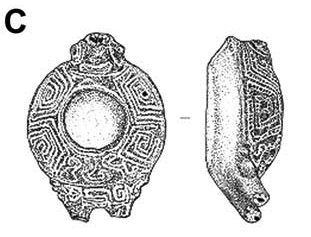
Red fine-walled ceramic snuff bowl from Puerto Rico
The UK Telegraph has run with a story, ‘Stone Age man took drugs, say scientists,’ about recent discoveries by a research team led by Quetta Kaye, of University College London, and Scott Fitzpatrick, of North Carolina State University. The drug taking ‘paraphernalia’ were dated to approximately 400 to 100 BCE, and were found in the Caribbean island Carriacou, 400 miles from where they probably originated on the South American continent. Daniel’s usually the one covering the posts on drugs (see, for example, his recent Drugs Round Up and the older Addiction Round Up), but I thought I’d put in my two cents on this one.

According to the Telegraph, the best guess for the mind altering substance involved is cohoba, a psychedelic substance produced from the ground seeds of the cojóbana tree. According to a quick surf around the web, cojóbana is likely a common name for Anadenathera peregrina, a tree native to both the Caribbean and South America, which also happens to be a good source of dietary calcium (the miracles offered by Mother Nature never cease).

Continue reading “‘Party on, dude,’ pre-Columbian style”

Cooperative Hunting by Chimpanzees

The following video is the best illustration I have ever seen of how chimpanzees hunt together in coordinated fashion, with different individuals having different roles. It combines both on-the-ground video and overhead infrared to illustrate just how this group of chimpanzees manages a successful hunt of colobus monkeys. Incredible footage!

(If it doesn’t play, try going directly to the You Tube clip.)

Christophe Boesch has spear-headed the research to document hunting roles among chimpanzees. He published on cooperative hunting in a 1994 Animal Behaviour article (pdf) and discussed hunting roles, meat sharing, and learning more specifically in a 2002 Human Nature article (pdf).

Craig Stanford is another researcher who has focused on hunting by chimpanzees. He has written this online essay, The Predatory Behavior and Ecology of Wild Chimpanzees, which is an excellent overview of what we know about chimpanzee predatory behavior.

John Mitani has also published on why male chimpanzees hunt and share meat; in 2002 John also provided an overview about recent developments in the study of wild chimpanzee behavior. I posted more video on chimpanzee behavior, including hunting, just this week – so check that out for more footage.

For what chimpanzee hunting means about our own evolution, we have two contrasting views – hunters vs. being hunted. Craig Stanford has a 2001 popular book The Hunting Ape: Meat Eating and the Origins of Human Behavior. That book should be tempered by the more recent Man the Hunted: Primates, Predation and Human Evolution.

The Moral Sense Test

Eric Schwitzgebel, a professor of philosophy at the University of California at Riverside, is running an on-line test about moral dilemmas with his colleague Fiery Cushman, a psychologist at Harvard. Eric runs the blog The Splintered Mind, which I have quite enjoyed reading lately – it covers “the philosophy of psychology, broadly construed.”

So they want to recruit some anthropologists, neuroanthropologists, and other related ilk to take the Moral Sense Test. They need you! Otherwise the test, promoted on a philosophy site, will only get philosophy type answers. While we know that both philosophers and anthropologists can give screwy answers about moral questions, the burning question is: will they give different screwy answers?

Eric assures me the moral dilemmas will do just that, create dilemmas. But you have the power to decide! (Well, assuming your mind just doesn’t freeze up.) Plus you’ll get 15 to 20 minutes of edu-tainment, becaue that’s how long the test takes.

So mosey on over to the test site for your Moral Sense. Eric and Fiery send their splintered, burning thanks!