Wednesday Round Up #15

Anthropology

Clifford Geertz, Very Bad News
The late great American anthropologist takes on Jared Diamond’s book Collapse: How Societies Choose to Fail or Succeed

Erik Davis, BBC Documentary: Tales from the Jungle: Malinowski
YouTube videos of the BBC documentary on one of the founders of modern anthropology, Bronislaw Malinowski

Integral Praxis, Investigating Global Health
Nice video and links on Paul Farmer’s work

John Hawks, Numbers, Amazon-Style
Numbers: universal phenomenon or cultural invention? Looks like Western linearity is acquired. Nice summary of a Science article by Stanislas Dehaene et al. that goes from the Mundurucu in Brazil to neural mapping

Ian Kuijt, The Regeneration of Life: Neolithic Structures of Symbolic Remembering and Forgetting
The abstract for a new Current Anthropology paper on archaeology and the “social construction of identity and memory… expressed through public ritual”

Terry Eagleton, Culture Conundrum
Civilization vs. barbarism? Why civilization needs (popular) culture

Keith Axline, Inside the Architecture of Authority
Photographer Richard Ross shows institutions in their concrete power

Social Fiction, On Ethnographic Surrealism
Gives us a pdf link to James Clifford’s classic paper, plus a cool image and plenty of playfulness

Mark Dingemanse, Under the Spell of Ideophones
Ghanian newspapers, vivid sensory language, and the uses of persuasion

Liam Stack, In Egypt, “Dramatic” Push For Women’s Voices
Anthropology and drama combine: An Egyptian women’s troupe takes on stereotypes Muslim and Western

Elitism in the US

En Tequila Es Verdad, Carnival of the Elitist Bastards #1
Just what it says! A blog carnival celebrating experts, smart people, and other bad-ass riff-raff

John Pieret, Be All The Bastard You Can Be
“Our elitisim is not exclusionary. We welcome everyone to join.”


Continue reading “Wednesday Round Up #15”

The New York Neuroanthropology Times Today

A series of articles today in the New York Times nicely captures several of the themes of Neuroanthropology—(1) the importance of evolution, with an emphasis on comparative work, variation, and mechanism in addition to adaptive function; (2) examining the interaction between the environment and behavioral biology, where the environment can significantly shape and even alter basic behavioral biology; (3) that brains are there not just to process information or create accurate representations, but are designed for doing things; and (4) social context matters, shaping what people do and what they experience (again, brain-environment interaction), so a focus on the brain alone will not explain significant social patterns or problems.

Evolution and social context are both necessary to successful neuronanthropology, which in turn focuses on what people do and feel through the lens of person-environment interaction. Our approach avoids placing analysis into any one academic category (saying something is an anthropological or a neurological problem alone) and eschews the essentialism that most academic fields incorporate into their causal explanations (culture or biology or psychology made them do it). So here are the articles.

–//–

Nicholas Wade reports on new research that shows that the evolution of brain complexity is related to synaptic structure, and not just to the number of neurons (the older “bigger brain” theory). The following graphic shows the sequence well.

Synapses had been viewed as a standard feature across animal brains. “In fact the synapses get considerably more complex going up the evolutionary scale, Dr. Grant and colleagues reported online Sunday in Nature Neuroscience. In worms and flies, the synapses mediate simple forms of learning, but in higher animals they are built from a much richer array of protein components and conduct complex learning and pattern recognition, Dr. Grant said… ‘From the evolutionary perspective, the big brains of vertebrates not only have more synapses and neurons, but each of these synapses is more powerful — vertebrates have big Internets with big computers and invertebrates have small Internets with small computers’.”

Continue reading “The New York Neuroanthropology Times Today”

Channeling Encephalon

Channel N has the latest edition of Encephalon up, and it’s quite a collection of neuroscience and mind-related materials. I also want to plug Channel N–a great resource for brain-related videos!

As befits the site, there is a video theme to this Encephalon, with a Steven Pinker intro, Bjoern Brembs covering spontaneous behavior (in drosophila), Jonathan Haidt on morality and happiness, Laura Collins on anorexia, The Karen Carpenter Story (also anorexia), Albert Bandura and social aggression, and a sleep walking robot all featured onsite!

A couple other posts that jumped out at me were Modern Medicine for Manipulation of the Mind on oxytocin, trust and pharmacological treatment and Socializing Promotes Survival of New Nerve Cells and May Preserve Memory on zebra finches and neurogenesis.

Also to note, we will be hosting the next Encephalon on June 23rd, so please send in your submissions to encephalon dot host @ gmail dot com before then!

Jean-Pierre Changeux, Gerald Edelman, and How the Mind Works

The nature of the brain’s “representations”—if there is such a thing—of the world, the self, the past and present, remains puzzling, as the very different approaches we have described suggest: Changeux’s view of “long-lasting global representations”; Edelman and Tononi’s view of memory as constructive recategorizations, and Rizzolatti’s stunning discovery of mirror neurons, suggesting that we know and understand others, to some extent, through neural imitation. And as these differing views show… we are still far from a full understanding of the nature of memory, perception, and meaning.

So Israel Rosenfield, a doctor and historian, and Edward Ziff, a biochemistry professor, conclude their review How The Mind Works: Revelations in a forthcoming New York Review of Books piece. What I liked about this essay is its clear statement on starting points to think about our brains and its insightful summaries and critique of recent work. But in the end I was still left with a “So what?” Their hints at subjective psychology, the acting brain, and relational representation remained the side dishes, rather than the main course. I’ll deal with that main course later this week, and in this post cover Changeux and Edelman.

Rosenfield and Ziff give us a quick historical summary of work on the neuron as a cell that uses electrochemical signaling. Early research by Hermann von Hermholtz and Santiago Ramon y Cajal contributed to defeating the notion that neurons functioned in a similar fashion to the dominate communication technology of that time, the telegraph. Neurons are slow in direct contrast to the speedy telegraph.

Today we still draw on an equally speedy but wrong view, the computer analogy. Jean-Pierre Changeux helped overturn the computer view using both basic research and basic biological theory, evolution by natural selection. (Still, I was left asking myself, why couldn’t we have learned from the failure of the telegraph model in the first place…)

As Rosenfield and Ziff note, Changeux’s research showed that “the human brain therefore does not make optimal use of the resources of the physical world; it makes do instead with components inherited from simpler organisms… that have survived over the course of biological evolution.”

Continue reading “Jean-Pierre Changeux, Gerald Edelman, and How the Mind Works”

Free Running and Extreme Balance

Mostly this is an excuse to link to these great videos of free running and parkour, unusual because they show much of the full sequence rather than mash-ups. But to go all scholarly on you, Cognitive Daily had a recent piece on learning to walk and children’s sense of balance. Leaning with backpack weights was a learned process, not an intuitive one, even with toddlers who knew how to walk.

These videos also give me the chance to plug Greg’s early piece on our sense of balance. Rather than an innate module gifted to us by evolution, “The evidence seems very clear that the sense of balance (again, with all the caveats of calling it ‘a’ single ‘sense’) can be trained to wide range of different challenges and to operate more efficiently or from different sets of information depending upon the task constraints. The variability of equilibrium was driven home to me in my research on capoeira, an Afro-Brazilian martial art and dance.”

Similarly with “l’art de displacement” through mixing balance, jumping, climbing and running. Wow!

Just like elite runners, I bet they stay focused on the task on hand, and not on the pain of a misstep or the fear over a missed jump—dissociation from risk and worry through expert technique. And this focused and skilled activity also relies on significant sensory integration of balance, vision, and touch. In turn, sensory integration, plenty of training and experience, and focus on the task help make free running predictable, understandable and controllable, and thus integrated into the person’s everyday interactive design.

Anyways, here’s a couple popular YouTube videos in the mash-up music video style:

More on the human ‘super-organism’

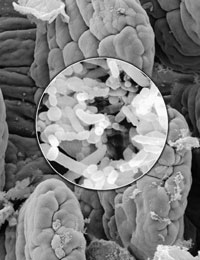
Intestine and gut microbeThere’s a good short piece, Humans Have Ten Times More Bacteria Than Human Cells: How Do Microbial Communities Affect Human Health?, in Science Daily, picks up on some of the themes we discussed in The human ’super-organism.’ The overwhelming majority of cells in human bodies belongs to microbes — the article says 10 bacteria cells for every human body cell (does it make you feel tired to think how much bacteria you’re carrying around?). Recognizing that we are a shambling micro-cosmos of oraganisms (or ‘microbiome’) suggests new understandings of all sorts of things, including disease. The Science Daily article points out that ‘changes in these microbial communities may be responsible for digestive disorders, skin diseases, gum disease and even obesity.’

There’s one passage in particular that I thought was worth posting, even if I don’t have too much to add:

“This could be the basis of a whole new way of looking at disease. In order to understand how changes in normal bacterial populations affect or are affected by disease we first have to establish what normal is or if normal even exists,” says Margaret McFall Ngai of the University of Wisconsin, Madison.

The microbiome research is particularly interesting to us at Neuroanthropology, even though it’s not strictly about the brain or nervous system, because it’s a particular compelling demonstration that the human body is a dynamic system; that is, the body is a system of different forces and processes, at a number of scales, that together continually produce the whole, sometimes in equilibrium and sometimes in ways that produce dysfunction.

Continue reading “More on the human ‘super-organism’”