Brain TV and Online 3D Images

University of California at San Diego has a webcast series, Grey Matters: From Molecules to Mind, with lectures by leading neuroscience researchers.  Topics include decision making, brain development, addiction and more.
Hat Tip: Neurophilosophy

The Visible Body is an on-line 3D guide to anatomy.  You can focus in on particular structures, including the brain, and rotate them at your convenience.  Great guide and it’s free if you sign up on the Argosy website. 
Hat Tip: Neurophilosophy

Brain Place is an online resource focused on SPECT imaging: single photon emission computed tomography.  You get 3D images that you can rotate—sort of 3D x-rays.  Good for tracking global changes, for example, with substance abuse due to changes in blood flow or glucose utilization.  Some striking images of “holes” in the brain due to tumors or drug abuse. 
Hat Tip: My Students
 

Blatant plug: new book, Brain Rules, by John Medina

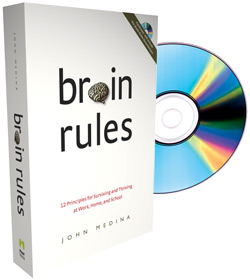
book_dvd.jpgThe publisher of John Medina’s new book, Brain Rules: 12 Principles for Surviving and Thriving at Work, Home, and School, sent me an email saying that the book might be appropriate for Neuroanthropology. Normally, I wouldn’t plug something I haven’t yet read (and you can be confident that the publisher didn’t bribe me with a review copy, as I don’t have a copy… yet…), but I thought that the website in support of the book itself was worth a look.

The website contains a wealth of Flash-based audio-visual elements from the book, bibliography, graphics, and a host of other resources. I’m struck by several things about it; first, Medina is very savvy — he’s pitched this book brilliantly for a general audience. I don’t mean that as a backhanded compliment; in fact, it’s something that I aspire to in my own writing, and it’s educational to see such a good practitioner. Second, he’s done a great job of distilling some complicated ideas into bullet-point amenable, succinct statements. This sort of nested complexity (because there is more when one scratches the surface) is going to be a hallmark of neuroanthropological work, as we’re going to have to be able to write on several levels at once if we’re to persuade both specialists in the areas we’re writing about and other, non-specialists. For example, if I’m going to discuss brain modularity and it’s relationship to cultural theory, I’m going to have to be able to come up with compelling glosses for very complex research (to appeal to those more interested in cultural theory than modularity, but also vice versa), and deeper explanation so that I don’t get off-sides with the specialists.

Finally, I’m just amazed at the media support for the book — it’s excellent. As a former design ‘consultant,’ I just dig deeply the richness of the website and accompanying material. For example, there’s clever little bits of Medina giving audio versions of some of the book’s main points, but they’re much slicker and better produced than the usual head-on or 45-degree-to-the-side, video-camera-on-tripod, wide-angle-to-catch-powerpoints-and-speaker footage. He comes across as profoundly and engaging and funny. Frankly, he’s providing a really accessible counter-point to some of the simplistic ‘public intellectual’ versions of the brain sciences that we rail against frequently. For those of you with better access to well-stocked bookstores, you might want to check it out.

Social Entrepreneurship

David Brooks has an editorial today, Thoroughly Modern Do-Gooders, about how rich entrepreneurs like Bill Gates and Bill Drayton are turning to philanthropy and social change through a decidedly different model than a generation ago.  The old model?  “The older do-gooders had a certain policy model: government identifies a problem. Really smart people design a program. A cabinet department in a big building administers it.” 

The new do-gooders come with a different view: “[They] have absorbed the disappointments of the past decades. They have a much more decentralized worldview. They don’t believe government on its own can be innovative. A thousand different private groups have to try new things. Then we measure to see what works.” 

Brooks points to the central problem of scalability.  “How do the social entrepreneurs replicate successful programs so that they can be big enough to make a national difference?”  In my classes and talks, I often call this the franchise model, the McDonalds of social change. 

The central assumption is still the “we can drive change” model—through knowledge, market forces, financing and scientific evidence, we can “rebuild him”—we can make a Six Million Dollar Man out of a broken social body, one involved in a terrible accident of history.  It is rather like my critique of behavioral economics in Decision Making and Emotion.  A definite step forward, but leaving too many things out.  It’s still all about the program, not the social context, not the relationships, not the world view, say of black versus white, that might also impact social change.  Find the right techniques, and we can change the world.

Continue reading “Social Entrepreneurship”

Autoimmune epidemic

I’m afraid I don’t have much interesting to say about this link, but I just can’t scrape my jaw off the floor. There’s a story on Alternet about the incidence of autoimmune disorders, The Autoimmune Epidemic: Bodies Gone Haywire in a World out of Balance. I’m simply floored by some of the accounts, the numbers, and the whole phenomenon. I wish I had something to add, but I thought the least I could do was point out the story to some of our readers.

The autoimmune system is of special interest to those of us concerned about how environmental factors affect the development of organisms, including humans, because it is one of the clear cases of a system that gets substantial input from the environment to accomplish basic functions. We also find that it offers all sorts of interesting examples of non-genetic forms of heredity, including influences in utero and the widely-recognized importance of breast feeding for shaping the immune system. Less widely understood are the effects of changing environment on immune system functions in things like allergies.

Continue reading “Autoimmune epidemic”

Obama and Race

The importance of history, the role of our own personal lives, a recognition of the power of our ideas and the stains of our faults, the emphasis on the strength of both inequality and hope.  Barack Obama’s speech on race in the United States, on the terrible patterns of the past and the foundational hopes and ideas of this nation, embodies much that I have found in trying to understand people’s lives on their own terms, those lives as both driving the same repeating patterns and offering the possibility of change. 

It was luck that I had decided to post a series on race today, and Obama’s speech, and the array of reactions today, were more than worthy inclusions—they were necessary.  Obama captures the movement towards a new way of managing our problems, of integration and reconciliation, of the best ideas presented clearly rather than as decisions hidden behind the doors of power.  Oh, he is a hard-core democrat, and I have as much cynicism about the possibility of our government working towards change.  History provides both lessons, of tragedy and triumph, and always at a cost.  And yet… 

Obama is reflexive, he sees the limits of knowledge, he sees the value of emotion as well as reason, he can judge vociferous ideas and statements but still cherish a person, he draws on his own experience to think about the larger lessons.  He is, as he says, against our continued tendency to “simplify and stereotype and amplify the negative to the point that it distorts reality.”  We simplify politics, we simplify brain biology, we simplify anthropology—and thus distort our engagement with our own larger reality.

Race is about that distortion, and using that distortion to justify the discrimination Obama so eloquently argues against.  It is an old theme in anthropology, the theme that really founded the field in the United States.  There is no manifest destiny in our biology; we forge it, for ourselves and too often against others.  It is time to turn the page, both back to our foundational moments and forward to what we can now do.