Catching Happiness: Christakis and Fowler and the Social Contagion of Behaviors

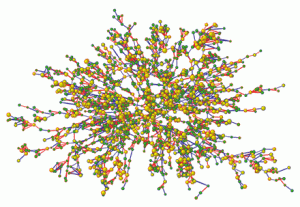
Christakis & Fowler Obesity Network

“Is Happiness Catching?” is the feature article in this week’s New York Times Magazine. Clive Thompson writes about the Framingham Heart Study, which has followed 15,000 people starting back in 1948. Originally framed as a study of physical disease, the data are now being turned to social ends.

Nicholas Christakis, a medical sociologist and doctor at Harvard, and James Fowler, a political scientist at UC San Diego, have taken this data set to examine a question that dates back to Durkheim and his ideas about collective effervescence, anomie, and suicide – how do our social relationships affect what we experience and do? As Thompson frames it:

By analyzing the Framingham data, Christakis and Fowler say, they have for the first time found some solid basis for a potentially powerful theory in epidemiology: that good behaviors — like quitting smoking or staying slender or being happy — pass from friend to friend almost as if they were contagious viruses. The Framingham participants, the data suggested, influenced one another’s health just by socializing. And the same was true of bad behaviors — clusters of friends appeared to “infect” each other with obesity, unhappiness and smoking. Staying healthy isn’t just a matter of your genes and your diet, it seems. Good health is also a product, in part, of your sheer proximity to other healthy people.

Their research shows that common explanations for problem behavior, such as individual being at fault or peer pressure, are inadequate. What we experience and how we act spreads further than we think. Take a major illness affecting a mother late in life, and the strain and stress her daughter experiences caring for her mother. That strain can affect the daughter’s husband, who in turn shapes his friend’s life.

Christakis saw this through his clinical experience, and with Fowler, decided to study the impact of social networks. One of their main findings is that in the Framinghamn study, “drinking spread socially, as did happiness and even loneliness. And in each case one’s individual influence stretched out three degrees before it faded out. They termed this the ‘three degrees of influence’ rule about human behavior: We are tied not just to those around us, but to others in a web that stretches farther than we know.”

When a Framingham resident became obese, his or her friends were 57 percent more likely to become obese, too. Even more astonishing to Christakis and Fowler was the fact that the effect didn’t stop there. In fact, it appeared to skip links. A Framingham resident was roughly 20 percent more likely to become obese if the friend of a friend became obese — even if the connecting friend didn’t put on a single pound. Indeed, a person’s risk of obesity went up about 10 percent even if a friend of a friend of a friend gained weight.

Christakis and Fowler’s work provides an in-depth description of the functioning of social networks – not a examination of why loneliness spreads so much as an examination of how it does. In other words, there is not a theory of social contagion of behaviors, but an examination of the role of social networks in loneliness. As they write in an in-press paper co-authored with John Cacioppo:

Results indicated that loneliness occurs in clusters within social networks, extends up to three degrees of separation, and is disproportionately represented at the periphery of social networks. In addition, loneliness appears to spread through a contagious process even though lonely individuals are moved closer to the edge of social networks over time. The spread of loneliness was found to be stronger than the spread of perceived social connections, stronger for friends than family members, and stronger for women than for men.

Continue reading “Catching Happiness: Christakis and Fowler and the Social Contagion of Behaviors”
Gravlee et al: Race, Genetics, Social Inequality, and Health

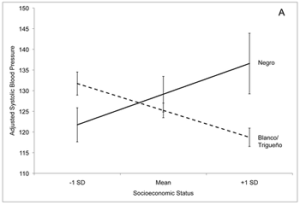
Color SES SBP
Clarence Gravlee, Amy Non and Connie Mulligan have just published an outstanding article in PLoS ONE, Genetic Ancestry, Social Classification, and Racial Inequalities in Blood Pressure in Southeastern Puerto Rico. The abstract opens:

The role of race in human genetics and biomedical research is among the most contested issues in science. Much debate centers on the relative importance of genetic versus sociocultural factors in explaining racial inequalities in health. However, few studies integrate genetic and sociocultural data to test competing explanations directly.

Note how that fits so well into the points just made in Nature/Nurture: Slash to the Rescue. But Gravlee, Non and Mulligan don’t just say we need to overcome the nature vs. nurture dichotomy, they do research that bridges it and even better, test ideas on both sides: “We draw on ethnographic, epidemiologic, and genetic data collected in southeastern Puerto Rico to isolate two distinct variables for which race is often used as a proxy: genetic ancestry versus social classification.”

This type of collaborative research can be crucial to getting the data to answer complicated questions. Connie Mulligan and Lance Gravlee deserve credit for taking the time to discuss how to bring together their respective approaches before going out to do research. In this case, the data come down more on the nurture (or social) side. As they write:

Our preliminary results provide the most direct evidence to date that previously reported associations between genetic ancestry and health may be attributable to sociocultural factors related to race and racism, rather than to functional genetic differences between racially defined groups.

Before someone gets all hot and bothered, Lance has also shown how to bring nurture back to nature. In Gravlee’s recent paper, How Race Becomes Biology: Embodiment of Social Inequality (pdf), he gives us following: “Drawing on recent developments in neighboring disciplines, I present a model for explaining how racial inequality becomes embodied – literally – in the biological well-being of racialized groups and individuals. This model requires a shift in the way we articulate the critique of race as bad biology.”

In the PLoS paper, Lance, Amy and Connie are aiming squarely at the use of race in medicine, where it has become common in some circles to use racial classification as a proxy for genetics. Basically this research destroys the proxy notion, since social classification turns out to be a better predictor of blood pressure than genetic ancestry.

Continue reading “Gravlee et al: Race, Genetics, Social Inequality, and Health”

Four Stone @ Ad

fourstonecomplete
Ad Hominin is hosting the anthropology carnival Four Stone Hearth #75. Ciaran Brewster has done an outstanding job putting together a carnival that covers the breadth and depth of anthropology.

From hand axes to fossils for all, focused gathering in teaching to design thinking, a review of the book Engaging Anthropology and debunking the idea that culture simply overrides biology, this anthropology carnival is a stand-out edition. Ciaran even includes a magical Flickr photostream that I encourage people to check out right at the bottom.

For lots more great stuff, head over to Four Stone Hearth #75.

Sex on the brain & neuroanthropology on sex

brainonsexI promised my Human Evolution students that I would compile a sort of ‘collected works’ posting on our discussions of sex and evolution here at Neuroanthropology.net. I’m a bit frightened to see just how much we talk about it, but here goes anyway…

Over our time at Neuroanthropology.net, there have been a few of posts on abuses of ‘evolutionary psychology’ in its popular incarnations. I suspect that these would be among the most relevant for my students in ‘Human evolution and diversity’: Chicks dig jerks?: Evolutionary psych on sex #1, Girls gone guilty: Evolutionary psych on sex #2, along with Bad brain science: Boobs caused subprime crisis.

Lecture yesterday and tutorial today covered quite a bit about sexual dimorphism and, at the same time, the homologies between men and women. For one take on this, and on how culture can affect the physiological development of gender traits, check our Throwing like a girl(’s brain).

A while ago, probably under the influence of last year’s lecture, I also posted a sprawling piece Neurosexism, size dimorphism and not-so-’hard-wiring’.

If you still haven’t had enough about sex, check out Daniel’s compilation of all sorts of links: The Sex Round Up.

Paul Mason provides a discussion of the Sex and Gender distinction along with a whole series of relevant online resources.

And our most recent discussion of a most egregious attempt to do research on slash fan fiction, alleging that these works exposed the ‘evolutionary roots’ of sexuality. The series has run onto three posts so far: Sex, Lies and IRB Tape: Netporn to SurveyFail, SurveyFail redax: Downey adds to Lende, and Nature/Nurture: Slash To The Rescue.

Wednesday Round Up #80

Wednesdays this semester are busy. Yesterday it was teaching two classes, office hours, meeting with a thesis student, a reception, and then school information night. Not a lot of time in there for this…

Top of the List

Rex @ Savage Minds, Anthropology, ‘Internet Addiction’, and Care
World of Warcraft and thinking through addiction, treatment, and engagement. A most worthy read.

Keith Oatley, Changing Our Minds… by Reading Fiction
Reading fiction “measurably enhances our abilities to empathize with other people and connect with something larger than ourselves.”

Neededalj, Recognizing and Responding to Legitimate and Illegitimate Researchers
A guide to recognizing good researchers and research, in response to the SurveyFail debacle

The Neurocritic, Rule 34: What Netporn Tells Us about the Brain
The Neurocritic also covers SurveyFail and the Ogas/Gaddam debacle – sorry for not catching that earlier in the week! As always, great coverage, including Ogas playing Who Wants To Be A Millionnaire? and of course some great visuals

Sharon Begley, Pink Brain, Blue Brain: Claims of Sex Differences Fall Apart
“Why parents may cause gender differences in kids” – a Newsweek piece

E. Blair Bolles, Three Years On: Voluntary Redirection of Attention
Babel’s Dawn hits three years of exploring language and language evolution, and Blair reflects on one of his main insights, that humans can voluntarily redirect attention and that this supports language use

Francisco Ortega & Fernando Vidal, Mapping the Cerebral Subject in Contemporary Culture
Online paper outlining much of the Brainhood project: “The ‘cerebral subject’ refers to the anthropological figure that embodies the belief that human beings are essentially reducible to their brains. Our focus is on the discourses, images and practices that might globally be designated as ‘neuroculture’.”
The paper can’t be accessed directly, so click on Online Texts on the left hand side. Mapping the cerebral subject is the first paper listed.

Anthropology

Rebecca Atwood, Institutions Slap Down Those Who Speak Up, Argues Campaigning Scholar
Public anthropology and Nancy Scheper-Hughes, via Times Higher Education

Continue reading “Wednesday Round Up #80”

Nature/Nurture: Slash To The Rescue

Slash is cool – creative writing, community, and alternative imaginations all wrapped in one. Like I said at the end of my post Sex, Lies and IRB Tape: Netporn to SurveyFail, if I want to understand slash, I’d read some.

And so I have, exploring recommend pieces over at Whispered Words. Cassandra Claire’s The Very Secret Diaries on the Lord of the Rings made me laugh and laugh. Greyworlf’s Kirk/Spock And In the Darkness Bind You was erotic, intense, and well-written, a classic of slash according to Whispered Words.

But today I want to expand on what I thought was a throw-away line in that post, and connect it to some of what Greg wrote about in his post on ethnography, hard-wired assumptions, and sexuality in SurveyFail Redax. (For more on SurveyFail, see Rough Theory; you can also follow the controversy in more detail through the links rounded up at Anti-Oppression Linkspam Community.)

The throw-away line was this: “But nature/nurture is dead (except perhaps in slash?).”

Today I am making it the punchline. Slash can save the day for nature/nurture.

Nature versus nurture refers to the debate of genes versus environment, human nature versus culture, of our animal side versus our civilized side, and so forth. As Greg said, it’s a very old theme in Western thought. In SurveyFail, Ogi Ogas and Sai Gaddam operated from a restricted and dichotomized view of nature versus nurture, where nature, dictated by evolution and primitive brain circuits, dictate sex differences and sexual interests. Here’s how Greg put it:

In their responses to some of their critics, Gaddam offers the blanket explanation that, ‘When we talk about the ‘oldest parts of the brain’ [the subcortical regions], it is in the context of the tectonic tussle between these and the prefrontal cortices that give rise to the peaks of our culture and the terrain of our behavior.’ Daniel points out that Gaddam describes an opposition in the brain between the ‘oldest’ pre-cultural, primitive elements and these newer cortices that produce culture; nature v. culture played out in brain layers.

Slash can change that. Not by having nature and nurture meet in a bar (though if someone knows some slash on that, by all means leave a comment!), but in how slash works as an imaginative process.

Quite simply, nature vs. nurture is an oppressive division. Slash reworks the relationship between nature/nurture in ways that help us in our thinking and that are closer to the actual reality of how nature/nurture works.

Continue reading “Nature/Nurture: Slash To The Rescue”