Thinking through Claude Lévi-Strauss

Clevistrauss
Claude Lévi-Strauss, 1908-2009

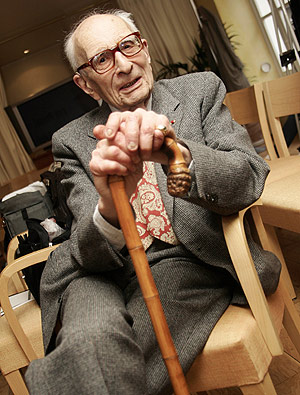
Claude Lévi-Strauss, one of the true giants of anthropology, passed away this past week on 30 October, just shy of 101 years old.

As Maurice Bloch writes, Lévi-Strauss was ‘the last survivor of these great beasts such as Sartre, Foucault and the sociologist Pierre Bourdieu,’ the theorists who have given contemporary anthropology, and social theory around the world, a French accent and Gallic cadence.

Excellent obituaries appeared in a number of places, two of my favourites being the one by Bloch in The Guardian, and another by Edward Rothstein in The New York Times (thanks, Jovan!).

I’m not going to retread the substance of these obituaries, nor will I repeat what was better (and more quickly) written by other commentators online such as Rex at Savage Minds, Marshall Sahlins at the AAA website (for the 100th birthday), Richard Price, a student of Lévi-Strauss, and Robert Mackey at the NYTimes website, The influence of Claude Lévi-Strauss (a piece that links to a number of video clips in English and French, including interviews with other scholars). Instead, I’m going to write briefly about the relation of Lévi-Strauss to the study of brain and culture from my perspective.

I’ve been wanting to write a post on Lévi-Strauss for a while, and even started it once, because I’ve been grappling with the question about how neuroanthropology aspires to produce theoretical and empirical projects that are distinct from what is typically called ‘cognitive anthropology.’ Lévi-Strauss’ work is crucial to the foundation of cognitive anthropology, as a range of authors have argued (see Sperber 2008, for example), so he’s a critical point of departure for neuroanthropology.

Although I admire Lévi-Strauss, and I’m perfectly content to be considered close classificatory kin to cognitive anthropology, there are some characteristics of Lévi-Strauss’s thought, structuralism (the theoretical school Lévi-Strauss dominated, but which did not encompass all of his work [see Doja 2008]), and contemporary cognitive anthropology with which I fundamentally disagree. So although this post is written in respect, it has elements of opposition, perhaps even the false binarism that arises whenever one is trying to highlight distinctiveness in the midst of significant overlap. Beware the theoretical belligerence of small difference!
Continue reading “Thinking through Claude Lévi-Strauss”

Four Stone 79

fourstonecomplete
Four Stone Hearth, the anthropology carnival bringing together all things four-field, is now up in its 79th edition over at Anthropology.net. Thanks, Tim, for putting this one together on short notice!

Some really intriguing data and ideas about female choice and sexual strategies among chimps, which are rightly highlighted right at the top.

Good stuff on Ardipithecus, Bluestonehenge, and plenty more.

Enjoy Four Stone Hearth #79.

Second annual Neuroscience Boot Camp wants you!

recruits
Not your grandad's boot camp!

Applications are now being accepted for the 2010 Neuroscience Boot Camp at the University of Pennsylvania. For more information, head on over to the Boot Camp website.

Kezia Kamentz dropped me an email and shared that last year’s Boot Camp went really well: “great teachers, a small but very diverse group of students, and a varied set of teaching methods.” Kezia said that they would love to have some anthropologists on board, and I know that there’s a few of you out there. Kezia writes:

Through a combination of lectures, break-out groups, panel discussions and laboratory visits, Boot Camp participants will gain an understanding of the methods of neuroscience and key findings on the cognitive and social-emotional functions of the brain, lifespan development and disorders of brain function. Like last year’s faculty, the 2010 Boot Camp faculty consists of leaders in the fields of cognitive and affective neuroscience who are committed to the goal of educating non-neuroscientists.

For more information.

Wednesday Round Up #88

A busy week – but now you can peruse some economics, war, NY Times mind, anthro, and blogging mind.

Top of the List

Sandra Kiume, Social Neuroscience
Channel N gives us a great video with John Cacioppo speaking on “Connected Minds: Loneliness, Social Brains and the Need for Community.” Sometimes Channel N didn’t load right for me, so you can also go straight to the RSA page with the Cacioppo video.

Ed Yong, Holy Fellatio, Batman! Fruit Bats Use Oral Sex to Prolong Actual Sex
What a title! Just wait until you see the video.

David Dobbs, “YouTube! That’s Why I Became A Writer!”
Very funny video about a writer talking with his agent about how to promote his new book

Dan Sperber, Grieving Animals
An amazing photo of chimpanzees, and a big question about culture among our primate relatives

Economics and Neuroanthropology

Simeleon Sense, Video: Bribing vs. signalling – Marketplace Dept. of Behavioral Economics
Funny video – surviving the cubicle during the downturn, as seen through the eyes of a nature documentary

Sean Mallin, PBR and “Hip” Consumption
Pabst Blue Ribbon flies under the advertising radar, and builds a niche market during the economic downturn

Continue reading “Wednesday Round Up #88”

The Uncultured Project

The Uncultured Project is about fighting global poverty, about one man’s decision to try and make the world a better place. It’s a story told through a website and promoted on YouTube.

Imagine leaving behind your friends, family, possessions, and a full scholarship to a good university – all to go halfway around the world to a third world country just to help the poor.

This is exactly what I did.

And I’m using YouTube to tell my story.

Continue reading “The Uncultured Project”