How would you complete this quote?
“Emotional expressions are crucial to…”
Continue reading “Complete this quote: “Emotional expressions are crucial to…””

How would you complete this quote?
“Emotional expressions are crucial to…”
Continue reading “Complete this quote: “Emotional expressions are crucial to…””
I’m hoping this is the last of the recent Thursday editions – the end of the semester is getting close, and with it the heavy teaching load I’ve had on Mondays and Wednesdays. But onto the round up – it’s free will, climate change, mind and anthropology this week.
Top of the List
Gretchen Reynolds, Phys Ed: Why Exercise Makes You Less Anxious
Very cool – exercise prepares the brain to deal with stress. Is this the new version of no pain, no gain?
Carlos Reynoso, Ciencia Cognitiva y Antropología del Conocimiento
The summary page for a fascinating seminar on cognitive science and anthropology in Buenos Aires. Fascinating overviews, and lots to download (under Creative Commons license). Que lastima que no pude asistir.
Ed Yong, Travels with Dopamine – The Chemical That Affects How Much Pleasure We Expect
What is dopamine and how does it affect us.
Schott’s Vocab, Weekend Competition: Squiffy, Sozzled, Smashed
“This weekend, co-vocabularists are invited to share the words and phrases they use to describe being drunk, drummed, daffy, decanted, or utterly Dean Martoonied.” Some smashing entries!
Conrad Lee, Is Obesity Contagious? A Review of the Debate over “Network Effects” of Obesity
In-depth analysis and critique, particularly in terms of modeling and statistics, of the work by Nicholas Christakis and James Fowler that obesity is “contagious” and passed through social networks
Free Will
Anil Ananthaswamy, Free Will Is Not An Illusion After All
Libet’s milestone study that alleged to show free will doesn’t exist is now being challenged by new research.
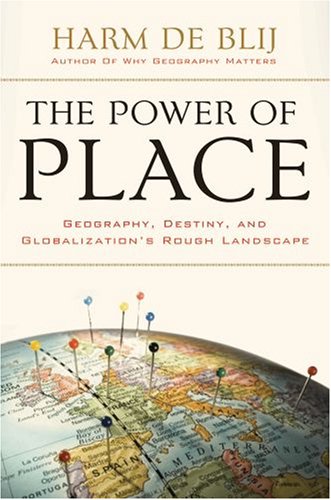 The Lancet’s recent commission on the effects of climate change on health[i] is a reliable diagnosis of pertinent contemporary issues on a global scale. One of the conclusions of this report is that “The most urgent need is to empower poor countries, and local government and local communities everywhere” (Costello et al. 2009:1728). It is a conclusion to which Human geographer Harm de Blij also leads his readers in his recent book, The Power of Place [ii] .
For provocative thought, scope, and endeavour, the book is unquestionably comparable to the works of Jared Diamond, Tim Flannery and James Lovelock. De Blij successfully, cleverly and effectively covers matters of politics, economics, climate, religion, education, human languages, natural disasters, health, gender issues, urbanization and globalization. He integrates these issues into a digestible and relevant description of contemporary cultural landscapes.
De Blij demonstrates an acute awareness of the historical context of his subject matter whilst developing his arguments. His approach to contentious issues and sensitive polemics at times may seem brash; however the treatment is conscientiously balanced, with biases explicit. It is hard to tackle these subjects dispassionately. To de Blij’s merit, he rarely extends further than an evenhanded evaluation of the data that leaves the reader reflecting if the judgment calls are not indeed fair. His ability to impartially juggle with the contingencies of cultural geography without resorting to simplified cause-and-effect rationalisations, may in fact be de Blij’s genius.
I give the book 4.5 neurons.


The following post is my first draft of a book review that has been published by Anthropology and Medicine. It includes points and viewpoints that are not necessarily academic in style, but that I would nonetheless like to share with you on this blog. I strongly reccomend readers to read both the published book review and the book, “The Power of Place”.
How would you complete this quote?

“If a meme is to dominate the attention of a human brain, it…”
The annual American Anthropological Association meeting will take place in Philadelphia from December 2nd – Dec 6th. I will put on a workshop entitled “Taking Anthropology Online: Strategies for Teaching and Scholarship” on Thursday Dec 3 from 12:00 noon to 2PM. Here’s the description:
Informants, students, communities, culture, inequality, data – all increasingly have a life online. This workshop will cover the basics of anthropology online, with a focus on content production, scholarship and teaching. Specific areas covered include: blogging, social networking, online video, podcasts and wikis.
There are still spots open for this workshop. It costs $20 for regular participants and $10 for students. If you have any questions, you can contact me (Daniel Lende) by just leaving a comment.
To see all the workshops, you can get the 2009 Workshops List here. You can register for my workshop, and any of the others, when you pick up your conference materials onsite in Philadelphia. Registration is on the 4th floor of the Philadelphia Marriott Downtown.
I’m leading off with an important set of readings on genetics in relation to neuroanthropology, including plastic genes, gene-culture interactions, and critical takes on genetics in society. Then we’ve got some other top reads, followed by a section on applied anthropology that includes a lot of pdfs you can get online. Then the mind and an anthro grab-bag to finish it off.
Genetics
David Dobbs, I’m Not Vulnerable, Just Especially Plastic. Risk Genes, Environment, and Evolution, in the Atlantic
Genes are not bad, they are just sensitive. Dobbs covers his own feature article coming out in The Atlantic, which includes a video interview with Steve Soumi and his rhesus monkeys.
William Dressler et al., Cultural Consonance, a 5HT2A Receptor Polymorphism, and Depressive Symptoms: A Longitudinal Study of Gene × Culture Interaction in Urban Brazil
Abstract for an American Journal of Human Biology 2009 article. Serotonin function and the ability to match society’s ideals create significant interactive effects, including greater depressive symptoms with individuals with a particular polymorphism. “These results are consistent with a process in which genotype moderates the effects of culturally meaningful social experience on depressive symptoms.”
Dr. X, Do Collectivist Cultures Evolve as Buffers to Psychopathology?
Looking at whether collectivist-individualist dimensions of culture coevolve with genetic peril for anxiety and mood disorders. “Here, we demonstrate for the first time a robust association between cultural values of individualism– collectivism and allelic frequency of the serotonin transporter gene, controlling for associated economic and disease factors.” You can even get the full text free online.
Surfdaddy Orca, Making a Smarter Rat
Overexpressing the NR2B gene lets brain cells communicate just a bit longer. Result: a smarter rat.
The Neurocritic, Genomarketing!
Brains are not enough. Now companies are looking at ways to target you based on genetics. Includes a great graphic: the MAOa Card.
Cesar Vallejo, Genes and Human Freedom to a Case
Why an Italian court reduced the punishment of a man found guilty of murder. So is MAOa now a get out of jail free card? Here’s the original Nature report, Lighter sentence for murderer with ‘bad genes’
Cory Doctorow, Love of Shopping is Not a Gene: Exposing Junk Science and Ideology in Darwinian Psychology
But I thought my genes made me do it.
Nicholas Wade, Speech Gene Shows Its Bossy Nature
NY Times write-up of recent results on the FOXP2 gene that has gotten so much press as the “language gene” – but this time it’s about playing around with the chimp version and considering genetic orchestration rather than cause. John Hawks also comments, and links to more reactions to the Nature article.
 Neuroanthropology