Autism and Mirror Neurons

Autism has been my latest lens for learning about neuroanthropology. It started with reading claims that autism is linked to mirror neuron disfunction. Mirror neurons are currently used to explain how the brain understands the intentions and emotions of others. Researchers suggest that lack of brain activity in mirroring areas of the brain found in autistic children could explain deficits in social interaction and empathy. A related article on the site links the mirror system to the study of culture: Culture Influences Brain Cells: Brain’s Mirror Neurons Swayed By Ethnicity And Culture. A study compared reactions of subjects to both American and Nicaraguan hand gestures, measuring differences in mirror neuron activity in the brain depending on who was giving the information and whether they were a member of their own ethnic group or a different group.

“We believe these are some of the first data to show neurobiological responses to culture-specific stimuli,” said Molnar-Szakacs. “Our data show that both ethnicity and culture interact to influence activity in the brain, specifically within the mirror neuron network involved in social communication and interaction… An important conclusion from these results is that culture has a measurable influence on our brain and, as a result, our behavior. ” “We are the heirs of communal but local traditions,” said Iacoboni. “Mirror neurons are the brain cells that help us in shaping our own culture. However, the neural mechanisms of mirroring that shape our assimilation of local traditions could also reveal other cultures, as long as such cross-cultural encounters are truly possible. All in all, our research suggests that with mirror neurons our brain mirrors people, not simply actions.”

I’m still trying to wrap my mind around this article—it seems as if it would be a given that culture impacts behavior so am not sure if they discovered something new so much as found a more scientific way of measuring it. Could this possibly be a tool that would indicate whether someone would suffer from culture shock? And linking it back to the first article, would this imply that autistic people would have equal trouble picking up on social cues regardless of who they are with while for others it would depend on whether they share the same cultural background?
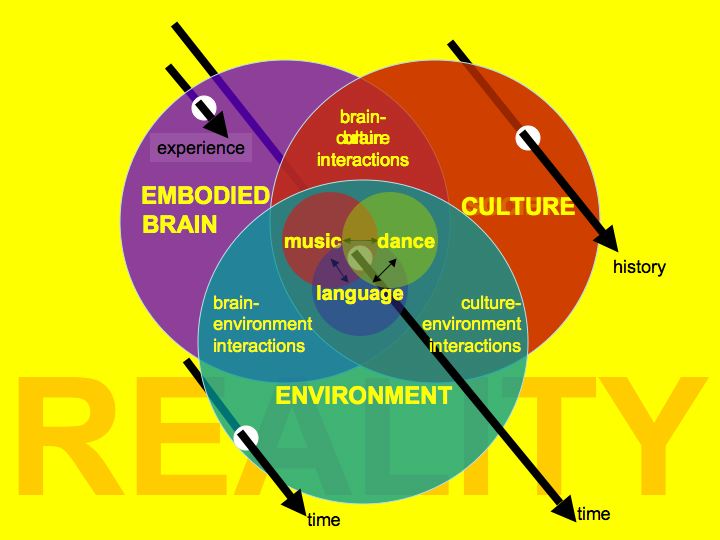
Paul Mason: Slides on Neuroanthropology

Paul Mason has sent me PowerPoint slides on Neuroanthropology that draw upon a lot of the same resources that he cited in an earlier post I put up on his behalf. Paul’s in the field in Indonesia, and he writes in sometimes from internet cafes, but we should eventually have him as a regular contributor when he’s back with some regular Internet access. And then he can also tell us more, too, about his own research.

Paul includes a number of choice quotes, but I wanted to make sure that everyone got a chance to see his diagram of a systems-based approach to ‘fight-dancing’ in cultural, biological, and ecological context (in both Indonesia and Brazil). It’s a rich diagram, and I think that we, as neuroanthropologist, will need to do a lot of complex visualization in order to make our points to a broad audience. Paul must get all the credit for this one.Mason slideIn the meantime, i don’t yet have a complete bibliography on this material, so we’ll have to get in touch with Paul if anyone really wants to get the sources he’s using. He sent this about a month ago, and I was not clear on how to post PowerPoint slides, but I think it’s pretty straightforward. We’ll see….neuroanthropology.ppt

Loneliness and Health: Experience, Stress, and Genetics

Blogging on Peer-Reviewed ResearchFeeling lonely?  Well, that might make you sick.  The mechanism?  Well, here’s the surprise.  Patterns of genetic expression.

 Here’s the press release from Genome Biology, “People who experience chronically high levels of loneliness show gene-expression patterns that differ markedly from those of people who don’t feel lonely.”  The study’s lead author, Steven Cole, notes: “In this study, changes in immune cell gene expression were specifically linked to the subjective experience of social distance.  The differences we observed were independent of other known risk factors for inflammation, such as health status, age, weight, and medication use. The changes were even independent of the objective size of a person’s social network. What counts, at the level of gene expression, is not how many people you know, it’s how many you feel really close to over time.”    Continue reading “Loneliness and Health: Experience, Stress, and Genetics”

Autism, Depression and The Body

Blogging on Peer-Reviewed ResearchMental disorders such as depression and autism are generally viewed in one of two lights, either as something neurological or something psychological.  Cultural anthropology obviously has greater affiliation with the psychological side, and biological anthropology with the neurological.  The same split is true in psychiatry, ably demonstrated by Tanya Luhrmann’s Of Two Minds, which, to radically simplify, describes the fight between talk-therapists and pharmaceutical-dispensers.  (Still, at least this anthropologist wishes Luhrmann had gone beyond ethnographic description of fields to tackle the same problem that both anthropology and psychiatry embody—bridging the nature/nurture or biology/culture split.)

 But is this way of dividing things, an enculturated mind versus an epigenetic brain, an accurate description?  Recent research suggests no. 

Continue reading “Autism, Depression and The Body”

‘Exercise’ is mindset as well as activity

Blogging on Peer-Reviewed ResearchAn article last year in Psychological Science by Alia J. Crum and Ellen J. Langer, Mind-Set Matters: Exercise and the Placebo Effect, laid out an extremely interesting example of ‘top-down’ culturo-psycho-physiological dynamics in the body from my favorite area of research: exercise and sports.  Crum and Langer looked at a group of 84 hotel room keepers.  From the abstract:

Those in the informed condition were told that the work they do (cleaning hotel rooms) is good exercise and satisfies the Surgeon General’s recommendations for an active lifestyle. Examples of how their work was exercise were provided. Subjects in the control group were not given this information. Although actual behavior did not change, 4 weeks after the intervention, the informed group perceived themselves to be getting significantly more exercise than before. 

If this were the only finding, there wouldn’t be too much news here.  But the change in understanding of what they were doing also had physical effects on the room attendants, including, in addition to changed impressions, an average weight loss of 2 pounds, decrease in systolic blood pressure of 10 points, and positive effects on body mass and heart rates — in only 4 weeks with NO change in the actual activity level.  Becoming convinced that they were getting enough exercise or engaged in adequate activity to promote health helped their background activity to affect their physiology.  Exercise was not just a physical activity, it was also a state of mind (more accurately, without the ‘state of mind’ activity didn’t have the effects of ‘exercise’).  (This research is also discussed in an article in The New York Times.) 

Continue reading “‘Exercise’ is mindset as well as activity”