More on persuasive, irrelevant ‘neuroscience’

Continuing on the subject from my previous post, Mark Liberman has a nifty little post on ‘The Functional Neuroanatomy of Science Journalism’ on the blog, Language Log (tip of the hat to Coturnix at A Blog Around the Clock for alerting me to this one). Liberman points out some of the same things that I argued in the previous post, but he also brings in a very careful reading of a number of recent pieces in the press that attracted quite a bit of attention while really offering very little in the way of something new, except for the Unexpected Flavor of Neuroscience to spice things up!

One of the pieces that Liberman discusses is an article on the ‘hard-wiring’ of maternal instincts that Daniel explored in an earlier post, ‘Headline: Maternal Instinct Is Wired Into The Brain.’ Liberman nominates the original article by Tara Parker-Pope of The New York Times as an example of what he believes is a leading candidate for the ‘Most Pernicious Science Narrative of the Decade’:

1. Consider the hypothesis that (Stereotypical-Observation-X-About-People).
2. Brain Researcher Y used fMRI to show that (some experimental proxy for) X is (somewhat) true. Now we know!
3a. Optional bonus #1: Now we know why! It happens (somewhere) in the brain!
3b: Optional bonus #2: This shows that X is hard-wired and biological, not all soft and socially constructed.

Continue reading “More on persuasive, irrelevant ‘neuroscience’”

Deep Capture and The Situationist

The Situationist has a nine-part series on “Deep Capture”, the hypothesis that “there will be a competition over the situation (including the way we think) to influence the behavior of individuals and institutions and that those individuals, groups, entities, or institutions that are most powerful will win that competition.”   

Jon Hanson and David Yosifon lay out their theory most explicitly in Part VI.  (For those of you interested in the most recent post, which contains links to the earlier posts, here it is.)  They write, “[T]oday we have an extremely powerful institutional force with an immense stake in maintaining, and an ability to maintain, a false, though intuitive, worldview. Our basic hypothesis (and prediction) is that large commercial interests act (and will continue to act) to capture the situation–[both] interior and exterior–in order to further entrench dispositionism. Moreover, they have done so largely undetected, and without much in the way of conscious awareness or collaboration. Hence, large corporate interests have, through disproportionate ability to control and manipulate our exterior and interior situations, deeply captured our world.” 

For example, most public situations are defined through a “pro-commercial disposition,” favoring pro-business views as an “obvious truth.”  Or, to take a comment in another post on The Situationist website, The Disposition Is Weaker Than The Situation, in the US we favor an individual-oriented disposition through “attributing solely to people’s disposition what should be attributed significantly to the their situation. ‘Tough on crime,’ for instance, means ‘tough on criminals,’ not tough on the situations that tend to produce criminal behavior. ‘Personal responsibility’ means attributing personal bankruptcies to the flawed choices of those declaring bankruptcy and disregarding, say, the unexpected medical costs or layoffs experienced by families trying to make ends meet. ‘Common sense’ means blaming the obesity epidemic on the laziness and bad food choices on the part of the obese and dismissing any role that situational forces might have played.” 

Much of their proposal is about getting both everyday people and academics to stop being so naïve, to stop believing that most of the players in any given situation have a commitment to some larger “truth.”  They don’t.  As Hanson and Yosifon write in their first post, academic economists came to this realization after “two centuries” of seeing their best work ignored by politicians.  They had bought into the assumption that governments were about public welfare, and not about power, particular the monopoly and use of violence and having control over the redistribution of resources.  To be honest, I think most anthropologists still have this naïve orientation about “policy,” even as we are critical of those in power and often spend time trying to give voice to those who rarely have it in today’s world. 

In the end, it’s quite an interesting hypothesis, simply because it forces us to think differently about any given situation.  Who’s trying to control a situation?  How do they use our dispositions against us?  It’s a rather clever reduction of both inequality and cultural theory, of focusing on how power works and on how culture works at the same time. I might like to see some broader considerations of how culture/power come together, like I briefly outlined in the post Prison Nation, or with dispositions, how context, symbolism and neuropsychology come together, as Greg discussed in What’s The “Culture” in Neuroanthropology.  But Hanson and Yosifon present a lot of interesting considerations over the breadth of their series.

‘Neuroscience’ persuasive, even when irrelevant

Cognitive Daily, one of my favorite websites, has a great piece on a study that examined whether or not people find references to brain areas ‘lighting up’ in neuroimaging (one of my least favorite expressions) and other neuro-speak more persuasive than plain old psychology articles. The piece is titled, ‘When we see a brain “light up,” [most of] our brains shut off.’ Author Dave Munger reports that he originally found out about the research through an online article in Seed Magazine (available here) (I hope I’m not inadvertently misrepresenting anything Munger has written…). The newly published study, ‘The Seductive Allure of Neuroscience Explanations,’ has appeared in the Journal of Cognitive Science (abstract here).

The study set out to find whether or not a bit of neuroscience-speak can persuade people, even when explanations are bad: ‘Explanations of psychological phenomena seem to generate more public interest when they contain neuroscientific information. Even irrelevant neuroscience information in an explanation of a psychological phenomenon may interfere with people’s abilities to critically consider the underlying logic of this explanation’ (from the abstract). The crucial part of this is that, according to experts, the neuroscience in the experimental passages was irrelevant to whether or not the argument being advanced was valid or not.

Munger describes the original study as finding, not that neuroscience is always more persuasive than psychological explanation, but that neuroscience makes bad explanations more persuasive. He explains:

While there was no significant difference in the results for good explanations, people rated the bad explanations significantly better when they included irrelevant neuroscience. The team repeated the experiment on college undergraduates who were enrolled in an introductory neuroscience class, and the results were similar, both at the beginning and the end of the semester. The students actually rated all the explanations significantly better when neuroscience was included, whether or not the explanations themselves were good.

Continue reading “‘Neuroscience’ persuasive, even when irrelevant”

Trust your hand, not your eyes

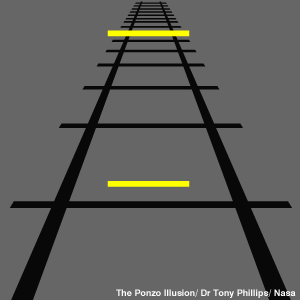
Blogging on Peer-Reviewed ResearchDaniel forwarded me a link to the story, The Hand Can’t Be Fooled, Study Shows, from Science Daily. The story is a short piece about research by Ben-Gurion University of the Negev Psychologist Tzvi Ganel and his colleagues on how the “Ponzo” illusion affects visual perception. The “Ponzo” illusion occurs when two equal line segments appear to be of different lengths because they are superimposed on a pair of converging lines; like two lines hovering over train-tracks disappearing into the distance appear to be of different lengths, as you can see from this illustration I took from the BBC. Ponzo illusion

Ganel and his colleagues ‘hooked participants’ index finger and thumb to computerized position tracking equipment and asked them to grasp the objects with their fingers. Even thought the object appeared to be larger (or smaller) than it really was, the size of their grasp reflected the object’s real rather than apparent size. For good measure, the researchers arranged the illusion so that the object that appeared to be the smaller of the two was actually the larger of the two.’

Ganel argues that the experiment provides compelling support for the ‘two visual systems’ hypothesis put forward by Mel Goodale and David Milner about a decade ago (see Goodale and Milner 1992; Milner and Goodale 1995; for an overview, see Goodale and Humphrey 2001). According to Goodale and Milner, one visual system processes input for object and color recognition, recognizes objects no matter what the perspective of the viewer, and uses conscious parts of the brain; another visual system judges spaces, movement and object trajectories in egocentric space in order to control body movement, and does not necessarily access conscious thought. I’ve written about the two visual systems hypothesis elsewhere in a book chapter that just came out (Downey 2008), so Daniel probably recognized that I’m a bit of a fan of the ‘tectopulvinar’ (motion control) visual system. (For a quick overview of the two systems, this is a good set of diagrams and explanation.)

Continue reading “Trust your hand, not your eyes”

Wednesday Round Up #2

On Brains

Susan Greenfield, Bewitched by Bacchae
Meaning, neuronal connections, and Euripides—perfect!

Robert Krulwich and Jad Abumrad, Radio Lab: Into the Brain of a Liar
How big was your fish?  Big-time liars have “more connections in the part of their brains responsible for complex thinking”

Charles Choi, Tiny Brain-Like Computer Created
This chip has dendrites!

Lauran Neergard, Study: Creativity Jazzes Your Brain
Stick a keyboard and a jazz musician in an fMRI, and this is what you get

The Internet

Gamespot, Study Uncovers MMORPG Gender-Swapping Epidemic
“54 percent of all males and 68 percent of all females “gender swap”–or create online personas of their opposite sex”

David Pogue, How Dangerous Is the Internet for Children?
Not as dangerous as the media sometimes says.  Surprise, the context of how you manage the Internet and your children at home makes a big difference in how they interpret what’s online

General Interest

Penepole Green, What’s In a Chair?
Psychiatrists’ offices matter!

Also see Vaughan’s take on this article at Mind Hacks

Nicholas Cristakis, Social Networks Are Like The Eye
The dynamics of social networks

Kevin Lewis, Uncommon Knowledge: Surprising Insights from the Social Sciences
The Boston Globe’s own round up

Continue reading “Wednesday Round Up #2”

Glucose, Self Control and Evolution

Galliott et al. published a 2007 article entitled “Self Control Relies on Glucose as an Energy Source: Willpower Is More Than Self Control” (pdf here). Recently Vaughan at Mind Hacks and Dave at Cognitive Daily have taken up the topic with some creative posts.  Vaughan writes that Resisting Temptation Is Energy Intensive, focusing on the role of attention and the prefrontal cortices.  Dave posts on Practicing Self-Control Takes Real Energy, and includes a recreation of the research procedure (with video) and an informative summary.  I also mentioned some of this research in a previous post on Willpower as Mental Muscle.

What I want to add today is that this sort of research has implications for our understanding of brain evolution and for social problems like obesity and addiction.  Focusing attention and using one part of your brain against another part, that takes significant energy.  The brain is already our most energy-intensive organ, so adding the demands of “self control” on top of that is likely to have presented some adaptive issues in the past.  Put differently, it’s unlikely to expect that we’ve evolved to be able to maintain self control over extremely long periods of time (say, months), simply because such problems rarely presented themselves in the past (there were few adaptive benefits) and because the energetic costs of doing so would have been quite high.

Diets are often marked by periods of effortful weight loss, followed by a slide back, where weight is regained.  That pattern is not simply a matter of mind over matter, of willpower so we can match a cultural and cognitive ideal.  It’s hard for people to maintain sustained mental efforts, it costs energy, and there’s little evolutionary reason to expect everybody’s brains to suddenly begin cooperating with what our culture tells us we should be able to do.