
A Hot Cup of Joe is hosting the latest anthropology Four Stone Hearth carnival. It’s hot! It’s caffeinated! It’s some good anthropology.
Wednesday Round Up #28
This week it’s anthropology, the brain, HIV/AIDS, and some integrative interactions. Enjoy!
Anthropology
Paul Mason, Passion for Research and Music Combined
Our own Paul writes in the Macquarie Globe about his interdisciplinary interests. Includes this photo if you want to get a look at the man!
The Evolving Mind, Gaps in the Brain and Jack of Many Trades
Plasticity meets the Swiss army knife metaphor: ‘Any blade currently manifest, endowed in us by “nature,” is one nurture has extended.” For more, see a follow-up post on the creative confines of nature.
Mark Liberman, David Brooks, Social Psychologist
Language Log takes down Brooks’ facile “collectivist mentality” op-ed
Mark Liberman, One Question, Two Answers, Three Interpretations
Language Log turns from Brooks to David Nisbett’s research on US/East Asian differences, as well as James Flynn’s work on the social rise in IQ test scores
Science Daily, New Evidence Debunks ‘Stupid’ Neanderthal Myth
Recreating stone tools—were Neanderthal tools simpler to make? Not to modern hands at least
NPR, The Science of Getting a ‘Yes’
Social psychology and persuasion
Wray Herbert, Brrr, It’s Lonely Out There
Metaphor, meaning and basic perceptions
Clive Thompson, Brave New World of Digital Intimacy
NY Times Magazine on social networking and our changing forms of intimacy. Mind Hacks discusses the article here.
Brains
Neuronism, Dendritic Plasticity and ‘Input Feature Storage’
Synaptic plasticity meets computational neuroscience
Great Diagrams in Anthropology
A Flickr site, Great Diagrams in Anthropological Theory, is offering up a whole bunch of illustrations and diagrams taken from anthropological works. They are up to three pages of images, and hopefully people will start adding more! I have included several below that struck my fancy.
The hat-tip goes to John Curran, who started the public archive. Braniac over at the Boston Globe has also featured the diagrams.
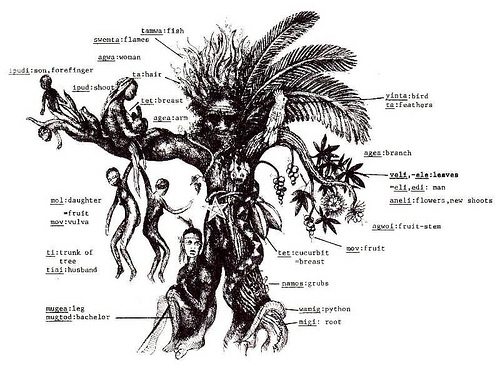
Shout out for conference info…
I am compiling an extensive list of upcoming conferences to post up on neuroanthropology. If you have a submission deadline approaching or know about a conference that you would like to advertise through our blog medium, please just drop me a note with Name, Location, Date and URL info at: Continue reading “Shout out for conference info…”
Learning Evolution
The internet is full of really great resources for learning about the processes of evolution, um like the above youtube clip… err… maybe not. Try the following list instead… Continue reading “Learning Evolution”
Is evolutionary psychology really rational choice theory?
I recently came across a couple of postings on a Psychology Today blog, Remaining puzzle #7 solved: Why children may love their parents, and Stump the evolutionary psychologist: Remaining puzzles, both by Satoshi Kanazawa. Dr. Kanazawa is a self-proclaimed ‘evolutionary psychologist’ (by that, I just mean that I’m not the one applying the label — he is) who is affiliated with Management at the London School of Economics and Political Science, the Department of Psychology at University College London, and the Department of Psychology at Birkbeck College, University of London. Listed as one of his primary qualifications is his co-authorship, with the late Alan S. Miller, of Why Beautiful People Have More Daughters.
In the first of the posts, ‘Stump the evolutionary psychologist,’ Dr. Kanazawa writes about his blog, The Scientific Fundamentalist:
Regardless of the particular topic at hand, the consistent theme in my blog has been to illuminate the power of evolutionary psychology to explain human cognition and behavior — what we think, how we feel, what we want, and what we do. The range of topics covered in this blog reflects my belief, shared by all evolutionary psychologists, that evolutionary psychology provides the best and the most ultimate (as opposed to the proximate) explanations of human behavior.
The fact that evolutionary psychology can explain so much of human behavior, however, does not mean that it can explain everything. Yet. Although I have absolutely no doubt that evolutionary psychology (along with behavior genetics and cognitive neuroscience) can eventually explain all of human cognitions and behavior some day, the day is still far ahead. There is still so much that we do not know.
Continue reading “Is evolutionary psychology really rational choice theory?”
 Neuroanthropology