Bad Boys or Bad Science

So here’s a recent New Scientist title: “Bad Boys Can Blame Their Behaviour on Hormones.”

All I can think is: New Scientist, Old School. Old, as in nature-nurture old and biological determinism old. Old as in moldy, rusted, failing ideas old.

But it’s not just New Scientist. Discover matches New Scientist with, “Teenage Hoodlums Can Blame Bad Behavior on Hormones.” And The Daily Mail delivers “Now Teenage Thugs Can Blame Their Hormones for Bad Behaviour.”

So what’s the problem? Well, it’s two-fold. First are journalists playing out a cultural script just like they subscribe to old-school cultural determinism. And second is some bad research that, not coincidentally, helps the journalists act like cultural automatons.

The cultural model goes like this: stereotypes, then blame, then biology. Take a stereotype we fear (“we” meaning journalists and readers alike). Bring in the politics and ideology of blame – hey, there’s a reason they are not like us, and why they threaten us. Invoke a cause, generally biological (though cultural causes come up too), outside of our particular realm of control. Hormones, nothing we can do about that, it means they were bad from the get-go. So we’re right to fear them and better make sure they don’t hurt us, whatever it takes.

Don’t believe me? Just look at the photos that accompany the articles. At the Daily Mail, a hooded guy point his hand like a gun at us the reader. Over at Discover, a crazed man with a clenched fist yells in our faces.

We all know journalists will play to stereotypes and will get research wrong and so forth. But in this case, like in most of the biologically-oriented research about complex human phenomena, the research only feeds into journalists typing out the normal crap.

The article in question is “Cortisol Diurnal Rhythm and Stress Reactivity in Male Adolescents with Early-Onset or Adolescence-Onset Conduct Disorder” (full access) by Graeme Fairchild, Stephanie van Goozen et al. and appears in the October 2008 issue of Biological Psychiatry. Neurocritic gives us the overview of the article if you don’t want to read the whole thing. (While I liked the Bad Boys music, I could have done with some more criticism in this particular Neurocritic post – but that’s okay, I’m going to play the bad boy this time.) Here’s the popular take from New Scientist on the article:

Out-of-control boys facing spells in detention or anti-social behaviour orders can now blame it all on their hormones. The “stress hormone” cortisol – or low levels of it – may be responsible for male aggressive antisocial behaviour, according to new research. The work suggests that the hormone may restrain aggression in stressful situations. Researchers found that levels of cortisol fell when delinquent boys played a stressful video game, the opposite of what was seen in control volunteers playing the same game.

Continue reading “Bad Boys or Bad Science”

Ethos: Cultural Politics of Mental Health in Native North America

I thought this would interest some of you.  Here’s the link to the online version. And for more info on Ethos, including the links to an entire issue on Jerome Bruner, just click here. Or check out the editorial office.

To view an online version of this email, click here.
Journal of the Society for Psychological Anthropology

Ethos presents a special collection:

Cultural Politics of Mental Health in
Native North America

Guest Editor: Joseph P. Gone

The September issue of Ethos includes a remarkable collection of articles on the contradictions and conflicts that arise in mental health counseling involving majority culture counselors and Native Americans. Articles featured in this collection include:

Introduction: Mental Health Discourse as Western Cultural Proselytization
Joseph P. Gone

Discourses of Stress, Social Inequities, and the Everyday Worlds of First Nations Women in a Remote Northern Canadian Community
Naomi Adelson

Clinical Paradigm Clashes: Ethnocentric and Political Barriers to Native American Efforts at Self-Healing
Joseph D. Calabrese

Sobriety and Its Cultural Politics: An Ethnographer’s Perspective on Culturally Appropriate Addiction Services in Native North America
Erica Prussing

Commentary: The Problem of Mental Health in Native North America: Liberalism, Multiculturalism, and the (Non)Efficacy of Tears
Audra Simpson

Commentary: No Itinerant Researchers Tolerated: Principled and Ethical Perspectives and Research with North American Indian Communities
Joseph E. Trimble  


About Ethos

http://www.wiley.com
 
Ethos is an interdisciplinary and international journal devoted to publishing scholarly articles exploring interrelationships between the individual and the sociocultural milieu, between the psychological disciplines and the social disciplines.

Printing four times a year, Ethos is the journal of the Society for Psychological Anthropology and is published in partnership with the American Anthropological Association. The journal is one of more than 20 publications featured in AnthroSource, a service of the American Anthropological Association.


This message was sent to [#EmailAddr#]. If you would rather not receive future messages from us, unsubscribe at any time by clicking here. You may also review our Privacy Policy at www.wiley.com/privacy.

Visit our Help page to find information on ordering, shipping/returns, your account, journal subscriptions, mailing lists and RSS feeds. You may also visit our Contact Us page to find a contact for additional assistance with a related product or service.

John Wiley & Sons, Ltd. | The Atrium, Southern Gate, Chichester, West Sussex, PO19 8SQ, UK
Tel: +44 (0)1243 779777 | Fax: +44 (0)1243 775878 | Registered Number: 641132 England

John Wiley & Sons, Inc. | 111 River Street, Hoboken, NJ, 07030, USA
Tel: 201.748.6000 | Fax: 201.748.6088

Copyright © All rights reserved.
EB720

Wiley-Blackwell

Alesha Sivartha and the Phrenology of Culture

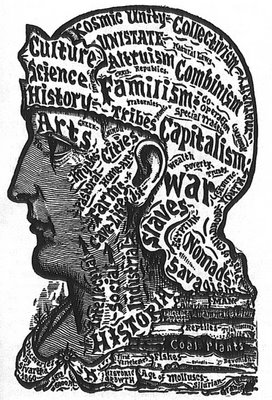
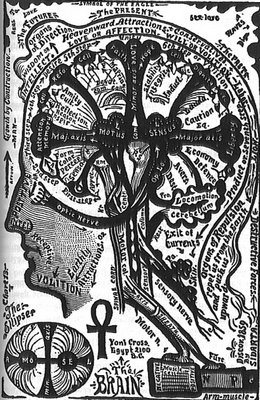
BibliOdyssey featured the Brain Maps of Alesha Sivartha two years ago, a fantastical collection of illustrations created by Sivartha as part of his 1912 “The Book of Life: The Spiritual and Physical Constitution of Man.” You can explore the book some through Google, but the better spot to go is Sivartha’s great-great-grandson’s website which covers the book in some detail.

Sivartha goes well beyond the typical phrenology of the nineteenth century, which generally focused on individual traits (i.e., the “mind”) as located in specific parts of the brain. History and culture and religion find their way into Sivartha’s work, and even the brain/body. He might even be called an early representative of cultural neuroscience!

Indeed, I see the illustrations as showing us how problematic it can be to force cultural and social phenomena onto the metaphor or image of the brain. Our enthusiasm must be tempered by critical neuroscience and by neurocriticism. Everyday life matters greatly, whether while camping without worrying about culture or brains, or dwelling more specifically on our “everyday brain” or the flavors of cultural brain we might enjoy.

Still, I find Sivartha’s illustrations quite wonderful. Just like early anthropologists trying to cover all the important domains of one culture in one book, so Sivartha tries to jam everything in, to create an impossible representation. It doesn’t work, but the images do provide much to reflect upon.

Colour, is it in the brain?

Colour is a perceptual interaction arising from our ability to discriminate between different wavelengths of light from within a narrow band of electromagnetic radiation. Light itself has no colour. The colour of a specific wavelength can change according to context. For example, in the above picture, despite having the same spectral reflectance, the ‘X’ appears to be different when set against the two different backgrounds (Albers J. 1975). Continue reading “Colour, is it in the brain?”

Role of Emotions in Brain Function

Emotions can be overpowering, but they are also the driving force of life. It was long thought that emotion and thought were separate processes. Brain science has begun to realise that the brain is not an organ of thought, but that it is a feeling organ that thinks. A tiny almond shaped structure deep in the brain, the Amygdala, is the first to respond to an emotional event. It triggers a series of reactions within the brain’s emotional core and sends signals throughout the body that change body posture, facial expression, heart-rate, breathing and awareness. The emotions are important in social interaction and in forming social connections. The awareness of emotion is crucial to motivation, decision-making, memory and forethought. Learning how to manage our emotions is an important skill that we continually develop throughout our lives.

Continue reading “Role of Emotions in Brain Function”

Cultural Neuroscience

Shihui Han and Georg Northoff have just published Culture-Sensitive Neural Substrates of Human Cognition: A Transcultural Neuroimaging Approach. This article will prove foundational for “cultural neuroscience,” a term Han & Northoff use near the end of the article. I highly recommend that everyone read the full version (pdf), but will outline and comment on it here.

In this Perspectives piece in Nature Neuroscience Reviews, Han and Northoff review the evidence on how culture influences neural mechanisms, highlight the need to integrate social neuroscience and cultural cognition research, argue for transcultural neuroimaging as an effective method for cultural neuroscience, and lay out implications for the future of this emerging field.

But if you don’t take my word for it, here’s their abstract:

Our brains and minds are shaped by our experiences, which mainly occur in the context of the culture in which we develop and live. Although psychologists have provided abundant evidence for diversity of human cognition and behaviour across cultures, the question of whether the neural correlates of human cognition are also culture-dependent is often not considered by neuroscientists. However, recent transcultural neuroimaging studies have demonstrated that one’s cultural background can influence the neural activity that underlies both high- and low-level cognitive functions. The findings provide a novel approach by which to distinguish culture-sensitive from culture-invariant neural mechanisms of human cognition.

Cultural Effects on Cognition

Han and Northoff systematically cover research on “cultural effects on cognition,” including perceptual processing, attentional modulation, language and music, and number representation and mental calculation. Their Figure 1, presented below, summarizes research on culture and attention, highlighting context-dependent differences in attention between Americans and East Asians.

Continue reading “Cultural Neuroscience”