
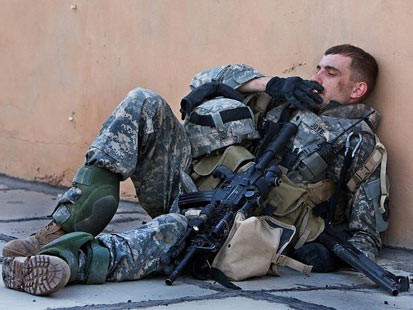
 Over the past year and a half, I have been conducting research among male U.S. veterans who have served combat tours in Iraq and Afghanistan, most of whom have been diagnosed with Post-Traumatic Stress Disorder (PTSD). An anthropologist myself, I planned to follow the trail originally blazed by Victor Frankl and Robert Jay Lifton, psychotherapists who wrote a great deal about meaning in their descriptions of trauma and PTSD.
Early on, however, a psychiatrist whose work on trauma I admire opined to me that crises of meaning belong to the realm of depression rather than PTSD. He suggested that combat PTSD was best thought of as the physiological effects of living under conditions of extreme stress, while more meaning-related struggles were best understood as a symptom of depression. Given the frequency of comorbidity between PTSD and depression, I was for some time inclined to go along with his analysis.
Then two things happened. First, I began the work of talking with veterans themselves about their stories of trauma and PTSD, listening to how they describe their own experiences. And second, I began to explore the increasingly dominant Prolonged Exposure model of PTSD, which views the disorder as a pathology that develops when individuals fail to process their traumatic memories in the normal way.
Some background is important here. A recent RAND report suggests that as many as 18.5% of combat troops have gone on to develop PTSD after serving in Iraq or Afghanistan; alarming as that number is, it nonetheless demonstrates that the vast majority of combat-exposed individuals do not develop PTSD. However, most of the veterans I’ve spoken with – even those without a formal PTSD diagnosis – report experiencing some PTSD symptoms for a period of time following their combat deployment. Many of them dealt with such symptoms for a while – a month, three months, a year – before passing through this period of processing their memories and going on with their lives. They may be changed by their experiences in the war zone, but they are not broken by them, and may even describe them as resulting in personal growth and other positive effects.
Continue reading “Cultural Aspects of Post-Traumatic Stress Disorder: Thinking on Meaning and Risk”

 Neuroanthropology