Exporting American mental illness

The New York Times Magazine has a great discussion of the effects of the exportation of American ideas about mental illness, titled appropriately, The Americanization of Mental Illness by Ethan Watters, based on his forthcoming book, Crazy Like Us: The Globalization of the American Psyche, coming out this month from Free Press. The article is quite good, offering some intriguing cases, such as the rise of virulent, American-style anorexia nervosa in Hong Kong, the effect of possession beliefs on communities’ reactions to schizophrenia, and how the narrative of mental illness as ‘brain disease’ might actually lead to great stigma as it spreads and replaces local understandings. The article is well worth a read, and I’m looking forward to the book.
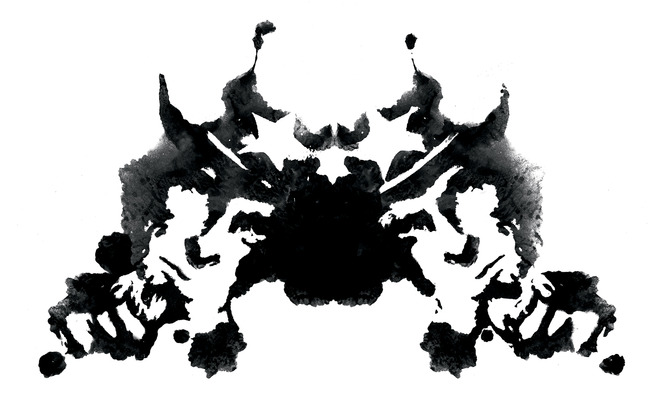
graphic by Alex Trochut, NYTimes

The ethnographic record is full of conditions that didn’t make it into the most recent edition of the DSM — amok, nervios, koro, zar — you can check out Wikipedia or some other source on ‘culture bound syndromes,’ such as Introduction to Culture-Bound Syndromes in Psychiatric Times, to get a fuller discussion of some of these conditions. The Psychiatric Times piece suggests that there are at least 200 culture-bound syndromes.

One thing I really liked about the New York Times Magazine article, however (and by extension, Watters’ book, I suspect), is that the discussion of ‘culture-bound syndromes’ usually tends to treat other people’s syndromes as ‘culture-bound,’ Western psychological illnesses as not ‘culture-bound.’ Watters’ work points out that Western mental illness is both itself culture-bound and that persuading people to believe in Western-style mental illness can affect the way that psychic disorders manifest.

Continue reading “Exporting American mental illness”

PTSD and Traumatic Brain Injury: Trauma Inside Out

by Drew Matott and Drew Cameron
By Zoë H. Wool

Jake was fond of saying that even though he had become dumber, he wasn’t quite dumb enough. He knew that the improvised explosive device (IED) in Iraq had mangled his body, brain and self.

Jake (a pseudonym) lost 30 IQ points due to Traumatic Brain Injury (TBI) from that IED blast. According to the military, he was still smart enough to function and hold down a job, so they didn’t plan to include TBI in his disability rating.

He fought them on this, just as he fought them on the decision not to amputate his leg. After countless surgeries and rehabilitation techniques, his leg was almost useless, allowing him maybe 30 minutes of use before it started rebelling against its reconstructed form. The pain that caused was excruciating; he simply couldn’t use it more.

Eventually Jake won his battle to lose his leg. It was the best thing that happened to him during the year I got to know him while doing my dissertation fieldwork at Walter Reed Army Medical Center in Washington, D.C. (yes, that Walter Reed).

Dealing with, or writing about, TBI is rarely as clear as an amputation. The same is true of TBI’s nearly constant companion, Post Traumatic Stress Disorder (PTSD). TBI and PTSD are not injuries that you can see, unlike a lost leg. Despite the high numbers of TBI and PTSD cases from Iraq and Afghanistan, the relationship of these conditions to more obvious forms of combat trauma remains a fraught one: Witness the debate about PTSD and the Purple Heart.

Most people think that the Purple Heart, that most iconic of military honors, is awarded to American military members injured in combat. As with most issues military, it is not quite that simple.

In 2008, after months of consultation, the decision was made not to award the Purple Heart to those suffering from PTSD because, in part, the medal “recognizes those individuals wounded to a degree that requires treatment by a medical officer, in action with the enemy or as the result of enemy action where the intended effect of a specific enemy action is to kill or injure the service member.” PTSD doesn’t count.

Though the decision was officially framed in rather bureaucratic terms, the debate which surrounded it raises much deeper issues about the nature of trauma. Thinking through these issues has led me to think about the Cartesian split between the (internal) mind and the (external) body and the nature of trauma inside and out.

Continue reading “PTSD and Traumatic Brain Injury: Trauma Inside Out”

Daphne Merkin: A Journey through Darkness

Daphne Merkin

It is a sparkling day in mid-June, the sun out in full force, the sky a limpid blue. I am lying on my back on the grass, listening to the intermittent chirping of nearby birds; my eyes are closed, the better to savor the warmth on my face. As I soak up the rays I think about summers past, the squawking of seagulls on the beach and walking along the water with my daughter, picking out enticing seashells, arguing over their various merits. My mind floats away into a space where chronology doesn’t count…

So opens Daphne Merkin’s recounting of her life with severe depression. A Journey through Darkness is the feature article in this week’s New York Times Magazine. On that sparkling day in mid-June, Daphne was on a “fresh air” break in The Patients’ Park & Garden, the all-concrete highlight of her latest clinic.

Merkin recounts her life, an intractable life, in this moving essay. She mixes in recounting her latest stay in a clinic with reflections on depression and how this illness has shaped her life in such fundamental ways. Here are two pieces that spoke to me.
Daphne Merkin 2

This is the worst part of being at the mercy of your own mind, especially when that mind lists toward the despondent at the first sign of gray: the fact that there is no way out of the reality of being you, a person who is forever noticing the grime on the bricks, the flaws in the friends — the sadness that runs under the skin of things, like blood, beginning as a trickle and ending up as a hemorrhage, staining everything. It is a sadness that no one seems to want to talk about in public, at cocktail-party sorts of places, not even in this Age of Indiscretion.

–//–

This was enraging in and of itself — the fact that severe depression, much as it might be treated as an illness, didn’t send out clear signals for others to pick up on; it did its deadly dismantling work under cover of normalcy. The psychological pain was agonizing, but there was no way of proving it, no bleeding wounds to point to. How much simpler it would be all around if you could put your mind in a cast, like a broken ankle, and elicit murmurings of sympathy from other people instead of skepticism.

Link to A Journey through Darkness

The Foundation for Applied Psychiatric Anthropology

fapaThe Foundation for Applied Psychiatric Anthropology (FAPA) is a new organization founded by the anthropologist and social worker Rebecca Lester and the psychiatrist Davinder Hayreh.

The Foundation “promotes the use of ethnographic research and mixed-methods approaches to improve understandings and treatments of mental illness, broadly defined. FAPA facilitates collaboration among scholars and practitioners who wish to integrate clinical work with ethnographic research and advocacy initiatives related to culture and mental health.”

FAPA also offers reduced-fee psychotherapy services to residents in the Saint Louis, Missouri area. To find out more, check out FAPA’s description of its clinical services and approach.

Rebecca Lester is a professor of anthropology at Washington University in Saint Louis. You can read about her treatment philosophy. For researchers, Rebecca has put together a great list of books in psychiatric anthropology.

And here’s Davinder Hayreh’s LinkedIn profile. He is presently nearing the finish of his residency in psychiatry at Barnes-Jewish Hosptial in Saint Louis.

For more information, you can contact them at office @ psychanthro.org [remove spaces].

Forever at War: Veterans’ Everyday Battles with Post-traumatic Stress Disorder

ptsd-iwo-jima“To this day, every time I smell firecrackers or fire arms being shot, I feel like I am right back there. All I have to do is close my eyes and I see the whole scenario over and over again. I can’t erase it.”
Hundreds of thousands of US veterans are not able to leave the horrors of war on the battlefield. They bring the combat home and re-experience it in their minds each and every day, no matter how much time has passed.

“I don’t like people. I just live my life.”

Many PTSD veterans live a life riddled with divorce, unemployment, and loneliness because they are unable to form lasting social networks within civilian life. It is not uncommon for a war veteran plagued with PTSD to desire a solitary life in the mountains. One informant described Montana as the ideal locale – far away and quiet.

“I should have buried him.”

This veteran is still tormented by the fact he did not give an honorable burial to a fellow soldier. He knows he would have met a similar fate if he tried to leave his foxhole; yet his inability to act haunts his memory. He asks himself everyday why he didn’t even try to honor his fallen comrade. He also has never been able to justify why he wasn’t the soldier left unburied on that remote Pacific island.

“I didn’t even have the motivation to kill myself.”

Many of these men and women believe their situation will never improve. Some contemplate suicide as their only relief from the symptoms of PTSD. A number of the veterans we spoke with had thought about or even tried to end their own lives. They also participate in risky activities, threatening their life in a deliberate yet indirect way.

“I always feel like there is someone behind me – following me.”

Being on edge is the only way to survive in combat. Unfortunately, many PTSD veterans are unable to readjust within the civilian world. Everyday life becomes a battlefield.

Something as mundane as walking through a crowded grocery store aisle can be a source of intense anxiety for a veteran suffering from PTSD. Overwhelmed by a feeling that the shoppers behind them are enemies, PTSD veterans always feel as if they are under attack. A trigger as simple as the clashing of shopping carts can make them jump in fear of an imminent explosion. They are forever at war.

OUTREACH

Over the course of 4 months, South Bend veterans with Posttraumatic Stress Disorder (PTSD) have revealed their daily realities to us, five undergraduates at the University of Notre Dame. In conjunction with a course taught by Dr. Daniel Lende entitled Researching Disease: Methods in Medical Anthropology, we have engaged in community-based research with members and supporters of PTSD, Vets, Inc. Here, with the approval and encouragement of these vets, we seek to give their experiences a well-deserved voice.

Continue reading “Forever at War: Veterans’ Everyday Battles with Post-traumatic Stress Disorder”

Body Swapping

Do psychotherapists now have a new trick? Or is it all smoke and mirrors? The New York Times reports today on Standing in Someone Else’s Shoes, Almost for Real, where neuroscientists have shown that “the brain, when tricked by optical and sensory illusions, can quickly adopt any other human form, no matter how different, as its own.”

The article “If I Were You: Perceptual Illusion of Body Swapping” by the Swedish researchers Henrik Ehrsson and Valeria Petkova appears this week in PLoS ONE, and is ably summarized over at Neurophilosophy. You can also read Ehrsson’s previous article on the virtual arm illusion and his Science piece on the experimental induction of out-of-body experiences.
out-of-body-illusion
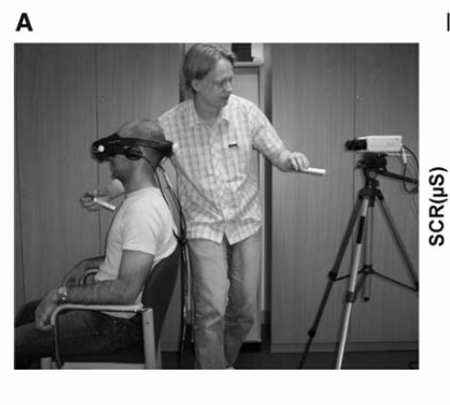
The approach in all of this research is rather simple. You can see the out-of-body experiment design pictured to the right. Body swapping adds another person with goggles.

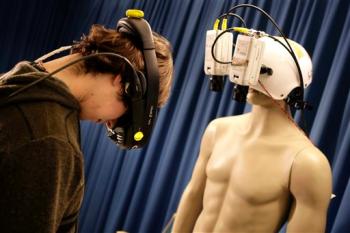
A subject stands or sits opposite the scientist, as if engaged in an interview.. Both are wearing headsets, with special goggles, the scientist’s containing small film cameras. The goggles are rigged so the subject sees what the scientist sees: to the right and left are the scientist’s arms, and below is the scientist’s body. To add a physical element, the researchers have each person squeeze the other’s hand, as if in a handshake. Now the subject can see and “feel” the new body. In a matter of seconds, the illusion is complete.

body-swap-by-niklas-larsson
This “switching” happens because the brain is literally embodied – after growing up with this particular body, it’s a fair assumption to assume that one’s eyes and one’s hand are getting feedback about the same interactive phenomenon. For a first-person view of this, see Karl Ritter’s AP article today on the body-swap illusion, which includes this photo of the two-goggle set-up.

Ehrsson is excited about being able to trick the brain in this way: “You can see the possibilities, putting a male in a female body, young in old, white in black and vice versa.” The NY Times article pushes the uses body swapping can have in therapy.

Continue reading “Body Swapping”