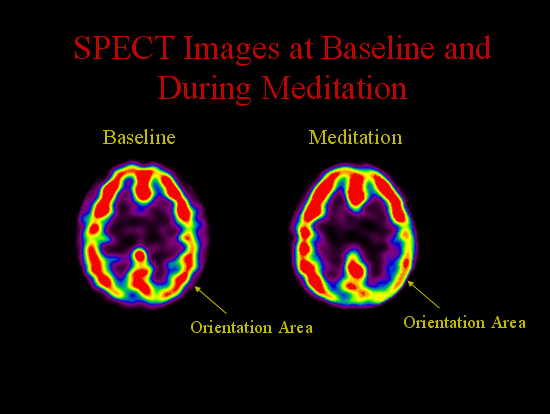
 The Pew Forum on Religion and Public Life brought together the neuroscientist Andrew Newberg and the journalist David Brooks (yes, of neural buddhists fame) for joint presentations back in May, followed by a round-table Q&A discussion with a prominent group of journalists. The transcript of the entire event is now up, and that includes the audio as well as plenty more of the pretty brain graphics that you see here and some good event photos.
The presentations and discussions covered a wide range of topics, ably summarized and linked at the beginning of the transcript, including the physiology of beliefs and brains in meditation and prayer from Newberg and the revolution in brain research and neuroscience and soft-core Buddhism from Brooks. The discussion was also wide-ranging, going over issues such as Is religious Darwinism valid? and Brain physiology in party politics. As befits a Pew gathering, there is a considerable amount of attention focused on religion, atheism, and the like.
Newberg covers a lot of his take on the biology of belief as well as imaging research he has done on people praying or meditating. Here’s an excerpt on belief:
So our brain is trying to put together a construction of our reality, a perspective on that reality, which we rely on heavily for our survival, for figuring out how to behave and how to act and how to vote. But again, the brain is filling in a lot of gaps and helping us think certain things that may or may not really be there… So what are beliefs? Again, I apologize, but I always come at this from a scientific perspective. I am defining beliefs biologically and psychologically as any perception, cognition, emotion, or memory that a person consciously or unconsciously assumes to be true. The reasons I define beliefs in this way are several-fold. One is that we can begin to look at the various components that make up our beliefs. We can talk about our perceptions. We can talk about our cognitive processes. We can talk about how our emotions affect our beliefs. And we can also look at how they ultimately affect us. Are we aware of the beliefs we hold? Or are they unconscious? And which ones are unconscious and which ones are conscious?
And an excerpt connecting belief to the practice of religion.
The practices and rituals that exist within both religious and non-religious groups become a strong and powerful way to write these ideas into our brain. Again, go back to the idea that the neurons that fire together, wire together. The more you focus on a particular idea, whether it is political or religious or athletic, the more that gets written down into your brain and the more that becomes your reality. So that is why when you go to a church or a synagogue or a mosque, and they repeat the same stories, and you celebrate the same holidays that reinforce that, you do the prayers, and you say these things over and over again, those are the neural connections that get stimulated and strengthened. That is a strong part of why religion and spirituality make use of various practices valuable for writing those beliefs strongly into who you are.
Brooks aims to place these sorts of ideas into a social and cultural context.
Continue reading “Wired for Belief?”




 Neuroanthropology