Wednesday Round Up #31

This week we have more from John Hawks’ students, food, psychology, evolution, the brain, and anthropology.

Biology of Mind

I love encouraging students, and find that blogging raises the bar for them. Suddenly it’s not just the professor who’s reading a paper, but their fellow classmates and in the case of this new blog, Biology of Mind, the whole world! So here are students’ reflections and critiques on papers they have found fascinating:

Effects of Meditation Seen through Long-Term Buddhist Practitioners
Brain Damage from Stress
Looking Further into Semiotics…
The Anatomy of Humor
Is There Something about How We Live Today That Is Bad for Our Mental Health?
Behavioral Evidence for Theory of Mind in Monkeys
Culture Codes
Which Came First : Large Brains or Complex Social Groups?

Food

Eric Nagourney, Nutrition: Soda Ban in Schools Has Little Impact
Banning soda? “Only about 4 percent fewer children from the no-soda schools said they did not drink it.”

Elisabeth Rosenthal, Fast Food Hits Mediterranean; a Diet Succumbs
Fast food invades Greece, and childhood obesity and diabetes become problems. Plus this tidbit, “Greece, Italy, Spain and Morocco have even asked Unesco to designate the diet as an ‘intangible piece of cultural heritage’.”

Tara Parker-Pope, Instead of Eating to Diet, They’re Eating to Enjoy
Is this the better way to be healthy and to avoid the yo-yo effect?

Associated Press, Mexico Pushes National Campaign to Lose Weight
Increasing disease burden due to obesity leads to a new government initiative

Psychology

Eric Schwitzgebel, Six Ways to Know Your Mind
Getting to know yourself – a good guide to how to think about subjectivity and research focused on our experience (or phenomenology). A good follow up is Eric’s End of (Philosophical) Innocence, about how to effectively deal with the intuitions and assumptions at the core of our ideas and our research
Continue reading “Wednesday Round Up #31”

Emerald Encephalon

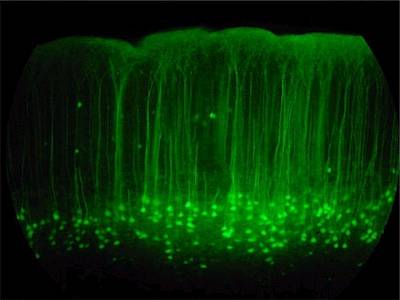
The latest edition of Encephalon is out over at Neuroscientifically Challenged. Fifty five times the mind/brain carnival has done its fortnightly thing. Oh rapture. So I found some cool emerald-colored neurons to celebrate the occasion!

Marc leads off with a video game post, and that’s got me hooked! It’s about the gaming professors Cheryl Olson and Lawrence Kutner, who have written the book Grand Theft Childhood: The Surprising Truth About Violent Video Games and What Parents Can Do. Using research, not accusations, the couple present a balanced view of the good and the bad of video games, and come down mostly on the good. So go to Sharp Brains for a great overview of their work.

Cognitive Daily has a post on condoms and teenage sexual behavior. As it happens, what matters here is not good intentions but having the damn thing at hand. Ah, the old anthropological dictum, what people say and what people do are often very different things…

Ever wondered what computational neuroscience is? Neuronism gives us the overview of this modeling approach.

And Mouse Trap gives us eight basic adaptive problems that animals face. They are: predators, eating the right food, forming relationships, helping children, helping kin, reading other people’s minds, and communication.

These eight come from two evolutionary psychologists, and are not the only way to parse evolutionary problems. Life history theory might focus on growth and the timing of reproduction and the importance of disease and immune function, all of which involve lots of brain/body interactions. An evolutionary-inclined neuroscientist might take a page from computational neuroscience above, and say that just getting accurate brain function (say, useful perceptions of the world) is a much more significant adaptive problem. Just more food for thought… Uh oh, that’s non-adaptive, shouldn’t food go into reproducing? And what about those condoms?

Anyway, head over to Neuroscientifically Challenged for these and more!

Mind Hacks Spike Activity

Most of you are probably aware of the weekly round up or “Spike Activity” appearing every Friday at Mind Hacks. But for those of you who don’t, today’s version was really a great one.

First up, no pun intended, is the study over at Cognitive Daily on condoms: “Cognitive Daily covers a sobering study on sex education that found ‘among sexually active teens, actual condom use bears no relationship to intention to use a condom or belief that using condoms is a good idea. The only factors in their study that correlate with using condoms are buying and carrying condoms’.”

Probably not a big suprise to most anthropologists, where the difference between what people say versus what people do is ground into aspiring ethnographers. It also reminded me of my work with teenage drug users – carrying drugs around was always a good indicator of a real problem, despite many teens’ assertions to the contrary.

Channel N is featuring a video on how obesity spreads through social networks. For those of you looking for research on this topic, Nicholas Christakis and James Fowler published a landmark article in the New England Journal of Medicine on “The Spread of Obesity in a Large Social Network over 32 Years” (full text).

PLoS Biology has an important article just out entitled “On Mice and Men, and Chandelier Neurons” (full text) aiming at what makes human brains different, with a focus on short-axon neurons in the frontal cortex.

Then we have cognitive neuroscience in relation to freewill and in relation to philosophy of the mind, as well as Newsweek’s recent article on cognitive neuroscience itself.

Plus even more, so hack into this spike or even those in the past.

Ptak Science Books

John Ptak runs an interesting blog where he explores the “History of Ideas–unusual connections in the history of science and mathematics with the arts and social history.” His musings and reflections, his use of striking imagery, and his grounded historical approach make for some enjoyable online reading.

I ran across it while looking for an image of Darwin’s “branching tree” diagram, which he handily included in this post The Wrong Stuff, Righted–the Attack on Darwin’s Descent, 1871.

Ptak Science Books features in the same month of March this striking image of Albrecht Durer’s Geometrical Man, a creation that astounded me for dating to the 1500s.

More recently he’s explored the building and use of the atomic bomb, the hidden geography in old prints, and historical breakthroughs in astronomy.

Wednesday Round Up #30

This week it’s gaming, mental health, academia, technology, the brain, and anthropology.

Video Games

Heather Chaplin, Xbox’s ‘Braid’ Is a Surprise Hit, for Surprising Reasons
NPR on Braid, a “game grownups can play” and a “meditation on the meaning of life”

Clive Thompson, How Video Games Blind Us with Science
Do kids practice science when they play? Professor and gamer Constance Steinkuehler argues yes

Maggie Greene, UC Irvine Gets Grant to Study WoW
World of Warcraft in US and the China – will culture matter?

The Brainy Gamer, Brilliant
Engagement, obsession, immesion? How about open worlds and the ability to express yourself!

The Game Anthropologist, Games’ Influencing of Players
“The long and short of it? The game makes the player.”

Cognitive Daily, The Bloodier the Game, The More Hostile the Gamer
Mortal Kombat settings and a one-game study – the bloodier the game play, the more violent the resulting thoughts. So, are players after that arousal gap? And with the sword, are they looking for that bloody spray? And here context (in game only) helps shape resulting experience.
So, interesting results but various ways to interpret what players are doing and experiencing

Mental Health

Sarah Kershaw, Girl Talk Has Its Limits
Teenage girls and co-rumination – or wallowing in sorrows and anxieties together

Serendip, Mental Health and the Brain
A discussion over at Bryn Mawr college this fall

Richard Perez-Pena, The Sports Whisperer, Probing Psychic Wounds
Gary Smith and the wounds and obsessions and stories of athletes

Clara Moskowitz, Social Isolation Makes People Cold, Literally
Rejected people feel colder. Is it all metaphor and embodied reactions? Benedict Carey at the NY Times also covers the same research in A Cold Stare Can Make You Crave Some Heat

Continue reading “Wednesday Round Up #30”