Talent: A difference that makes a difference

A young Andre Agassi
Studying sports training and skill acquisition, I often run headlong into the concept of ‘talent.’ When I suggest that athletic achievement demonstrates the extraordinary malleability of the human nervous system, the ability of our muscles to remodel, the refinement of athletes’ perceptual acuity, and even how our skeletons can be reconfigured by training, audience members often respond, ‘Yeah, but what about innate talent?’

Or, confronted by the yawning gap between elite athletes’ performances and the ability of the average person, sceptics still want to focus on the slight differences among elites athletes (for example, Jon Entine’s book Taboo), suggesting that this tiny fraction of difference is the ‘innate’ part, the ‘talent.’ I can describe the years of arduous labour that go into producing elite-level achievement, the countless hours of training and sophisticated coaching, and someone will inevitably say, ‘Okay, but some people are just inherently good at sports, aren’t they?’

But as psychologist K. Anders Ericsson said in an interview in Fast Company (cited here by Dan Peterson), ‘The traditional assumption is that people come into a professional domain, have similar experiences, and the only thing that’s different is their innate abilities. There’s little evidence to support this. With the exception of some sports, no characteristic of the brain or body constrains an individual from reaching an expert level.

Obviously, certain dimensions of the body can affect one’s ability to participate in a sport like basketball or sumo at an elite level, or a genetic abnormality may create an unusual wrinkle in a metabolic or even a neural process, but research like Ericsson’s suggests that these sorts of traits are likely the exception rather than the rule. That is, even if there is a genetic trait that helps some Kenyan runners to excel, or gives an individual with photographic memory, or helps a free diver to endure oxygen deprivation, these cases do not confirm the folk idea that talent is innate (and thus likely genetic).

In this post, I want consider the difference that makes a difference. That is, how the concept of talent itself actually affects the unfolding and compounding of developmental variation, helping extreme ability to emerge (and de-motivating those who don’t demonstrate early ‘promise’). Whether or not ‘talent’ exists—and I’m profoundly skeptical—believing that it does is a good foundation for exaggerating variation in skilled ability.

Continue reading “Talent: A difference that makes a difference”
Escaping Orientalism in cultural psychology

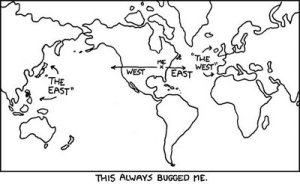
eastwest1In a recent article in American Psychologist, Adam Cohen (2009) suggests that a number of fields in psychology have taken up the study of culture, but the results, although interesting, have been limited by what sorts of ‘culture’ have been investigated. As Cohen (2009:194) writes:

A person reading these literatures could be excused for concluding that there is a very small number of cultural identities (North American vs. East or Southeast Asian), that vary principally on the dimensions of individualism–collectivism or independent–interdependent self-construal—whether people are seen as inherently independent from others or whether social roles are most important in defining the self.

In this post, I want to provide a bit of a bibliography of some of the literature fast emerging on cultural difference in psychology, neuroimaging, and related fields, but also focus a bit on the consequences of this limited imagination in considering cultural difference, the almost exclusive focus on East-West contrasts. Just because I love a bit of controversy with my breakfast, I’ll suggest it’s a form of what Edward Said has called ‘Orientalism.’

Although Cohen brings up the issue and offers a few suggestions for how the problem might be addressed, I think his prescriptions would herald more of the same sickness, although perhaps spreading the infection to more hosts. That is, Cohen puts his finger on a serious problem in the psychological study of culture, but the prognosis won’t improve much unless we actually understand the root of the problem: it’s not studying Europeans (and European-Americans) and Asians (and Asian-Americans) that’s causing the whole problem. Part of it is misunderstanding what is being studied in the first place when cultural difference is under the lens.

This post is based on part of a talk I gave on Tuesday to the Centre for Cognitive Science (MACCS) here at Macquarie. When I got into the subject, I realized it was far more than I could possibly share in a 50-minute presentation, so I thought I’d post it here.

Continue reading “Escaping Orientalism in cultural psychology”

What Is The Value of Neuroscience?

Jonah Lehrer has a great post, The Value of Neuroscience, over at The Frontal Cortex. He writes about struggling with a common question he got during his recent tour for his new book, How We Decide.

The question is, “What practical knowledge have we gained by looking at decision-making in the brain that we didn’t already have, either through introspection or behavioral studies?”

His answer is, “The best answer, I think, is that learning about the brain can help constrain our theories. We haven’t decoded the cortex or solved human nature – we’re not even close – but we can begin to narrow the space of possible theories.”

That is both an elegant and a practical answer – it claims neither too much nor too little for neuroscience, and provides a way to think about neuroscience. Ways of thinking are often much harder to grasp than what to think, where neuroscience churns out an enormous quantity of information but not necessarily an enormous range of hypotheses about people as people.

Lehrer’s answer echoes my own view of evolutionary theory, that its greatest utility is in limiting the range of possibilities when confronting the diversity and commonality of people’s behavior lives today and in the recent past. People are often aghast when I say this – but what about all the predictions, the selective forces, Darwin’s genius? But there is evolution’s strength – certain possibilities are more likely, and others are often not on the table. Combine that with the mechanistic understandings from neurobiology–the outcomes of evolutionary adaptations and present function–and suddenly the range of possibilities is constrained further.

Continue reading “What Is The Value of Neuroscience?”

Throwing like a girl(‘s brain)

We’ve all read some of the discussions about differences in men’s and women’s brains, but the case of throwing overhand offers a cautionary tale about thinking we’ve found something inherent in being male or female. The danger is that we accept too quickly observed differences without digging a bit deeper into their variation and potential causes. In the United States, most of our readers will have run across the idea that women throw like, well, … girls.

Jennie Finch can strike you out.
In fact, the empirical gulf between average throwing ability in men and women is huge (just as it is symbolically important), dwarfing virtually any other measurable difference between the sexes, even things like aggression, frequency of masturbation, attitudes towards casual sex, and spatial abilities on paper-and-pencil tests.

Janet Shibley Hyde, one of the leading proponents of the ‘gender similarity hypothesis,’ concedes that there are some marked differences between men and women, singling out throwing ability as the most pronounced among them (2007: 260; see also 2005).

Thomas and French (1985: 266 & 276), in a meta-analysis reviewing all available research on sex differences in throwing, found that the gap stood at 1.5 standard deviations at three years of age, and increased over time, widening to between three and five standard deviations by puberty. By contrast, the much discussed ‘math gap’ between boys and girls, in Hyde’s meta-analysis of 48 studies, was a +0.08 on problem solving and +0.16 on national math tests (Hyde 2005; 2007: 260). In other words, if you’re impressed by the gap in math scores (I’m not), you should be awestruck at the gap in throwing ability.

I just finished writing the draft of a potential book chapter on throwing ability for a volume Prof. Robert Sands is putting together on biocultural approaches to sports. The chapter steps off from my observations that most of my colleagues in Brazil, men included, ‘threw like girls’ even though they were incredibly talented athletes, some of the most astounding capoeira practitioners I have ever seen. The book chapter is linked to some other work I’ve been doing, so I’ve got notes enough for several chapters – I thought I might put some up on Neuroanthropology.net because they were especially related to some of the things we focus on here.

This is probably going to wind up being at least two or three posts, so in this one, I’m only going to discuss the neurological issues surrounding throwing and the likely mechanical or technical issues that make (some) women (and Brazilian men and others) ‘throw like girls.’ At least one more post is going to deal with physiological plasticity beyond the nervous system, such as the way throwing remodels the shoulder, to explore anatomical plasticity more broadly, but you’re going to have to come back later for that one…

Continue reading “Throwing like a girl(‘s brain)”

My genome is not my self

pinker-hairBy Agustin Fuentes

We are not our genes and they are not us. Knowing what copies of genes we carry can tell us a little about getting sick and losing our hair, and maybe even add insight into our ancestry. But that does not tell us about how and why we do the things that we do.

Steven Pinker, in his recent New York Times Magazine article My Genome, My Self, argues that genes do have great influence on our behavior. As an anthropologist, evolutionary theorist, and a researcher of human and other primate behavior I am here to tell you that he is overshooting the mark. Human behavior is simultaneously biology, culture, experience and more.

Natural selection, one of the main drivers in evolutionary change, works on the whole body and behavior complex, not on single genes or even the genome itself. It is the dynamic product of genes, organs, bodies, behaviors, ecologies, and societies that eventually affects evolutionary patterns in humans. No gene or even set of genes can be held in isolation of the systems in which they exist.

Continue reading “My genome is not my self”

How intelligent are intelligence tests?: Whitehead responds

Dear readers. Dr. Charles Whitehead wrote a long and thoughtful response to my earlier post on the Flynn Effect, but I worried that comments may not get read as often (or carefully) as the main posts, so I’m taking the liberty of giving Dr. Whitehead his own post. For more about Charles Whitehead’s work and his online activities, see Charles Whitehead: Social Mirrors here at Neuroanthropology.

From an anthropological point of view cognitive scientists are being less than rational when they treat intelligence scales as though they are measuring something fundamental and innate in human beings. No doubt innate abilities are used by people when they tackle IQ tests, but it is unlikely that such abilities evolved under selection pressure for this kind of problem solving.

Intelligence scales are culturally embedded artifacts designed to meet the idiosyncratic needs of postindustrial western societies, and reflect the equally idiosyncratic assumptions found in the west – such as our habit of referring to someone as “brainy” when we mean “intelligent”, and the widely held assumption that brains got bigger during human evolution because of selection pressure for “intelligence” (and/or language: e.g. Deacon 1992). The idea that human intelligence is the ultimate pinnacle of biological evolution may be little more than colonialist propaganda, suggesting that “scientific” societies are the ultimate pinnacle of cultural evolution – and hence morally entitled to dominate others who formerly managed perfectly well without the blessings of “modernity”.

Sir Francis Galton devised the first intelligence test in the late 19th century and this was followed by the scale developed by Alfred Binet and Théophile Simon between 1905 and 1911 (Atkinson et al., 1993: 457-8). As early as 1884 Galton examined more than 9,000 visitors to the London exhibition and found to his chagrin that eminent British scientists could not be distinguished from ordinary citizens on the basis of head size (ibid: 458). From that point on the kind of assumptions made by Galton have continued to pervade scientific thinking with little or no empirical encouragement.

Continue reading “How intelligent are intelligence tests?: Whitehead responds”