No wonder the altar boys look spaced out…

(And before I go any further, yes, I know that girls outnumber boys as servers in most American Catholic Churches — I just couldn’t get a title with the same ring…)

I just came across a recent story on PsyOrg.com, Incense is psychoactive: Scientists identify the biology behind the ceremony, that confirms something I have long suspected. As a veteran Catholic altar boy who has spent more than my fair share of hours inhaling incense, I knew the stuff made me loopy. I even once watched a friend of mine take a slow, sideways dive with a half twist off a kneeler into the front row of church after he got a little over-enthusiastic swinging the incense boat around and checked out of conscious-ville for a few minutes. Turns out that incensole acetate, a Boswellia resin constituent that can be isolated from frankincense, lowers anxiety and acts as an anti-depressant in mice (unless those mice are forced to kneel for long periods of time in heavy cassock and surplus, or chant in Latin).

The danger of this sort of data is that someone will say that they can use it to ‘explain’ religion, as if everytime someone got mildly baked off of psychoactive chemicals in bark or tree resin, they came up with two-millenia-lasting notions of a triune God, the Resurrection of Man, and other assorted ideas. That is, psychoactive chemicals can explain certain phenomena within religion, but they certainly could not explain any religion as a whole. Otherwise, there’d be a lot more theological creative stoners shambling around.

And so we’re left with the advice in Exodus (30:34-37):

And the Lord said to Moses: Take unto thee spices, stacte, and onycha, galbanum of sweet savour, and the clearest frankincense, all shall be of equal weight. And thou shalt make incense compounded by the work of the perfumer, well tempered together, and pure, and most worthy of sanctification. And when thou hast beaten all into very small powder, thou shalt set of it before the tabernacle of the testimony, in the place where I will appear to thee. Most holy shall this incense be unto you. You shall not make such a composition for your own uses, because it is holy to the Lord.

What makes humans unique?

Photo by JoProf. Michael Tomasello, co-director of the Max Planck Institute for Evolutionary Anthropology, whose work on chimpanzees and human children, on the biological capacity for culture, and a range of other subjects, must place him among the most important contemporary thinkers using comparative primate data, asks ‘How Are Humans Unique?’ in a recent piece for The New York Times‘ Idea Lab.

As Tomasello suggests, many things that we thought once definitively marked the difference between humans and other species, have gradually been found in evidence in other species — tools, deductive learning, language, even certain patterns of anti-social behaviour suggesting war and the like. The result is, for some, an uneasy sense that we might not be so different from other animals, and for others, a satisfaction that humans might be thought about using analytical frames developed with other species.

One thing that Tomasello points out very well is that many of humans’ cognitive advantages over other intelligent animals are ‘products of collective cognition,’ that is, not so much just an individual’s ability as the ability of an individual invested with the collective creativity and mental tricks invented by previous generations of humans.

Continue reading “What makes humans unique?”

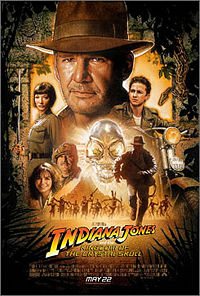
The Kingdom of Indy, Skullduggery and All

Meditations before May 22nd: Indiana Jones and the Kingdom of the Crystal Skull

My wife recently picked up the first three Indiana Jones movies at a garage sale, and my boys have loved watching them, discovering the movies that I remember fondly from my years growing up. Of late, anything—a piece of rope, a broken bead necklace—has become an instant stand-in for Jones’ whip in our house.

In the first movie, I recall so well how Indy fought all the Arabs, punching and whipping his way free as he searched for the kidnapped Marion. Then that deadly swordsman appeared, twirling his blades madly. Oh, the humor and perfection in that moment when Indy pulled out his gun and shot the bad guy. Harrison Ford actually came up with the idea when, bored after too many takes, he did just that. One of those cherished moments from my childhood movie memories.

As a recent NPR piece on Indiana Jones and archaeology put it, Dr. Jones is “handsome, and he can beat up most anybody. He’s definitely a stud — with tenure.” But is he saving history or stealing it?

The Story on Archaeology

Archaeologist Winifred Creamer makes no bones about it: “You could say Indiana Jones is the worst thing to happen to archaeology, because Indiana Jones has no respect for anybody and anything. Indiana Jones walks a fine line between what’s an archaeologist and what’s a professional looter.”

But Creamer also confesses that students love Indiana Jones. As one student puts it, “I thought it was damn cool. I wanted to do that… (Indy) does everything that all archaeologists would like to do. Go on crazy adventures, fight bad people, not steal stuff but save it from being destroyed by the bad guys.”

That becomes a hook for Creamer: “They come in thinking that they are going to talk about pyramids and gold and serious cool stuff. Instead, people want to talk about tree-ring dating and radiocarbon dating and the atmosphere, so some are really turned off by it. Others are intrigued by puzzling out an answer and the problem-solving aspect of it, and some of them stick around.”

Creamer notes that a “true archaeologist is more interested in the context” of the whole tomb, rather than destroying it to get one artifact. The tomb can tell us about life in a past culture—that is our true treasure. And that treasure comes through the gathering of data, not pieces to show off. Rather than tomb raiding, it’s painstaking excavations. This type of good science, coupled with modern-day anthropological comparisons, tells us a lot more than solving the mystery of one covenant on film.

Indy and Science

Love vs. the worst thing, destruction vs. truth—obviously anthropologists are ambivalent about Indiana Jones. The archaeologist Cornelius Holtorf writes in The New Scientist that “Indiana Jones Is No Bad Thing For Science.” This charismatic hero gives the field popularity. What other fields have such a great figure to attract interest? And, besides, just as with sci-fi movies and real space travel, audiences can distinguish between fact and fiction.

But as Holtorf also notes:

What weighs far more seriously is the criticism that elements of the film scripts communicate highly objectionable values. The adventures of Indiana Jones are premised on an imperial world in which western archaeologists routinely travel to the far corners of the globe in order to retrieve precious artefacts and save the world from Evil, giving the impression that the world is dependent on intervention from the west. Moreover, the films draw on a long cinematic tradition of portraying archaeology as the domain of white, heterosexual, able-bodied and comprehensively talented men who live though action-packed adventures in foreign countries.

Continue reading “The Kingdom of Indy, Skullduggery and All”

Nikolas Rose, Neurosociology, and Neurochemical Selves

Nikolas Rose, a well-established sociologist at the London School of Economics, has become increasingly interested in how the brain sciences and sociology can constructively interact. Like many of us, his own intellectual history reflects this; originally trained as a biologist, he then switched to psychology before finally ending up in sociology. His older research centered on “social and political history of the human sciences, on the genealogy of subjectivity, on the history of empirical thought in sociology, and on changing rationalities and techniques of political power.”

Today, Rose has turned to “biological and genetic psychiatry and behavioural neuroscience, and its social, ethical, cultural and legal implications.” He has a recent book, The Politics of Life Itself: Biomedicine, Power, and Subjectivity in the Twenty-First Century. Here is one review describes it:

From tattoos to organ transplants, cosmetic surgery to circumcision, obsessive dieting to exercise, the practice of manipulating bodies is increasingly widespread. But have we passed into a new phase of manipulation evidenced by the prevalent use of medicine to adjust our moods, enhance sports performance, slow ageing or alter fetuses? Nikolas Rose . . . argues that a threshold has been crossed into a world of ‘biological citizenship’ in which humans view themselves at the molecular level, medicine is based on customization, and biology poses fewer and fewer limits on life.

On his site, Rose has several downloadable papers on topics such as biological citizenship and Foucault. But I’ll focus on one entitled “Becoming Neurochemical Selves.” As he opens the paper, Rose asks, “How did we come to think about our sadness as a condition called ‘depression’ caused by a chemical imbalance in the brain and amenable to treatment by drugs that would ‘rebalance’ these chemicals?” The chapter then presents an historical and sociological treatment of how we have gotten to this point, focused on pharmaceuticals. But as he notes, he could have just as easily started with brain imaging or genomics.

Continue reading “Nikolas Rose, Neurosociology, and Neurochemical Selves”

The Neural Buddhists of David Brooks

It definitely appears that the New York Times columnist David Brooks is on a neuroanthropology kick. Today he’s published an editorial called The Neural Buddhists, which complements previous ones on globalization and cognition and demography and cultural identity.

Brooks’ editorial comes down to three things: dispatching soulless science; presenting the new touchy-feely brain; and taking on our culturally hard-wired Protestantism.

Richard Dawkins stands in nicely as the representative of the old science—genetic determinism, lumbering machines, neo-Darwinian atheism. Tom Wolfe, as Brooks points out, described this world view well in his essay Sorry, But Your Soul Just Died. On this site Greg fought the good fight against Dawkins’ memes in February, while I had fun taking on Dawkins’ protégé, Steven Pinker, and his argument about hard-wired morality back in January.

Unfortunately for people like Dawkins and Pinker, but fortunately for the rest of us, the brain plays a different game. Here’s what Brooks says about the new neuroscience:

The brain seems less like a cold machine. It does not operate like a computer. Instead, meaning, belief and consciousness seem to emerge mysteriously from idiosyncratic networks of neural firings. Those squishy things called emotions play a gigantic role in all forms of thinking. Love is vital to brain development.

Ah, music to my ears. Indeed, Greg took down the computer metaphor some weeks ago. I wrote on emotion’s role in decisions making (sorry, rational-genetic man). Still, a lot of old brain crap gets out in both scientific journals and the popular press. So Time Magazine’s version of love, the not-quite touchy-feely view, got Hannibal Lecterized at the start of the year.

Continue reading “The Neural Buddhists of David Brooks”

Nicholas Kristof in Colombia

Nicholas Kristof recently wrote an editorial about Colombia, free trade, and human rights entitled Better Roses Than Cocaine. He argued there that “Some Democrats claim that they are against the pact because Colombia has abused human rights. Those concerns are legitimate — but they shouldn’t be used to punish people like Norma Reynosa, a 35-year-old woman who just may snip the flowers that go into the Mother’s Day bouquet that you buy.”

He notes, “Colombia’s progress has been immense. Assassinations of union members, while still a problem, have fallen 80 percent since 2002. Last year, the murder rate for union members was 4 per 100,000, reaching levels far below the homicide rate for the general public.”

He finishes by writing, “To their credit, a large group of prominent Democrats from previous administrations have strongly endorsed the trade accord, declaring that it is ‘in both our vital national security and economic interests.’ But the presidential candidates aren’t listening. Democrats instinctively criticize Mr. Bush when he harms America’s standing in the world. That’s easy. But a test of intellectual honesty is your willingness to hold your own side to the same standard and to point out pandering in those politicians you normally admire.”

I have written previously on the controversy over free trade and Colombia. And Kristof’s readers responded in volume to his editorial, so check them out as well—lots of good critique. Finally, there was a video that went along with his stay in Colombia, so from the Bogota savannah landscape to the voices, as well as the coverage of these same issues, I recommend a look: