
Continue reading “Multimodal Redundancy”
Cognition and Culture Institute website

Olivier Moren just got in touch to tell us that the International Cognition and Culture Institute has just opened a new website/blog at http://www.cognitionandculture.net. I just surfed over to check it out, and there’s already plenty of stuff happening. Although it’s a new site, there’s a lot of good content already, and a formidable group of writers, from the sound of it. The writers used to have the AlphaPsy blog on humanities and human nature, but that site hasn’t had any new postings in a while, so it’s nice to have the group back with new material.
The International Cognition & Culture Institute comes out of the Department of Anthropology and apparently the Department of Political Science of the London School of Economics and Political Science with support from the Institut Jean Nicod (ENS, EHESS, CNRS) in Paris. Their website also includes a section for job listings (excellent!) and an intriguing note about a grant competition coming up in 2009:
Sometime in 2009, we will hold a small grant competition. Successful applicants will be funded to carry out the same research task in a variety of cultural settings, thus generating a body of comparable data
I’ll be interested to see what they come up with and the resulting data.
Although I’m fascinated by cognitive anthropology, cross-cultural psychology, and the field that we might describe as ‘culture and cognition,’ I often feel that some of the stuff that we do at Neuroanthropology doesn’t sit well within the ‘cognition’ category. I’ve been thinking about this a lot as I put together thoughts for a book proposal, but I worry that — nifty alliterations aside — the term ‘cognition’ puts front and centre certain qualities of the brain, body, and nervous system, and (even unintentionally) marginalizes other qualities, some of which I’m particularly interested in. Of course, the term ‘neuroanthropology’ has problems, too, as we’re just as interested in the effects of culture on the skeleton, muscle tissue, endocrine system, and other viscera as we are upon the neural wetware.
All reservations aside, I’m really happy Olivier contacted me. I’ll be putting their site on our blogroll (if Daniel hasn’t beaten me to it) and keeping a close eye on what they produce. Looking forward to the online seminars and more about the comparative projects that the Institute is able to sponsor.
A typical day of fieldwork
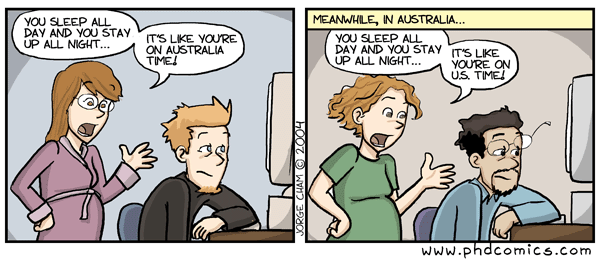
Cartoon by Jorge Cham from www.phdcomics.com
Australia is a beautifully multicultural country, which means that fruitful and efficient pre-fieldwork training and post-fieldwork analysis can be done in Sydney. Or does it?
The Encultured Brain at the AAAs
One month from today, on November 20th, Greg and I will convene our panel “The Encultured Brain: Neuroanthropology and Interdisciplinary Engagement” at the 2008 American Anthropological Association annual meeting. The meeting is being held at the Hilton San Francisco, right in the heart of the city, and our session kicks off at 8:00AM and runs to 11:45AM. We hope some of you will come!
Here is what our panel will address:
As a collaborative endeavor, neuroanthropology aims to better integrate anthropology, social theory, and the brain sciences. In this panel, we explore the implications of new findings in the neurosciences for our understanding of culture, human development, and behavior. Neuroanthropology can help to revitalize psychological anthropology, promote links between biological and cultural anthropology, and strengthen work in medical and linguistic anthropology. However, recent anthropology has not engaged neuroscience to produce the sort of synthesis that began when Franz Boas built cultural anthropology from psychophysics.
Neuroscience has increasingly produced basic research and theoretical models that are surprisingly amenable to anthropology. Rather than “neuro-reductionist” or determinist approaches, research has increasingly emphasized the role of environment, body, experience, evolution, and behavior in shaping, even driving organic brain development and function. At the same time, the complexity of the brain makes a mockery of attempts to pry apart “nature” from “nurture,” or to apportion credit for specific traits. Research on gene expression, endocrine variability, mirror neurons, and neural plasticity all beg for comparative data from across the range of human variation — biological and cultural.
Neuroscientists and other social scientists are already actively working on these sorts of integrated models; books like Wexler’s Brain and Culture and Quartz and Sejnowski’s Liars, Lovers and Heroes actively incorporate anthropological materials. In the social sciences, books like Turner’s Brains/Practices/Relativism aim to bring neuroscience into social theory, often with critical intent.
However, these works often leave out the best of anthropology. Although our research is being borrowed, we are being left out of the conversation precisely at a time when we should speak with authority. In the present round of integration, simplistic understandings of culture dominate, and, at times, outside authors read our research through unsettling ideological lenses. And, given the emphasis on experience, behavior, context and development, the absence of ethnographic research and insight into precisely those domains that impact our neural function is startling.
Anthropology has much to offer to and much to learn from engagement with neuroscience. An apt model is just how important genetics has become in anthropology, cutting across the entire discipline. A similar revolution is waiting with neurobiology, if we can draw on our strengths and build neuroanthropology on inclusion, collaboration and engagement, both within and outside anthropology. To this end, this session explores areas of anthropological research related to the brain where heredity, environment, culture and biology are in complex relations, with human variation emerging from their nexus rather than being determined by a single variable. Participants explore addiction, motor skill, autism, mental disability, and other brain-related phenomena that can only be explained by dynamic models including both “bottom-up” (biological, neural, and psychological levels) and “top-down” (cultural, social, and ideological) factors. Participants highlight that no single model of the biological-cultural interface holds for all cases. The papers in this panel also suggest ways in which anthropologists might intervene in public discussions of crucial human characteristics and make our concerns more persuasive for other academic disciplines exploring the complexity of the human brain.
We have a great group of presenters. This is the order, complete with talk titles. Greg and I will post more information about each talk in the days to come, so stay tuned for that.
Daniel H. Lende (University of Notre Dame) Ethnography and the Encultured Brain: Design, Methods and Analysis.
Peter Stromberg (University of Tulsa) Exploiting Autonomic Processes to Shape Ideas: An Example from Early-phase Tobacco Use.
Rachel S. Brezis (University of Chicago) Autism and Religious Development: A Case for Neuroanthropology.
Harold L. Odden (Indiana University-Purdue University, Fort Wayne) Ethnopsychologies and Children’s Theory of Mind: Finding Common Ground between Anthropology, Psychology, and Neuroscience.
Christina Toren (University of St Andrews, Scotland) Inter-subjectivity and the Development of Neural Processes.
Ryan Brown (Northwestern University) The Brain in Culture: Emotional Responses to Social Threats.
Katherine C. MacKinnon (Saint Louis University) and Agustín Fuentes (University of Notre Dame) Primate Social Cognition, Human Evolution, and Niche Construction: A Core Context for Neuroanthropology.
Cameron Hay-Rollins (Miami University of Ohio) The Relevance of Neurology to an Indonesian Healing Tradition.
Rebecca Seligman (Northwestern University) Cultural Neuroscience and the Anthropology of Dissociative Experience.
Greg Downey (Macquarie University, Australia) Balancing Between Cultures: A Comparative Neuroanthropology of Equilibrium in Sports and Dance.
We also have three outstanding discussants for our panel:
Claudia Strauss, Pitzer College
Naomi Quinn, Duke University
Robert Sapolsky, Stanford University
Here is our entire Encultured Brain AAA proposal for those of you who are interested.
Ian Kuijt and Guns, Germs & Steel
Ian Kuijt, my colleague here at Notre Dame, is an archaeologist who has specialized in the origins of agriculture, food storage, and the emergence of social inequality. He appeared in the PBS series Guns, Germs and Steel, based on the best-selling book by Jared Diamond. So it is my pleasure to present that particular clip from the PBS documentary , where Ian discusses the emergence of food storage, agricultural practices, and changes in social complexity.
The clip with Ian Kuijt is prefaced by segments one and two on You Tube. You can click here for all the clips (1-18) from the series. Ian also has a lot of good online material about the Dhra site itself.
In the documentary, Diamond argues for an ecological approach to human history, where local ecology, microbes and geography make a large difference in which societies demonstrate “progress” or “civilization.” There is a Wikipedia site on Guns, Germs and Steel, where both Diamond’s basic argument and some relevant criticisms are presented.
If you want something directly from the horse’s mouth, here is a short interview with Diamond. He also has a longer, but still accessible, essay over at Edge. And finally Diamond discusses why agriculture isn’t all that great for human health in this essay entitled The Worst Mistake in the History of the Human Race.
Neuroprospecting: Mining cultures for neuro-behavioural data
Bioprospecting: pursuit of plant-derived chemicals for pharmaceuticals: the process of searching for and extracting potential pharmaceutical compounds from plants.
Neuroprospecting: pursuit of culture-specific behaviours for neuroscience: the process of searching and extracting potential neuro-behavioural data from cultures.
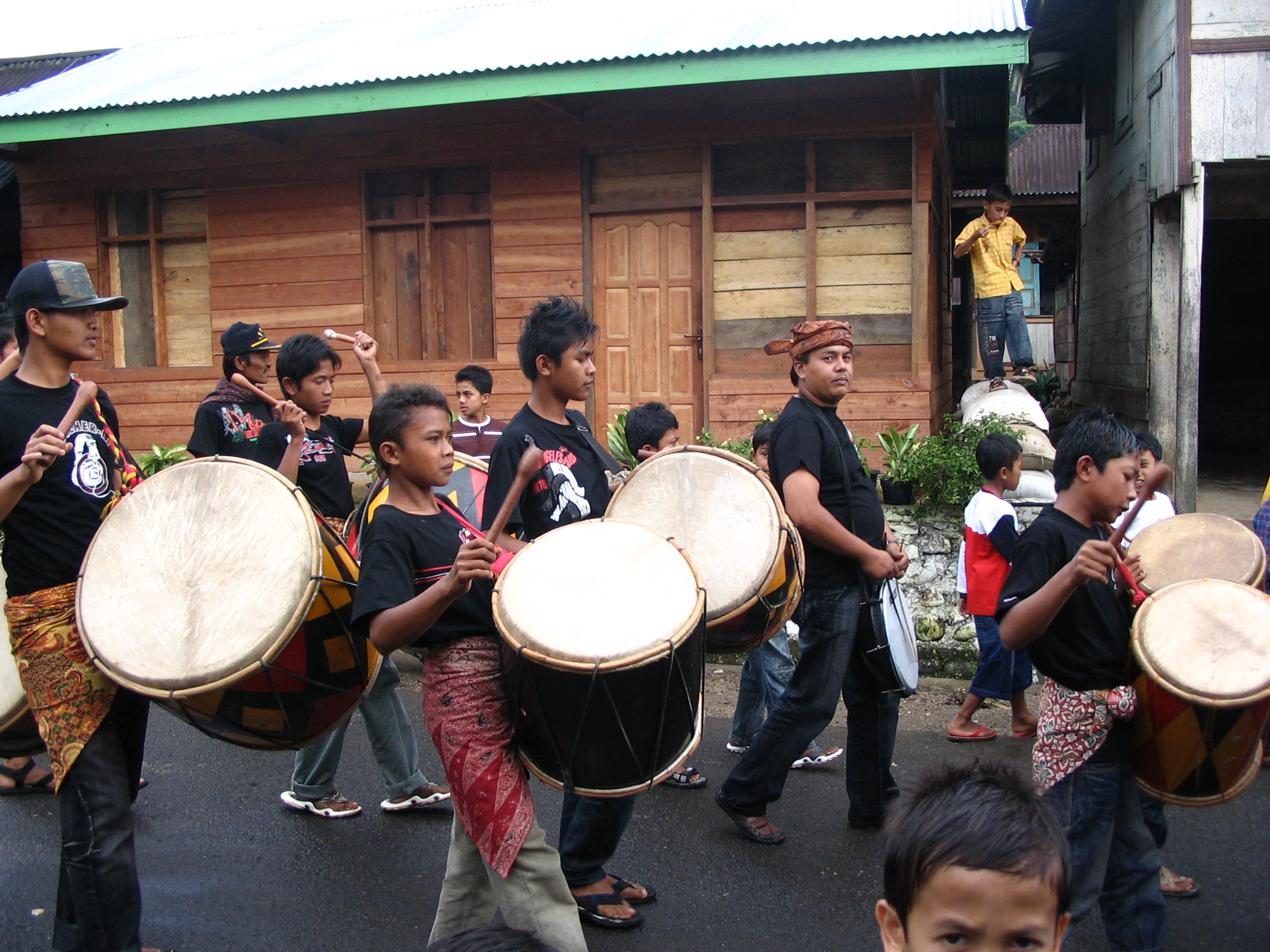
Group Sari Bunuan Macan Andaleh play Gendang Tambuah in a procession
Photo: Paul Mason
Continue reading “Neuroprospecting: Mining cultures for neuro-behavioural data”
 Neuroanthropology