Reply below and let us know how you would complete this quote:

“In collaborative research with dancers, scientists can…”
Continue reading “Complete this quote: “In collaborative research with dancers, scientists can…””

Reply below and let us know how you would complete this quote:
“In collaborative research with dancers, scientists can…”
Continue reading “Complete this quote: “In collaborative research with dancers, scientists can…””
Do you ever think about urban populations in terms of sustainability, Complex systems analysis or Resilience theory? Do you ever think of human communities in terms of Dunbar’s Number, cognitive health or overpopulation? Okay, before I overwhelm you: Free your mind. Reply below and let us know how you would complete the following quote:

Continue reading “Complete this quote: “From a systems standpoint, what cities are doing is…””
Basic plus one – top of the list, mind, anthropology, and addiction.
Top of the List
James Fowler and Nicholas Christakis, Cooperative Behavior Cascades in Human Networks
New full-access PNAS paper on social networks and cascades of behavior. For good commentary, see The Frontal Cortex and Not Exactly Rocket Science
Maximilian Forte, Multiplying Human Terrain Dreams of Victory and Fortune
Zero Anthropology examines the non-zero-sum game approach to expanding the use of social science for military ends
Ed Yong, An 60,000-year Old Artistic Movement Recorded in Ostrich Egg Shells
Very cool. Decorative ostrich shells many, many generations ago. Art is old.
John Hawks, Fat Rats
Lab rats come with starting conditions – they are not the representatives of “nature” that scientists have often assumed. In this case, studies on caloric restriction might be flawed because rats started from an unhealthy baseline, and thus any improvement extends their life
Nicholas Wade, Human Culture, An Evolutionary Force
Nice summary of recent research on how culture, broadly conceived, shapes natural selection.
Michael Smith, Blogs Don’t Get No Respect
Good rant about how American Anthropologist’s short piece on cultural anthropology blogs isn’t really all that
Mind
The Neurocritic, Depression’s Cognitive Downside
A critical look at Jonah Lehrer’s recent piece that covered evolutionary proposals about the adaptive benefits of depression; here the impairments come to the fore
 By Jenny Heil, Brendan Durr, Jon Lopez, Mac Kenzie Nunez, Mark Flanagan
It’s 3:00 AM and you finally decide that it is safe to venture out to the 24-hour Wal-mart. Not totally safe, mind you, but at least almost no one will be there—less potential threats to worry about…
You get home, and sleep in your chair. Sleeping in the bed is too vulnerable…
You wake up, and hear a loud bang. Automatically, you know it’s a bomb, and grab the enemy by the throat…
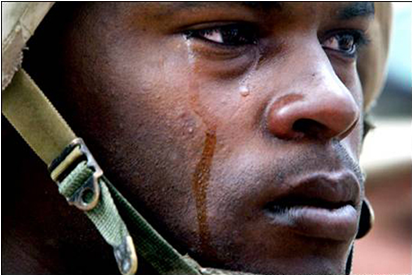
Veterans may leave the war zone, but they can never escape the war. For those who return from war with post traumatic stress disorder (PTSD), they constantly live as though their minds and bodies are still at war.
Fear of crowds and intense anxiousness around others. An inability to feel safe while sleeping. Flashbacks and nightmares, often triggered by sudden or loud noises. Always feeling like even the people closest to you are the enemy, poised for attack.
Veterans are living in this reality. As many as one in four veterans will experience PTSD, according to Dr. Michael Sheehan, a psychologist specializing in PTSD. PTSD is a disorder that can happen as a result of many kinds of trauma, and is especially prevalent in veterans of war.
People with PTSD may constantly relive the trauma of war (through flashbacks and nightmares), may try to avoid places and events that would cause memories, and may be easily startled and constantly feel on edge.
While PTSD is often not recognized as the same as other battle wounds, the experience of veterans verifies that PTSD is real. We hope that the information that we provide here will help you understand the experience of PTSD.
If you recognize the symptoms of PTSD as ones you experience yourself, please consider seeking help by joining a support group for veterans or talking to a psychologist or physician.
Our Research
We are a group of five Notre Dame undergraduate students who, over the course of a semester, have interacted with a group of veterans with PTSD in an attempt to better understand the experience of PTSD.
Continue reading “Post-Traumatic Stress Disorder: Getting Help Early to Feeling Welcomed”
Complete this quote:

“Musik dan tari dibuat oleh otak, dipengaruhi oleh kebudayaan dan tergantung kepada…”
“Music and dance are produced by the brain, influenced by culture and depend upon…”
By Daniel Lende
How can anthropologists reach a wider audience? Good debate on that question has sprung up in recent weeks at Savage Minds, Culture Matters, and Ethnografix. We’ve also written about this question here. Now it’s time for a synthesis.
Five Ideas for Reaching a Wider Audience
-Write about something specific
-Make our work relevant to readers
-Build appeal
-Move beyond critique
-Provide alternatives and how-to ideas
Write About Something Specific
Sometimes our love of anthropology as a field gets in the way. Most people are interested in specific topics, not the latest theoretical debate. They get engaged by stories and want to learn something concrete or new.
So rather than writing jargon-laden versions of “OMG anthropology is the best ever,” we should write about the topics and stories that capture people’s attention. Once we have their attention, we can also communicate why anthropology matters. We have great material, we just need to use it better.
As Ryan Anderson at Ethnografix writes:
Nobody–or very few people–are going to read books that are ABOUT the discipline of anthropology itself. And it seems to me that many of [our] general audience books are more about anthropology and its UNIQUE perspective and less about an actual subject, event, or issue…
As an analogy, this is like the difference between publishing a book that is ABOUT photography versus publishing a book that is a photographic essay. Huge difference. One will appeal mostly to photographers, and the other might have the possibility to appeal to a much different audience, depending on what it’s about.
To quote Henri Cartier-Bresson:
“Photography is nothing – it’s life that interests me.”
So what does that mean for anthropology? Maybe it means that we need less books about anthropology and more books by anthropologists about the ideas, subjects, events, issues, debates, stories, and experiences they know best.
Anthropologists share that passion with Cartier-Bresson – it is life that interest us. That is our strength. More than any other field, we embrace human life. Rather than foreground our reflexivity or the importance of this theoretical model or that, we should focus on what captures our own attention. Other people outside of anthropology also care about people’s lives, and they want to learn more – focusing on that will build a broader audience.
The proof is in the pudding, the saying goes. And here on Neuroanthropology.net, our most popular posts fit this “about something” model. Co-sleeping, barefoot running, and post-traumatic stress disorder all focus on a specific topic.
Make Our Work Relevant To Readers
Some of the recent online debate has centered on what anthropology can learn from journalism. This is an important topic, particularly for learning how to best communicate with a broad audience. But the simple fact remains – we are not journalists, we are anthropologists.
Continue reading “On Reaching a Broader Public: Five Ideas for Anthropologists”
 Neuroanthropology