Why We Love, The Time Magazine Version

Too bad Jeffrey Kluger didn’t pay closer attention to Hannibal Lecter.  He might have written a better article on “Why We Love,” out this week in Time Magazine, instead of giving us a flawed view of evolution and brain research.  Still, in furtive glimpses of data, rather than quick quotes and pop theories, another way to think about love glides onto stage. 

As I told my anthropology students yesterday, the initial assumptions we make so often dictate our ideas and our results.  But those assumptions are generally presented as “facts” or assertions of truth, part of an unassailable background.  So here are the ones packed into Kluger’s piece, right there at the beginning: (1) that humans rely on our wits, so “losing our faculties over a matter like sex” needs explaining (in other words, humans are rational, why have primitive passions); (2) that we evolved in a “savanna full of predators,” so getting distracted by love could be potentially dangerous, (3) that our genes have “concerns,” primary among them to make us reproduce as much as possible (“breed now and breed plenty gets that job done”), and (4) that we can extend these sorts of explanations to all “the rituals surrounding” sex, love and relationships (like a bunch of scientists drunk on their own ideas—explanatory expansion gone wild!). 
Continue reading “Why We Love, The Time Magazine Version”

Steven Pinker and the Moral Instinct

By Daniel Lende 

Steven Pinker is selling something.  Here’s what’s on the table: “the human moral sense turns out to be an organ of considerable complexity.”  This organ has been built into our brains by evolution, culture-free except for how its five domains (harm, fairness, community, authority, and purity) are “ranked” and “channeled” in different places around the globe.  Ready to buy? 

Let’s sweeten the deal.  Pinker is offering his “deeper look” which will help you “rethink your answers” about life and morality.  He’s providing “a more objective reckoning” to help people get over their moral “illusions.”  And he’s got the data to show it, from people in the lab, Web sites, and brain scanners.  (I can’t help asking, these are his moral examples?  People in artificial situations, people who don’t physically interact, and a series of images?)  Continue reading “Steven Pinker and the Moral Instinct”

Paul Mason: Slides on Neuroanthropology

Paul Mason has sent me PowerPoint slides on Neuroanthropology that draw upon a lot of the same resources that he cited in an earlier post I put up on his behalf. Paul’s in the field in Indonesia, and he writes in sometimes from internet cafes, but we should eventually have him as a regular contributor when he’s back with some regular Internet access. And then he can also tell us more, too, about his own research.

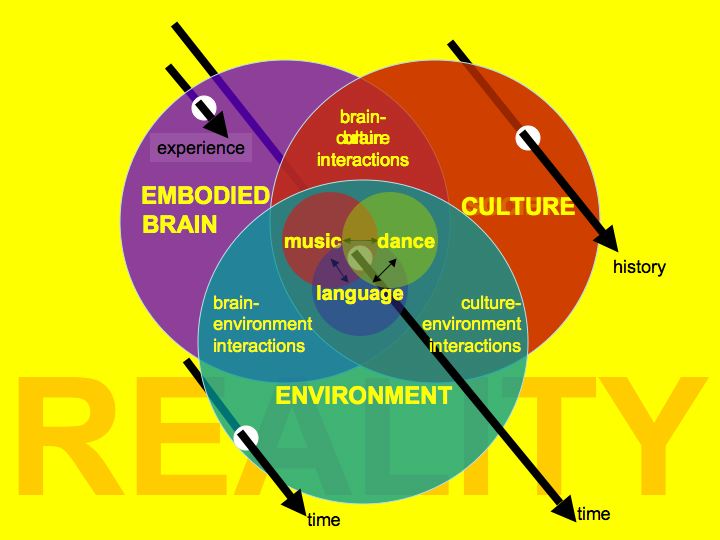
Paul includes a number of choice quotes, but I wanted to make sure that everyone got a chance to see his diagram of a systems-based approach to ‘fight-dancing’ in cultural, biological, and ecological context (in both Indonesia and Brazil). It’s a rich diagram, and I think that we, as neuroanthropologist, will need to do a lot of complex visualization in order to make our points to a broad audience. Paul must get all the credit for this one.Mason slideIn the meantime, i don’t yet have a complete bibliography on this material, so we’ll have to get in touch with Paul if anyone really wants to get the sources he’s using. He sent this about a month ago, and I was not clear on how to post PowerPoint slides, but I think it’s pretty straightforward. We’ll see….neuroanthropology.ppt

Big Theory and Our Biocultural World

Recent books with widespread public acclaim show that the biological and cultural approaches claimed as proper to anthropology are now part of the common social science agenda.  My question is, where does this leave anthropology?  

Certainly the rather ham-handed combination of biology and culture in these books leaves anthropologists with the familiar refrain of criticism and particularity.  But do we have a genuine alternative?  Do we have a big theory to offer? And if not, are we on track to get one?   

The books in question are Gregory Clark’s A Farewell to Alms: A Brief Economic History of the World and Lee Harris’ The Suicide of Reason: Radical Islam’s Threat to the Enlightenment.  They are both provocative books, with forceful theses and grand-standings authors, a tried-and-tested recipe for popular books in the intellectual vein.  I am not particularly concerned with each of their theses today, but here they are anyways. 

For Clark, it is that the Industrial Revolution was driven by the successful over-reproduction and downward social mobility of the upper classes, complete with their literacy, discipline, and delay of gratification.  For Harris, it is that the West, by being too wed to reason, fails to understand the radical threat represented by how Islam has spread through the world.  I am sure that many anthropologists will use these books as their favorite new targets. 

Rather, what interests me is the style of argument that they use to buttress their main point.  Continue reading “Big Theory and Our Biocultural World”

neuroanthropology and race- getting it straight

This is a response to the post by Doublehelix re: races and human biology emerging out of Daniel Lende’s post on IQ and environment..  The issue of human biological units and intelligence/cognition is very old and seems to keep appearing despite serious problems in the way the positions are most commonly framed.  This is a core factor in discussing neuroanthropology.  It is extremely important to realize that if you are going to use race as a biological unit then you must define it!  I would like to ask Doublehelix to present a definition of human groups that are consistently identifiable by a set of biological characteristics that separates them from other such groups.  There is no argument that human populations, both regional and meta-populations, vary in a number of biological characteristics.  However, are these evolutionary units or of evolutionary relevance?  Are there functional differences across human groups (once you are able to define what you mean by group).

Discovering shared frequencies of alleles in regional and meta-populations is expected via standard models of gene flow.  However, globally humans break the standard models of gene flow by their very low inter-population variation relative to species wide variation (not to discount the reality of a lot of variation across the geographical distribution of our species and huge inter-individual variation)…Doublehelix uses the Risch and other  articles to refute this, but ignores all of the work by many, many others (see below for a sample) that discuss and explain why one might see clustering of some allelic variation as associated with geography, and what that might or might not mean in an evolutionary sense. We are well beyond Lewontin 1972…  Allele frequency clusters are not races or even biological units…the association of function with specific distributions of frequency patterns of various alleles can and should be done, but has to be done with extreme care and we must play by the biological rule book.  If you are comparing biological units they must be biologically, not socially, defined.

The statement “As for the notion that race is not supported by biology, I ask: Why do races differ so profoundly in so many different characteristics, such as IQ, lactose tolerance, the resistance to malaria, skin and hair color, the effectiveness of certain drugs?” is rooted in a severe simplification…for example, lactase production is widespread across 100s of human populations with peaks in Northern European, east African and even middle eastern populations…so what does it say about race?  Malaria resistance via one of the 5 sickle cell mutations occurs with high frequencies in West Africa, but also South West Asia and the Middle East?  What race is that?   Hair color ands type are widely distributed…but not markers of unity…for example if having tight curly black hair unified groups then populations in Papua New Guinea and Nigeria would be linked…they are not.  As for drug differences, this is a very important and complex area of investigation where we actually see some amazing integration of social, physiological and contextual patterns (see recent BiDil research) but not clear patterning of socially defined races as showing any specific identifiable bio-based markers.


Continue reading “neuroanthropology and race- getting it straight”

Cave men in classrooms by Prof. Roger Schank

Roger Schank, founder of the Institute for the Learning Sciences at Northwestern University, John P. Evans Professor Emeritus in Computer Science, Education and Psychology, and author of about twenty books, gives us an offering on evolution and education on The Pulse, the blog of District Administration, an educational organization. His posting, Cave Man Didn’t Have Classrooms, borrows from the idea that we are gastro-intestinal ‘cave men’ eating twenty-first century (read: ill adapted) diets, using it to criticize the Western approach of education. As he puts it, cleverly, we are ‘still’ cave men (we’ll be back to that point): ‘We just wear better clothes.’

I take seriously the idea that, biologically, we are still cave men. And, mentally we are cave men as well. Just as we were evolved to live off the land without excessive alteration to what we find there, so have we evolved to think and learn in a certain way, a way that may not be consonant with how we think we think, and how we learn in the modern world.

He goes on to paint absurdist images of ‘cave men’ learning through lectures in class rooms to highlight the fact that human brains may not learn well by sitting quitely and listening. Prof. Schank writes:

Why do these images seem absurd? Because, we imagine, that cave men taught their children by example. We imagine that they took them along on the hunt when they were ready and that they practiced, by playing, prior to that. We assume, that learned to build shelters by doing simple tasks first and that they learned to defend against predators by watching and later helping. We don’t really have to imagine this very hard, as there are primitive societies where this still takes place today. In fact, prior to the idea of mass compulsory education, like that of mass feeding, we knew how to educate children properly, that is in the way that their minds were set up to work after 1,000,000 years of evolution. Instruction in cave man society, indeed in all societies until very recently, was by long-term apprenticeships. Knowing was not valued. Doing was seriously valued.

Continue reading “Cave men in classrooms by Prof. Roger Schank”