Wednesday Round Up #8

General

Robert Sapolsky, A Natural History of Peace
Foreign Affairs full-text article: humans, like most primates, make their own peace

Michael Gazzaniga, Are Human Brains Unique?
We’ve got big brains. So what?

Michael Wesch, Anti-Teaching: Confronting the Crisis of Significance
Pdf article bringing together Wesch’s work with digital ethnography, blogging, and participatory research with students—highly recommended

Carl Zimmer, The More We Know about Genes, The Less We Understand
The power of robust regulation: gene networks take the day

Nikhil Swaminathan, Can the Brain Be Rebooted to Stop Drug Addiction?
Brain pathways, neural plasticity, and searching for a reset switch

Arthur Caplan, Intelligent Design Film Far Worse Than Stupid
“Ben Stein’s so-called documentary ‘Expelled’ isn’t just bad, it’s immoral”

Happiness

Sue Halpern, Are You Happy?
New York Review of Books piece on the recent batch of happiness pop sci books

Continue reading “Wednesday Round Up #8”

How well do we know our brains?

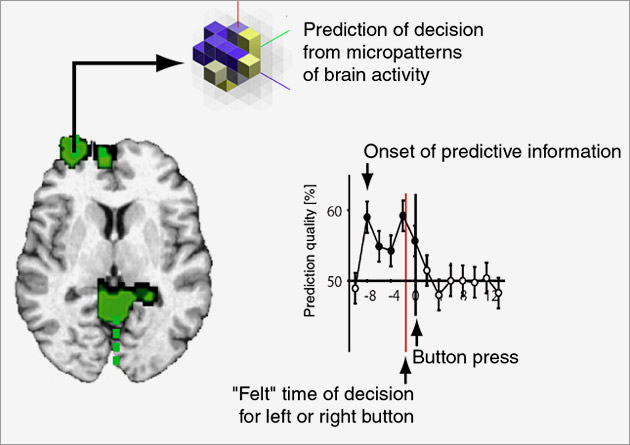
Blogging on Peer-Reviewed ResearchMaking the rounds of neuro-related sites on the web is a recent story from Wired, Brain Scanners Can See Your Decisions Before You Make Them, by Brandon Keim. It’s an interesting short piece on an even more interesting research paper by Chun Siong Soon, Marcel Brass, Hans-Jochen Heinze and John-Dylan Haynes forthcoming in Nature Neuroscience (abstract here). But like so much in the science writing about neurosciences, the piece leaves me feeling like either I don’t get it or science writers really don’t understand the significance of basic brain research. I won’t dwell too much on my issues though with the science writer because I want to really consider the relationship between brain activity and experience, or what role phenomenology might serve in neuroanthropology (besides, I’ve been railing at science writers a bit too much of late…).
Brain areas that predict decisions.  By John-Dylan Haynes.  Wired.
From Keim’s article, we have this explanation of Haynes’ work:

Haynes updated a classic experiment by the late Benjamin Libet, who showed that a brain region involved in coordinating motor activity fired a fraction of a second before test subjects chose to push a button. Later studies supported Libet’s theory that subconscious activity preceded and determined conscious choice [I have a problem with that phrase, especially ‘determined’] — but none found such a vast gap between a decision and the experience of making it as Haynes’ study has….
Taken together, the patterns [in frontopolar cortex and then parietal cortex] consistently predicted whether test subjects eventually pushed a button with their left or right hand — a choice that, to them, felt like the outcome of conscious deliberation. For those accustomed to thinking of themselves as having free will, the implications are far more unsettling than learning about the physiological basis of other brain functions.

The Libet research is a classic piece (I don’t know if it makes any top 100 lists, but it’s especially important to those of us interested in motor action). The problem seems to be forcing Haynes’ data — which confirms Libet’s older research about the subconscious activity that precedes conscious awareness of ‘choice’ — through a folk theory about ‘free will’ being a necessarily conscious activity setting in motion a chain of mind events leading up to action. Folk understandings posit the existence of ‘The Decider’ in the brain, a kind of uncaused cause, the prime neural mover, which is conscious.

Bottom line, as far as I’m concerned: the research can’t be proving whether or not we have ‘free will’ because ‘free will’ is fundamentally about constraints on ‘will’ (itself a fuzzy concept when you’re looking at brain imaging). That is, the research would have to examine not what the brain does when it makes a choice, but whether that brain activity was constrained by something external to the person. After all, if we say that a person’s ‘free will’ is limited by their brain, that doesn’t really make sense now, does it? Presumably, acts of a ‘free will’ would also be determined by the brain, wouldn’t they? For the brain to ‘constrain’ our own ‘free will,’ it would have to be a thing separate from us.

What the research is showing, however, is something fascinating about the relationship of phenomenology and native categories of mind and how they might intersect with brain science research.
Continue reading “How well do we know our brains?”

Testosterone and cortisol explain market behaviour?

There’s a fascinating post on Testosterone, Cortisol and Market Behavior on the website Pure Pedantry. Normally, I’d have a whole lot of caveats and snarky comments to add, but Jake Young does a great job of handling an original research article by Coates and Herbert, ‘Endogenous steroids and financial risk taking on a London trading floor’ (abstract). You should definitely check out Jake’s post if you find this material interesting, as he deals with the article in greater depth. Unlike in my last piece on ‘neuroeconomics’, Bad brain science: Boobs caused subprime crisis, in which I thought the science writer involved was really responsible, in this case, it looks like the authors of the original study are partly to blame, and Young does a good job of highlighting this issue.

The original research paper examines the links between market risk-taking behaviour among traders with endogenous steroids: testosterone and cortisol. Since both are linked to aggression and stress, this would seem to be a good place to study the body’s response to risk taking. But things don’t go brilliantly, as Young suggests: ‘Let’s file this paper under “wildly over-interpreted” because there are some big caveats that you have to remember before you can make a claim anything like [hormone changes lead to market changes and higher market volatility].’

Continue reading “Testosterone and cortisol explain market behaviour?”

The Decisions They Are-A-Changin’

Bob Dylan sang in his iconic The Times They Are-A-Changin’:

Come gather ’round people
Wherever you roam
And admit that the waters
Around you have grown
And accept it that soon
You’ll be drenched to the bone.
If your time to you
Is worth savin’
Then you better start swimmin’
Or you’ll sink like a stone
For the times they are a-changin’.

Come writers and critics
Who prophesize with your pen
And keep your eyes wide
The chance won’t come again
And don’t speak too soon
For the wheel’s still in spin
And there’s no tellin’ who
That it’s namin’.
For the loser now
Will be later to win
For the times they are a-changin’.

The Waters Have Grown

We are on the verge of a sea-change in our thinking about decision making. Rather than the universal and utilitarian approach of rational choice and subjective rankings, we are coming to recognize that our every-day decisions, the ones that drench us to the bone, that sink or change us, come in the moment. Our choices are driven by often poorly articulated but deeply held values, linked to the meanings culture give us, and shaped by the unequal circumstances of our lives.

Continue reading “The Decisions They Are-A-Changin’”

Social Entrepreneurship

David Brooks has an editorial today, Thoroughly Modern Do-Gooders, about how rich entrepreneurs like Bill Gates and Bill Drayton are turning to philanthropy and social change through a decidedly different model than a generation ago.  The old model?  “The older do-gooders had a certain policy model: government identifies a problem. Really smart people design a program. A cabinet department in a big building administers it.” 

The new do-gooders come with a different view: “[They] have absorbed the disappointments of the past decades. They have a much more decentralized worldview. They don’t believe government on its own can be innovative. A thousand different private groups have to try new things. Then we measure to see what works.” 

Brooks points to the central problem of scalability.  “How do the social entrepreneurs replicate successful programs so that they can be big enough to make a national difference?”  In my classes and talks, I often call this the franchise model, the McDonalds of social change. 

The central assumption is still the “we can drive change” model—through knowledge, market forces, financing and scientific evidence, we can “rebuild him”—we can make a Six Million Dollar Man out of a broken social body, one involved in a terrible accident of history.  It is rather like my critique of behavioral economics in Decision Making and Emotion.  A definite step forward, but leaving too many things out.  It’s still all about the program, not the social context, not the relationships, not the world view, say of black versus white, that might also impact social change.  Find the right techniques, and we can change the world.

Continue reading “Social Entrepreneurship”

Wednesday Round Up #2

On Brains

Susan Greenfield, Bewitched by Bacchae
Meaning, neuronal connections, and Euripides—perfect!

Robert Krulwich and Jad Abumrad, Radio Lab: Into the Brain of a Liar
How big was your fish?  Big-time liars have “more connections in the part of their brains responsible for complex thinking”

Charles Choi, Tiny Brain-Like Computer Created
This chip has dendrites!

Lauran Neergard, Study: Creativity Jazzes Your Brain
Stick a keyboard and a jazz musician in an fMRI, and this is what you get

The Internet

Gamespot, Study Uncovers MMORPG Gender-Swapping Epidemic
“54 percent of all males and 68 percent of all females “gender swap”–or create online personas of their opposite sex”

David Pogue, How Dangerous Is the Internet for Children?
Not as dangerous as the media sometimes says.  Surprise, the context of how you manage the Internet and your children at home makes a big difference in how they interpret what’s online

General Interest

Penepole Green, What’s In a Chair?
Psychiatrists’ offices matter!

Also see Vaughan’s take on this article at Mind Hacks

Nicholas Cristakis, Social Networks Are Like The Eye
The dynamics of social networks

Kevin Lewis, Uncommon Knowledge: Surprising Insights from the Social Sciences
The Boston Globe’s own round up

Continue reading “Wednesday Round Up #2”