
Robert Sampson has just published Disparity and diversity in the contemporary city: social (dis)order revisited in the British Journal of Sociology (BJS). It comes out of the annual BJS lecture that Sampson had the honor to give last fall. This paper focuses on both objective and subjective disorder, in particular highlighting the importance of subjective disorder for understanding the impact of disparity.
In his paper Sampson is basically taking on the Broken Windows approach to disorder, that visible and quite real signs of disorder encourage people to engage in criminal and other deviant acts. In one sense, Sampson wants to bring Durkheim back into the picture, that anomie – or a spirit or sense of disorder – is also vital to sociology.
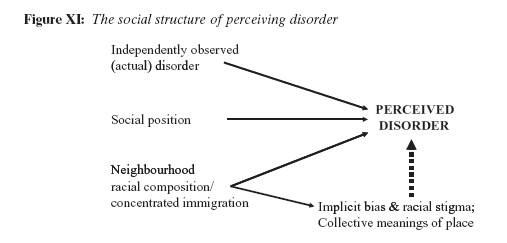
As he says, “My general thesis is that perceptions of disorder constitute a fundamental dimension of social inequality at the neighborhood level and perhaps beyond… I argue that the grounds on which perceptions of disorder are formed are contextually shaped by social conditions that go well beyond the usual suspects of observed disorder and poverty, a process that in turn molds reputations, reinforces stigma and influences the future trajectory of an area (6).”
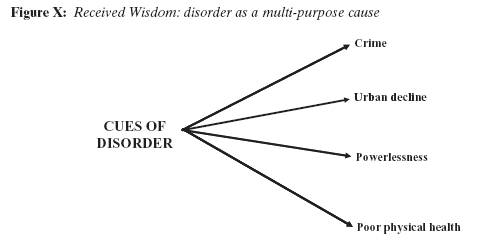
Sampson brings an intriguing mix of photoethnography, historical and theoretical analysis, and quantitative data from Chicago. His main thrust is to say that “because the link between cues of disorder and perception is socially mediated, it is malleable and thus subject to change.” He wants to get away from a mono-causal view of disorder to an understanding of disorder as something more complex and interactive, as these two contrasting figures from his paper show.


 Neuroanthropology