Matthew Taylor on human psychology and political change

One of my students, Nikolas Dawson, hipped me to these nifty animated videos developed from lectures at the RSA, the Royal Society for the encouragement of Arts, Manufactures and Commerce, ‘a cradle of enlightenment thinking and a force for social progress.’ My student was pointing out a video about recent financial crises, RSA Animate – Crises of Capitalism, that combined an edited version of a David Harvey lecture with great animation, but in the process of poking around their website, I realized that there’s an interesting clip for readers at Neuroanthropology.net.

The video is ‘RSA Animate Matthew Taylor: Left brain, right brain,’ and fortunately, it has virtually nothing to say about ‘left brain’ or ‘right brain,’ but is instead a very interesting discussion of the relation between human psychology and the possibility of social and political change. In addition, the animation is great!

The video is linked to the RSA’s project, The Social Brain, which is a platform for a number of expert speakers to discuss how the things we’re learning about the brain help us to understand a range of social issues. If you want to watch the whole video, but without the animation, you can go to YouTube recording of the whole lecture: Matthew Taylor – Left Brain, Right Brain: Human nature and political values. Matthew Taylor has his own blog as well.

The RSA website also has a piece by our colleague, Joan Chiao, ‘Face Value.’ Chiao discusses why some societies seem to prefer hierarchical governments, and others prefer leadership that promotes great egalitarianism, as well as some of the relationship between research on facial preferences and democratic decision making. She concludes:

This cultural diversity in political preferences and structures is proof that our evolutionary instincts for social hierarchy are not cultural destiny and that, through knowledge of where we come from and imagination about whom we may become, we can come closer to building a society with consideration and compassion for all.

For more information about the RSA, especially the Social Brain project, you can read below.

Continue reading “Matthew Taylor on human psychology and political change”

What’s in your gut? Termites, for example

Science News has a fascinating short story, Gut bacteria reflect dietary differences, by Gwyneth Dickey, that highlights one of the ecological dimensions of ‘enculturation’ that I think some symbolic models of culture have a hard time grasping. It turns out that a Western diet produces a less-varied gut ecology in Italian children than was found in African children. Moreover, the old adage ‘you are what you eat’ could apply in a particularly interesting way to those who eat termites.

The original article, Impact of diet in shaping gut microbiota revealed by a comparative study in children from Europe (urban Florence) and rural Africa (Boulkiemde province, Burkina Faso), by Carlotta De Filippo and colleagues, is open access on the Proceedings of the National Academy of Sciences website, so you should definitely surf over there if you find this interesting.

De Filippo and colleagues discuss the microbiome, the ‘complex consortium of trillions of microbes, whose collective genomes contain at least 100 times as many genes as our own eukaryote genome’ (see also Gill et al. 2006). This enormous, varied ecosystem in the gut, a symbiotic community, supplements human metabolic capabilities, provides a first line of defense against pathogens, modulates gastrointestinal development and even informs the configuration of the immune system (paraphrased from De Filippo et al. 2010).

Different gut ecologies brought about both by environmental factors and by food production techniques, dietary preferences, and even food handling practices are one way that human groups might inadvertently induce biological variation in our species, a subtle culture-biology link through the populations in our gastrointestinal tracts. Now De Filippo and colleagues has gone out and actually demonstrated this variation empirically, using high-throughput 16S rDNA sequencing and biochemical analyses of fecal microbiota.

Continue reading “What’s in your gut? Termites, for example”

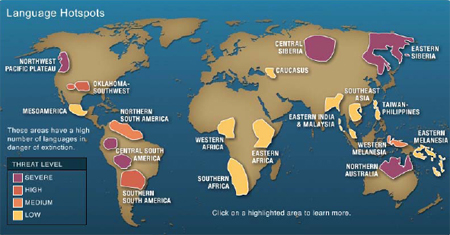
Language extinction ain’t no big thing?

Language diversity around the world is decreasing and Razib Khan of the Discover science blog, Gene Expression, doesn’t think you should care. I was going to let it slide because I don’t like getting in little blog tiffs, but then Khan went and tried to co-opt Neuroanthropology.net into the whole thing, so he forced my hand.


I had started to do a quick survey of the obvious, easily Googled data that might support or refute Khan’s argument, but decided that it was petty to point out the glaring logical, empirical and philosophical problems with his arguments, so I was just going to let it go. But then Khan took the liberty of demeaning my discipline and even linked through to my own site to supposedly support his argument, so I’m going to take the liberty of blogging while angry, which is kind of like drunk texting only more time consuming. I’m not really worried that Khan will actually read this post carefully, however, as he apparently didn’t bother to read closely the post to which he actually linked.

Khan doesn’t think linguistic diversity matters. After all, language diversity correlates with poverty, he argues. The evidence he produces for this is a graph that is apparently more of a thought experiment than any sort of actual data plot. So I thought I might just explore this question with a little anecdotal data like comparisons between nominal GDP/capita and numbers of indigenous languages in Ethnologue and how well these seem to correlate. I’m neither a statistician nor do I want to devote more time to this, but I want to just present some evidence in the discussion (especially because he implies anthropology is a kind of salon game for the intelligentsia and for fact-challenged jargon heads).

Normally, I try to be a pretty positive online presence, not prone to hurling invective or belittling other writers, but there are a few things that get me really hacked off, and one of them is conservative Social Darwinism thinly veiled with pseudo-science, as if this is just ‘nature’s’ way of sorting out the winners from the losers. Razib Khan’s example makes me particularly angry because he links in the direction of Neuroanthropology.net like something we argue supports this (please take down the link, Khan, if you read it – we don’t need your traffic if it comes from people who think we’re in your corner). Moreover, Khan’s argument demonstrates an extraordinary callousness, suggesting that concern about language rights assured in the Universal Declaration of Human Rights and other UN human rights documents are just a kind of bourgie latté sippers’ hysteria that people concerned about the ‘real world’ don’t share.

Continue reading “Language extinction ain’t no big thing?”

Four Stone Hearth brought to you by Zenobia

That's MacTut, laddie!
Zenobia: Empress of the East is hosting the latest edition of Four Stone Hearth, the anthropo-carnival. It it’s 97th edition, the carnival this time brings us a pile of good stuff, and although Judith admits she prefers her subjects long dead, and buried in hardened volcanic ash, she brings us a wide range of the fun and fascinating. From Pompeii to monkey adoption, prognasticating octopus to the first cuneiform tablet ever found in Jerusalem to King Tut’s surprisingly small penis, you know that Four Stone Hearth is going to bring you the best of virtual anthropology. And the best is damn good.

So if you’re wondering whether Tut was cursed to be both under-endowed and Scottish (ouch), whether passive sentences are really hard to understand or if it’s just the ‘paper-airplane effect’ in action, or if the Dutch truly have found the answer to the question of overcoming human differences — orange — the what are you still reading this for!? Get ye to Four Stone Hearth!

And by the way, am I the only her person who winds up shouting at the television set, ‘Caster Semanya’s GENDER was never in question! It was her SEX, dammit!’ simply because I hate the way that the word ‘gender’ seems to have simply become a euphemism for whether someone has a winky or not? Okay, maybe it’s just me.

Life without language

Thought without symbols — life without language — it’s a cognitive reality that is virtually impossible for most modern humans to fathom. For the vast majority of us, our thought processes have been profoundly shaped by the introjection of language into our cognitive worlds, the taking on board of a massive intellectual prosthesis, the collective product of countless generations. Human thought, for the majority, is not simply the individual outcome of our evolved neural architecture, but also the result of our borrowing of the immense symbolic and intellectual resources available in language. What would human thought be like without language?

Author Susan Schaller

The question of the relationship between language and ‘mind’ (a word I hate using), or between symbolic resources and cognitive abilities (there, that’s equally vague!), is philosophically intriguing, but hard to address in anything other than the hypothetical.

Herodotus tells the story of the Pharoah Psammetichus (Psamtik I), who allegedly gave two newborn children to a shepherd to raise without language, taking care of them and paying close attention to their first words. Psammethicus hoped to learn which language was the oldest, which one infant allegedly revealed by calling for ‘bekos,’ the Phrygian word for ‘bread.’ In fact, most historically recorded cases of feral children, however, suggest that they do not develop any language ability at all, perhaps even failing to develop symbolic abilities (or maybe not enough researchers speak Phrygian).

We might try to imagine thinking without language, but, of course, we’d be doing that with language itself. In my own work, I’m interested in thought — or maybe I should say perception and action — that is only partially rendered into language (high speed, perceptually-driven decision making and action in sports). But what would thought be like for those without language?

The rare case of individuals without language offers some potential window in on life across the intellectual Rubicon, if we had developed mentally without immersing ourselves in the shared symbols and communicative reality of language. Although we tend to think that only those who are profoundly intellectually disabled, criminally neglected or raised by non-humans fail to learn language, in fact, adolescents and adults without language may not be as rare as we think. Author Susan Schaller has written about the case of a profoundly deaf Mexican immigrant who grew up in a house with hearing parents who could not teach him sign language in her book, Man without Words.

The website, Works and Conversations, has a discussion of Schaller’s story, how she became interested in sign language through a fluke accident, but especially her work with Ildefonso, who had grown up without learning sign language or any other form of communication. The piece, Leap of Faith, the Story of a Contemporary Miracle, was written by Richard Whittaker in 2009 (although I only recently came across it). It’s a fascinating interview, and, although I may disagree with Schaller in certain ways, I think her story of trying to teach Ildefonso, not merely sign language, but the symbolic process itself, is absolutely fascinating.

Continue reading “Life without language”

We agree it’s WEIRD, but is it WEIRD enough?

The most recent edition of Behavioral and Brain Sciences carries a remarkable review article by Joseph Henrich, Steven J. Heine and Ara Norenzayan, ‘The weirdest people in the world?’ The article outlines two central propositions; first, that most behavioural science theory is built upon research that examines intensely a narrow sample of human variation (disproportionately US university undergraduates who are, as the authors write, Western, Educated, Industrialized, Rich, and Democratic, or ‘WEIRD’).

More controversially, the authors go on to argue that, where there is robust cross-cultural research, WEIRD subjects tend to be outliers on a range of measurable traits that do vary, including visual perception, sense of fairness, cooperation, spatial reasoning, and a host of other basic psychological traits. They don’t ignore universals – discussing them in several places – but they do highlight human variation and its implications for psychological theory.

As is the custom at BBS, the target article is accompanied by a large number of responses from scholars around the world, and then a synthetic reflection from the original target article authors to the many responses (in this case, 28). The total of the discussion weighs in at a hefty 75 pages, so it will take most readers (like me) a couple of days to digest the whole thing.

It’s my second time encountering the article as I read a pre-print version and contemplated proposing a response, but, sadly, there was just too much I wanted to say, and not enough time in the calendar (conference organizing and the like dominating my life) for me to be able to pull it together. I regret not writing a rejoinder, but I can do so here with no limit on my space and the added advantage of seeing how other scholars responded to the article.

My one word review of the collection of target article and responses: AMEN!

Or maybe that should be, AAAAAAAMEEEEEN! {Sung by angelic voices.}

There’s a short version of the argument in Nature as well, but the longer version is well worth the read.

Of course, I have tons of quibbles with wording or sub-arguments, ways of making points, choices of emblematic cases and the like in the longer BBS article (and I’ll get to a couple of those below the ‘fold’), but I don’t want to lose my over-arching sense that there is so much right in this piece. So before I get into the discussion, I just want to thank all of the authors, not just Henrich, Heine and Norenzayan, but also the authors of the responses, who pulled it together when I didn’t try. The collection is a really remarkable discussion, one that I find gratifying in such a prominent place, and I do hope that the target article has a significant impact on the behavioural sciences.

If you have one blockhead colleague who simply does not get that surveying his or her students in ‘Introduction to Psychology’ fails to provide instant access to ‘human nature,’ this is the article to pass along. If that colleague still doesn’t get it, please stop talking to them. Really. You. Are. Wasting. Your. Breath. If Henrich, Heine and Norenzayan don’t shake their confidence, I’m not sure what can.

The weirdest people in the world?

Continue reading “We agree it’s WEIRD, but is it WEIRD enough?”