Paul Mason: Slides on Neuroanthropology

Paul Mason has sent me PowerPoint slides on Neuroanthropology that draw upon a lot of the same resources that he cited in an earlier post I put up on his behalf. Paul’s in the field in Indonesia, and he writes in sometimes from internet cafes, but we should eventually have him as a regular contributor when he’s back with some regular Internet access. And then he can also tell us more, too, about his own research.

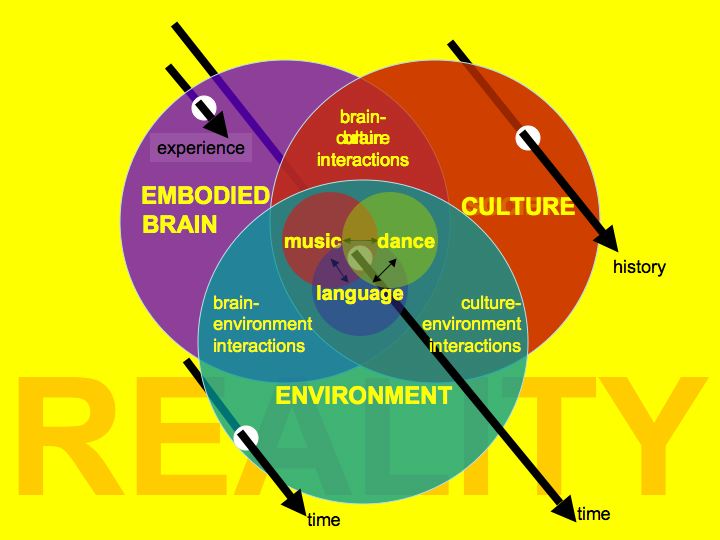
Paul includes a number of choice quotes, but I wanted to make sure that everyone got a chance to see his diagram of a systems-based approach to ‘fight-dancing’ in cultural, biological, and ecological context (in both Indonesia and Brazil). It’s a rich diagram, and I think that we, as neuroanthropologist, will need to do a lot of complex visualization in order to make our points to a broad audience. Paul must get all the credit for this one.Mason slideIn the meantime, i don’t yet have a complete bibliography on this material, so we’ll have to get in touch with Paul if anyone really wants to get the sources he’s using. He sent this about a month ago, and I was not clear on how to post PowerPoint slides, but I think it’s pretty straightforward. We’ll see….neuroanthropology.ppt
‘Exercise’ is mindset as well as activity

Blogging on Peer-Reviewed ResearchAn article last year in Psychological Science by Alia J. Crum and Ellen J. Langer, Mind-Set Matters: Exercise and the Placebo Effect, laid out an extremely interesting example of ‘top-down’ culturo-psycho-physiological dynamics in the body from my favorite area of research: exercise and sports.  Crum and Langer looked at a group of 84 hotel room keepers.  From the abstract:

Those in the informed condition were told that the work they do (cleaning hotel rooms) is good exercise and satisfies the Surgeon General’s recommendations for an active lifestyle. Examples of how their work was exercise were provided. Subjects in the control group were not given this information. Although actual behavior did not change, 4 weeks after the intervention, the informed group perceived themselves to be getting significantly more exercise than before. 

If this were the only finding, there wouldn’t be too much news here.  But the change in understanding of what they were doing also had physical effects on the room attendants, including, in addition to changed impressions, an average weight loss of 2 pounds, decrease in systolic blood pressure of 10 points, and positive effects on body mass and heart rates — in only 4 weeks with NO change in the actual activity level.  Becoming convinced that they were getting enough exercise or engaged in adequate activity to promote health helped their background activity to affect their physiology.  Exercise was not just a physical activity, it was also a state of mind (more accurately, without the ‘state of mind’ activity didn’t have the effects of ‘exercise’).  (This research is also discussed in an article in The New York Times.) 

Continue reading “‘Exercise’ is mindset as well as activity”

Equilibrium, modularity, and training the brain-body

Blogging on Peer-Reviewed ResearchRetaining one’s balance in movement is one of the more complicated sensory and motor tasks that humans routinely accomplish.  Elite athletic activities make the task of maintaining bipedal locomotion all the more difficult; no other species, I would argue, not even the kangaroo or gibbon, engages in a repertoire of bipedal activities even remotely close to as varied as that of humans.  We walk, run, skip, hop, and combinations of all three; we kick while running, jump over a range of obstacles, cross balance beams and tight ropes, ride unicycles; some of our species even juggle soccer balls, play badminton and volleyball with our feet (no kidding, in Brazil I used to see futevolei — ‘foot-volleyball’ — on the beach… amazing), balance objects on our feet and a host of other activities.  And, in the example I want to start discussing, some of us even invert our bodies and become bipedal on our hands, sometimes to extraordinary effect.

In order to accomplish these sorts of tasks, we use our ‘sense of balance.’  I hesitate to call it a sense, though, because the systems of perception, forms of analysis that we do, and reactions that we use to preserve our equilibrium are actually a complicated system, a set of shifting constellations of interio- and exterioceptions, differently weighted and compared depending upon our environment and task, and a host of active patterns of physical compensation, most of them only vaguely conscious, at best, that keep us upright.  Equilibrium is a perceptual-motor system in the sense discussed by James J. Gibson (1979), perhaps even more baroque the visual perception system (his favourite example).

Minimally, a brief ecological psychology of balance would need to include at least the following: the vestibular system; information from the visual system including the horizon line, parallax, relation of centre of field of vision to visual references, and movement in peripheral vision; sensations on the soles of the feet as well as at joints and other forms of proprioception; sense receptors at the back of the neck as well as a sense of the head’s alignment in space and in relation to the body; the gravity-resisting muscles, usually those of the lower body, and the reflexes that move them to compensate for perturbations in balance.

Continue reading “Equilibrium, modularity, and training the brain-body”

New features on Neuroanthropology

Just a quick note because I still have relatives staying with me (so I can’t get to a more serious post on Bruce Wexler’s book, Brain and Culture, to the collective memory conference I attended, or to the piece I’m working on about the equilibrium system and diverse physical training regimens). They go home tomorrow, so I should be able to present something substantive in the near future.

The first announcement is that we’ve added a Bibliography page that will try to keep a running list of the academic resources referenced in the postings.  Although I’m likely to fall behind from time to time up-dating it, my goal is to create a kind of ‘annotated bibliography’ with links back to postings or notes that discuss the readings.

In addition, Daniel Lende has generously put together a page of ‘web resources’ with links to things like news in the neurosciences and tutorials on brain architecture and function.  Especially for those of us in anthropology who are trying to better engage with the brain sciences, I think it will be an invaluable resource.

Finally, I’ve decided that we’re going to start using the icon from bpr3.org for blogs about peer-reviewed research.  You’ll see a small icon along articles that really discuss peer-reviewed research (rather than some of the ones we do about news or academic conferences or the like).  I’ll be happy to take care of providing the code, which I’ll just insert in appropriate posts.  It’s one more way that we can signal to our readers the nature of what we’re doing, and to let people in other fields know how research is being received and discussed among anthropologists.

Sorry I’m making you wait on other posts, but I promise more soon.

Paul Mason on Neuroanthropology defined

Our colleague, Paul Mason, sent the following post in from fieldwork in Indonesia. He apologized to me for it being ‘rough,’ and I still have to get a bibliography off him for it, but I thought it was well worth posting, especially because it does a great job of highlighting a whole host of intellectual precursors for what we’d like to do. Paul worked in the brain sciences, including in brain imaging, before we lured him over to anthropology, so he’s especially well positioned to help us carve out this new space. I think he brings a whole host of elements to the table that someone like me, trained in cultural anthropology primarily, can’t help but find fascinating and informative. So here’s his original text, with his apologies that it is ‘rough’ (we all know what it’s like to try to write from the field).

The brain is the organ of society and the biological vector of culture (Mason 2006). Neuroanthropology, a field of enquiry at the intersection of science and culture, is “The study of the cultural basis of mind and the biological basis of cultures” (Mason, 2005). Oliver Sacks is perhaps the most famous neuroanthropologist bringing fame to the field through his work on the ‘Neuroanthropology of Tourette’s Syndrome’ for which he received a Guggenheim Fellowship in 1989. The first proponent of the merging of neuroscience and anthropology was Ten Houten (1976) who defined the field as “the investigation of the cultural determinants of the ways in which our brains are developed historically and put to use” (p. 506). The research field was later defined by Laughlin, McManus and d’Aquili (1979) as, “The study of the relationship between the brain and sociocultural behaviour.” Neuroscientist, Jean-Pierre Changeux, has also advocated the unification of neuroscience and anthropology in his book, L’homme Neuronal (1983). The merging of neuroscience and anthropology is not altogether new. Paul Broca, a neurologist, famous for the discovery of Broca’s area of speech production in the brain, was also an anthropologist (Monod-Broca 2005). According to Couser (2001) neuroanthropology aims to study both how culture shapes neurological processes and how neurological substrates may produce distinctive cultural behaviours.

Continue reading “Paul Mason on Neuroanthropology defined”

Cave men in classrooms by Prof. Roger Schank

Roger Schank, founder of the Institute for the Learning Sciences at Northwestern University, John P. Evans Professor Emeritus in Computer Science, Education and Psychology, and author of about twenty books, gives us an offering on evolution and education on The Pulse, the blog of District Administration, an educational organization. His posting, Cave Man Didn’t Have Classrooms, borrows from the idea that we are gastro-intestinal ‘cave men’ eating twenty-first century (read: ill adapted) diets, using it to criticize the Western approach of education. As he puts it, cleverly, we are ‘still’ cave men (we’ll be back to that point): ‘We just wear better clothes.’

I take seriously the idea that, biologically, we are still cave men. And, mentally we are cave men as well. Just as we were evolved to live off the land without excessive alteration to what we find there, so have we evolved to think and learn in a certain way, a way that may not be consonant with how we think we think, and how we learn in the modern world.

He goes on to paint absurdist images of ‘cave men’ learning through lectures in class rooms to highlight the fact that human brains may not learn well by sitting quitely and listening. Prof. Schank writes:

Why do these images seem absurd? Because, we imagine, that cave men taught their children by example. We imagine that they took them along on the hunt when they were ready and that they practiced, by playing, prior to that. We assume, that learned to build shelters by doing simple tasks first and that they learned to defend against predators by watching and later helping. We don’t really have to imagine this very hard, as there are primitive societies where this still takes place today. In fact, prior to the idea of mass compulsory education, like that of mass feeding, we knew how to educate children properly, that is in the way that their minds were set up to work after 1,000,000 years of evolution. Instruction in cave man society, indeed in all societies until very recently, was by long-term apprenticeships. Knowing was not valued. Doing was seriously valued.

Continue reading “Cave men in classrooms by Prof. Roger Schank”