How well do we know our brains?

Blogging on Peer-Reviewed ResearchMaking the rounds of neuro-related sites on the web is a recent story from Wired, Brain Scanners Can See Your Decisions Before You Make Them, by Brandon Keim. It’s an interesting short piece on an even more interesting research paper by Chun Siong Soon, Marcel Brass, Hans-Jochen Heinze and John-Dylan Haynes forthcoming in Nature Neuroscience (abstract here). But like so much in the science writing about neurosciences, the piece leaves me feeling like either I don’t get it or science writers really don’t understand the significance of basic brain research. I won’t dwell too much on my issues though with the science writer because I want to really consider the relationship between brain activity and experience, or what role phenomenology might serve in neuroanthropology (besides, I’ve been railing at science writers a bit too much of late…).
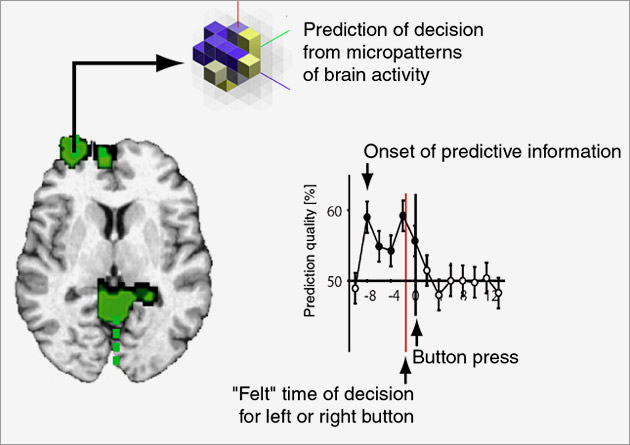
Brain areas that predict decisions.  By John-Dylan Haynes.  Wired.
From Keim’s article, we have this explanation of Haynes’ work:

Haynes updated a classic experiment by the late Benjamin Libet, who showed that a brain region involved in coordinating motor activity fired a fraction of a second before test subjects chose to push a button. Later studies supported Libet’s theory that subconscious activity preceded and determined conscious choice [I have a problem with that phrase, especially ‘determined’] — but none found such a vast gap between a decision and the experience of making it as Haynes’ study has….
Taken together, the patterns [in frontopolar cortex and then parietal cortex] consistently predicted whether test subjects eventually pushed a button with their left or right hand — a choice that, to them, felt like the outcome of conscious deliberation. For those accustomed to thinking of themselves as having free will, the implications are far more unsettling than learning about the physiological basis of other brain functions.

The Libet research is a classic piece (I don’t know if it makes any top 100 lists, but it’s especially important to those of us interested in motor action). The problem seems to be forcing Haynes’ data — which confirms Libet’s older research about the subconscious activity that precedes conscious awareness of ‘choice’ — through a folk theory about ‘free will’ being a necessarily conscious activity setting in motion a chain of mind events leading up to action. Folk understandings posit the existence of ‘The Decider’ in the brain, a kind of uncaused cause, the prime neural mover, which is conscious.

Bottom line, as far as I’m concerned: the research can’t be proving whether or not we have ‘free will’ because ‘free will’ is fundamentally about constraints on ‘will’ (itself a fuzzy concept when you’re looking at brain imaging). That is, the research would have to examine not what the brain does when it makes a choice, but whether that brain activity was constrained by something external to the person. After all, if we say that a person’s ‘free will’ is limited by their brain, that doesn’t really make sense now, does it? Presumably, acts of a ‘free will’ would also be determined by the brain, wouldn’t they? For the brain to ‘constrain’ our own ‘free will,’ it would have to be a thing separate from us.

What the research is showing, however, is something fascinating about the relationship of phenomenology and native categories of mind and how they might intersect with brain science research.
Continue reading “How well do we know our brains?”

Craving money, chocolate and… justice

Image by Lou Beach of The New York Times.A while back, I got really hacked off about a piece of really pathetic science reporting about some brain-related research in the post, Bad brain science: Boobs caused subprime crisis. And now, as if sent from heaven (or the Benevolent Goddess That Pokes Holes in Bad Evolutionary Psychology), this news release from UCLA, Brain reacts to fairness as it does to money and chocolate, study shows, by Stuart Wolpert. All caveats in place — including that I haven’t seen the reviewed piece that backs this up — we have some nifty data with which I can continue to pile scorn on those who think images of women’s cleavage dancing before them is what made the ‘financial titans’ leverage the US economy into subprime disaster.

The human brain responds to being treated fairly the same way it responds to winning money and eating chocolate, UCLA scientists report. Being treated fairly turns on the brain’s reward circuitry.

“We may be hard-wired to treat fairness as a reward,” said study co-author Matthew D. Lieberman, UCLA associate professor of psychology and a founder of social cognitive neuroscience.

That’s right — if you recall the sex-money-chocolate ‘hub’ in the brain that we discussed (well, snickered at) in the ‘Bad Brain Science’ post, now it also looks like this part of the brain is also involved in being treated fairly. So now it’s the ‘sex-money-chocolate-justice hub’ (they’re sure beer and pizza isn’t in there, too?).
Continue reading “Craving money, chocolate and… justice”

Rats’ visual systems made plastic by anti-depressants

Blogging on Peer-Reviewed ResearchMy mind raced for potential titles to a post when I read the recent report from Science, ‘The Antidepressant Fluoxetine Restores Plasticity in the Adult Visual Cortex,’ by a team headed by José Fernando Maya Vetencourt (abstract), but I’ve opted to be demure, rather than go with some of my other options (like ‘Anti-depressants the “Cocoon” pool for brain?’ or something similarly outrageous).

The research team investigated wither fluoxetine, a selective serotonin reuptake inhibitor (SSRI), could restore plasticity in the visual system of adult rats. They chose fluoxetine because long-term regimens of the drug promote neurogenesis and synaptogenesis in the hippocampus and increased activity of neurotrophin brain-derived neurotrophic factor (BDNF) and its primary receptor, TrkB (close paraphrase to the original article). These effects have been shown essential to the drug’s effect; block one of these processes, and the anti-depressant doesn’t work nearly as well. In order to test plasticity, the team studied how rats responded to monocular deprivation — covering one eye — both the initial shift in ocular dominance and then the recovery of visual function after long-term monocular deprivation. In general, the fluoxetine-treated rats responded in exaggerated fashion to both conditions, suggesting that plasticity was greater with long-term administration of the drug. From the abstract:

We found that chronic administration of fluoxetine reinstates ocular dominance plasticity in adulthood and promotes the recovery of visual functions in adult amblyopic animals, as tested electrophysiologically and behaviorally. These effects were accompanied by reduced intracortical inhibition and increased expression of brain-derived neurotrophic factor in the visual cortex. Cortical administration of diazepam prevented the effects induced by fluoxetine, indicating that the reduction of intracortical inhibition promotes visual cortical plasticity in the adult. Our results suggest a potential clinical application for fluoxetine in amblyopia as well as new mechanisms for the therapeutic effects of antidepressants and for the pathophysiology of mood disorders.

Continue reading “Rats’ visual systems made plastic by anti-depressants”

Testosterone and cortisol explain market behaviour?

There’s a fascinating post on Testosterone, Cortisol and Market Behavior on the website Pure Pedantry. Normally, I’d have a whole lot of caveats and snarky comments to add, but Jake Young does a great job of handling an original research article by Coates and Herbert, ‘Endogenous steroids and financial risk taking on a London trading floor’ (abstract). You should definitely check out Jake’s post if you find this material interesting, as he deals with the article in greater depth. Unlike in my last piece on ‘neuroeconomics’, Bad brain science: Boobs caused subprime crisis, in which I thought the science writer involved was really responsible, in this case, it looks like the authors of the original study are partly to blame, and Young does a good job of highlighting this issue.

The original research paper examines the links between market risk-taking behaviour among traders with endogenous steroids: testosterone and cortisol. Since both are linked to aggression and stress, this would seem to be a good place to study the body’s response to risk taking. But things don’t go brilliantly, as Young suggests: ‘Let’s file this paper under “wildly over-interpreted” because there are some big caveats that you have to remember before you can make a claim anything like [hormone changes lead to market changes and higher market volatility].’

Continue reading “Testosterone and cortisol explain market behaviour?”

Antidepressants suppress identity?

Another interesting one from The New York Times, Who Are We? Coming of Age on Antidepressants, by Dr. Richard A. Friedman; I found this one really well done, asking more questions than it answers, but thought-provoking.

The introduction to the article lays out the central existential question posed by long-term treatment with anti-depressants, especially for patients who started on their regimens when very young:

“I’ve grown up on medication,” my patient Julie told me recently. “I don’t have a sense of who I really am without it.”
At 31, she had been on one antidepressant or another nearly continuously since she was 14. There was little question that she had very serious depression and had survived several suicide attempts. In fact, she credited the medication with saving her life.
But now she was raising an equally fundamental question: how the drugs might have affected her psychological development and core identity.

As Friedman points out, the medical testing for these pharmaceuticals doesn’t include long-term research anywhere close to the lengths of time that people are actually spending on the drugs: the longest maintenance study — done on Effexor — lasted two years.

But the more subtle issues that Friedman raises, as far as I’m concerned, are the questions of identity that are clouded by long-term anti-depressant use. He discusses one woman who was concerned about her ‘low sex drive’ and pressure from her boyfriend to have sex after eight years on libido-reducing Zoloft: ‘She had understandably mistaken the side effect of the drug for her “normal” sexual desire and was shocked when I explained it: “And I thought it was just me!”’ I can’t tell from the way Friedman writes this how he feels about the idea that an individual has a ‘normal’ sex drive, something that might exist ‘prior to’ or ‘independent of’ any outside influences, whether that influence be an anti-depressant or a particular life event or the effects of interpersonal dynamics with a partner.

The idea that the ‘anti-depressed’ state might become ‘normal,’ both in the medical sense that intervention seeks to create this state and in the sense that a patient spends so much time in the drug-influenced state that it becomes a kind of reference, suggests yet another way that cultural expectations might become biological ‘nature.’

Differences in dyslexia

A fascinating article came out in the Science section of The New York Times: Patterns: Dyslexia as Different as Day and Night, by Eric Nagourney. The article is based on an original research piece by Wai Ting Siok, Zhendong Niu, Zhen Jin, Charles A. Perfetti, and Li Hai Tan, who examined the abnormalities in brain activity associated with dyslexia in Chinese speakers (in comparison to better documented examples of the disorder in English speakers).

The basic result is simple, but intriguing, especially in light of some of the other research we’ve discussed on how brain areas linked to language differ, Two languages, one brain and theory of mind:

The report, which appeared last week in The Proceedings of the National Academy of Sciences, found that changes in the brain that may contribute to dyslexia are different for English speakers and Chinese speakers.
The difference may be explained by the fact that English is an alphabetic language, the researchers said. A reader sees a letter and associates it with a sound. Chinese characters, on the other hand, correspond to syllables and require much more memorization.

In English-speaking individuals, dyslexia shows up in neuroimaging studies as weak activity in left occipitotemporal and temporoparietal regions of the brain. The researchers find out, however, that readers of Chinese with dyslexia have a different anomaly in their brain, perhaps due to the difference between alphabetic and ideographic languages. Children with (from the abstract) ‘impaired reading in logographic Chinese exhibited reduced gray matter volume in a left middle frontal gyrus region,’ an area that had already been found to be active in reading and writing Chinese characters. ‘By contrast, Chinese dyslexics did not show functional or structural (i.e., volumetric gray matter) differences from normal subjects in the more posterior brain systems that have been shown to be abnormal in alphabetic-language dyslexics’: the abstract details.

Continue reading “Differences in dyslexia”