Alesha Sivartha and the Phrenology of Culture

BibliOdyssey featured the Brain Maps of Alesha Sivartha two years ago, a fantastical collection of illustrations created by Sivartha as part of his 1912 “The Book of Life: The Spiritual and Physical Constitution of Man.” You can explore the book some through Google, but the better spot to go is Sivartha’s great-great-grandson’s website which covers the book in some detail.
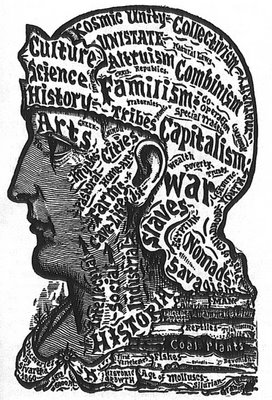
Sivartha goes well beyond the typical phrenology of the nineteenth century, which generally focused on individual traits (i.e., the “mind”) as located in specific parts of the brain. History and culture and religion find their way into Sivartha’s work, and even the brain/body. He might even be called an early representative of cultural neuroscience!
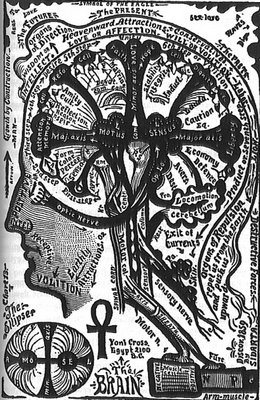
Indeed, I see the illustrations as showing us how problematic it can be to force cultural and social phenomena onto the metaphor or image of the brain. Our enthusiasm must be tempered by critical neuroscience and by neurocriticism. Everyday life matters greatly, whether while camping without worrying about culture or brains, or dwelling more specifically on our “everyday brain” or the flavors of cultural brain we might enjoy.

Still, I find Sivartha’s illustrations quite wonderful. Just like early anthropologists trying to cover all the important domains of one culture in one book, so Sivartha tries to jam everything in, to create an impossible representation. It doesn’t work, but the images do provide much to reflect upon.

Silent Raves

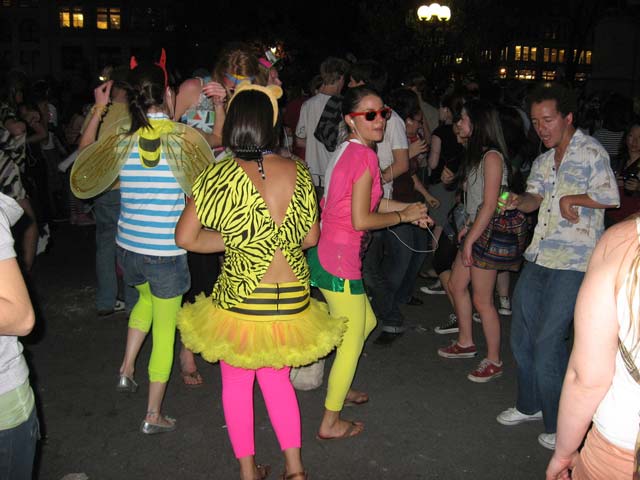
Silent Raves, where people get together to dance while listening to music on their headphones, came to my attention this week through NPR’s “Silent Ravers Dance ‘Together But Individually’.” Get together in a public place, turn on your music at the appointed time, and start dancing!

This particular Silent Rave took place in Boston’s Copley Square, and was promoted through both Facebook and MySpace. Here’s the MySpace ad:

WHAT IS A SILENT RAVE?? A silent rave is a dance party where everyone listens to their own music. Imagine looking out and seeing hundreds of people dancing, but hearing nothing. Pretty cool, eh?

This Myspace page will keep all you ravers updated on upcoming events. It’ll also help promote this event, and attract more people to the raves.

Basically, what you do at a silent rave is bring your MP3 player and headphones. After the countdown to the start time of the event (typically in the evening, but who knows!), everyone presses play at the same time, listening to their own favorite jams. Everyone then starts dancing (dancing, jumping up and down, flailing arms around wildly, it’s all the same at a rave!).

What’s the point? Well, it’s just an event where a bunch of people can get together to have fun, expend pent-up energy, and meet tons of new people with similar interests. These silent raves are supremely exciting (well, with the right attitude) and fun. Silent raves will normally be short and sweet, but everyone is more than welcome to stay afterwards to party and mingle with fellow ravers.

Simple guidelines:
-please Please PLEASE respect the locations where the silent raves are held, i.e. don’t litter and no violence. We don’t want to be attracting any unwanted attention from local authorities…
-Wait for the countdown to start raving, otherwise it’ll be a mess.
-Have fun.

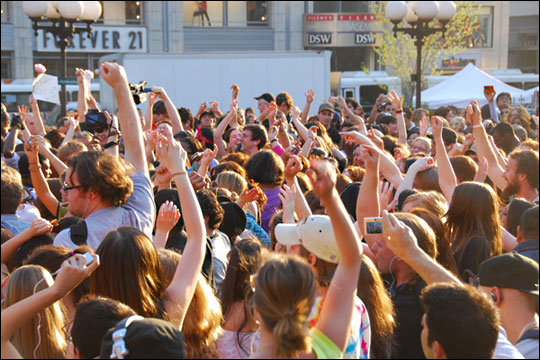
In the States one of the biggest Silent Raves was held last April in NYC’s Union Square. Both the NY Times and ABC News covered it. I’ve included a photo from that rave. For some video go to this You Tube clip.

The odd thing for me was that the You Tube clip included music! I suppose that makes sense for showing off what you were listening to, but as a curious anthropologist (and a guy just out of current style, one of my students commented yesterday) it didn’t help me capture the overall feel of the event. So here’s a video from Calgary. A lot smaller silent rave, but this one gives a better sense of what it looks like to someone on the outside.

And then there was this massive flash mob silent rave in Victoria Station in London!

Faces of the Human Past

Ian Tattersall, curator at the American Museum of Natural History, and Richard Milner, an editor at Natural History, co-authored the 2007 Natural History feature story Faces of the Human Past. But it’s the illustrations by Victor Deak and Gary Sawyer that really stand out.

Sawyer is a physical anthropologist at the American Museum, an expert in recreating muscles and tendons and other anatomical features from past bones; Deak is the artist who makes it all come alive. Just above I have posted my favorite of their recreations, a Paranthropus boisei (some still call that species an Australopithecus boisei). The boisei skulls and teeth are striking in their robust breadth, but I had never seen an illustration that caught my fancy until this one.

Australopithecus afarensis, Ardipithecus ramidus, Homo neanderthalensis and Homo ergaster are the other species featured in the article, with seven different images in total. There is also a captivating graphic of a “dissection in reverse,” showing how they went about recreating the face of a Homo heidelbergensis. All the illustrations, and more besides, were included in the recent book The Last Human: A Guide to Twenty-Two Species of Extinct Humans.

Wednesday Round Up #29

This week we’ve got medical anthropology (including Paul Farmer!), Iraq (in particular the new book The Forever War), the brain, society, evolution, and drug hacks.

Medical Anthropology

60 Minutes, Dr. Farmer’s Remedy
Paul Farmer, doctor and anthropologist, solves health problems linked to poverty and inequality

The Economist, Global Health: The Price of Being Well
Social forces impact health. A major statement by a new WHO group, highlighting the need for social justice alongside the provision of adequate care

Nicholas Wade, A Dissenting Voice as the Genome Is Sifted to Fight Disease
A young professor argues that the evidence on personalized medicine based on genetics doesn’t match the hype

Eugene Raikhel, Moving beyond Race in Pharmacogenomics?
Great discussion, with good links, over at Somatosphere

The Banana Peel Project, Communication, Criticism and Medicine
Foucault, commentary and the role of informed critique

Randal Archibold, Indians’ Water Rights Give Hope for Better Health
See social justice in action. Water rights to farming to having a sense of involvement, rather than the Pima being the case study for genetic vulnerability to diabetes (due to changed social circumstances)

Michael Conlon, Stressed Mothers May Raise Fat Children: Study
Stress from mother transformed into comfort food for kids

Lindsey Tanner, Got a Fat Gene? Get Active for 3-4 Hours a Day
Which is exactly what the modern world dictates, isn’t it?

Alan Feuer, Thousands Later, He Sees Lottery’s Cruelty Close Up
Being poor and chasing the wins—an in-depth look

Jennifer Gibson, Laughter Is the Best – and Possibly Oldest – Medicine
Brain Blogger on the power of laughter in healing

Iraq

Lee Hamilton, Outside the Green Zone, the Human Dimension
“The near-complete American failure to understand Iraq is still evident five and a half years into the war.” NY Times review of the book The Forever War by Dexter Kilkins, journalist become anthropologist through need and circumstance.
You can read the first chapter here. The Times also runs the Baghdad Bureau blog about working in Iraq

Continue reading “Wednesday Round Up #29”

The Philosopher’s Encephalon

Neurophilosophy, the originator of the mind/brain Encephalon carnival, is hosting the 54th edition this week. Mo opens with a striking quote from Ramon y Cajal describing neural plasticity at the turn of LAST century, and gives us his editor’s choice, Caio Maximo’s piece on the evolution of modularity.

What’s interesting is the contrast between these two, a view of changing connections versus a view of functional modules. A way out might be to consider multi-level selection, with plasticity and modularity happening at different levels. Another point is to realize the the way our brains and the evolutionary process break problems down into parts is not necessarily related to the way we think about function today – machine-like, optimal, accomplishing one thing, and so forth. Mosaic evolution, canalization and hill climbing are about processes, not functional modules…

In any case, the Neurophilosopher has put together an excellent edition – watching sports is good for your brain, the hippocampus and memories of the Simpsons, and how beauty modulates pain are just a few of the things to enjoy.

Oldies but Goodies: Daniel Lende

I posted some oldies but goodies from Greg a few weeks back when we hit 100,000. So now it’s my turn, even though we’re already at 120,000. The start of the semester has been busy!

These are posts when we were just getting started, and haven’t seen as much love as some more recent or more popular ones. My new student assistant Erin Brennan helped me pick them out, so many thanks to her.

Neuroanthropology

Wending between Faust and Wimsatt

On Stress – Blakey

Addiction and Our Faultlines

Visual Rewards

Human Variation

Obama and Race

Puzzles and Cultural Difference

Loneliness and Health: Experience, Stress, and Genetics

Will Power as Mental Muscle

Anthropology

The Family Dinner Deconstructed

Prison Nation

Play

The Neurobiology of Play

Taking Play Seriously

Play and Culture

Play and Embodiment