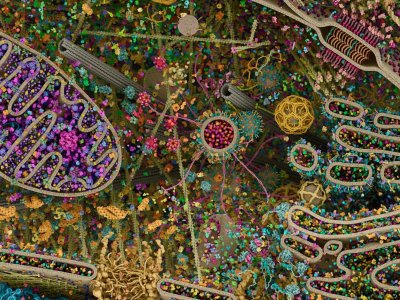
 Photo: Most detailed model of a human cell to date, obtained using x-ray, NMR and cryoelectron microscopy datasets. For more photos and info, see here.
The Denialist Playbook
I was shocked when I first learned about chiropractors’ opposition to the polio vaccine. The vaccine is widely viewed as one of medicine’s greatest success stories: Why would anyone have opposed it? My shock turned into excitement, however, when I began to recognize the chiropractors’ pattern of arguments was uncannily similar to those I was familiar with from creationists who deny evolutionary science. And once I perceived those parallels, my excitement became an epiphany when I realized that the same general pattern of arguments—a denialist playbook—has been deployed to reject other scientific consensuses from the health effects of tobacco to the existence and causes of climate change. The same playbook is now being used to deny facts concerning the COVID-19 pandemic.
In brief, the six principal plays in the denialist playbook are:
1. Doubt the Science
2. Question Scientists’ Motives and Integrity
3. Magnify Disagreements among Scientists and Cite Gadflies as Authorities
4. Exaggerate Potential Harm
5. Appeal to Personal Freedom
6. Reject Whatever Would Repudiate A Key Philosophy
The purpose of the denialism playbook is to advance rhetorical arguments that give the appearance of legitimate debate when there is none. My purpose here is to penetrate that rhetorical fog, and to show that these are the predictable tactics of those clinging to an untenable position. If we hope to find any cure for (or vaccine against) science denialism, scientists, journalists and the public need to be able recognize, understand and anticipate these plays.
Otegha Uwagba: ‘I’ve spent my entire life treading around white people’s feelings’
Despite the title, the book is not really for white people. What Uwagba hopes to achieve through the chronology of emotion, anger and disappointment in white allies since the death of Floyd, is a sort of shared black commiseration, a communing via the upheavals since the summer of Black Lives Matter. “I know it’s got their name on it,” she says, “and in that sense it’s addressed to them, but what I thought about a lot was how to write a work about race and racism and whiteness that isn’t just for the consumption of white people. It’s really, really important to me that this was an essay that black people can read and take something from, because with a lot of these anti-racist books and handbooks that are being published – I don’t get anything from them.”
Donald Trump has lost the election – yet Trumpland is here to stay
“I don’t think I’m ever going to earn as much as my parents,” she said. “I don’t think my husband and I will ever have the same life as they did.”
We were in Pennsylvania, often painted as a land of blue-collar aristocracy and true-blue Democrats. But the political economy that had underpinned those ballot-box majorities was as rusted as an abandoned factory. Instead, Maura saw a political system that had failed her and her generation, in which every new day was worse than yesterday. And while the Stouts were leftwing, they had little in common with the party they supported. In their eyes, their home had been gutted of manufacturing and bilked by foreign trade deals, and appeared nowhere on the Clinton/Obama ideological map…
Trumpland is not the same as the old Republican heartlands, even if they overlap. What the dealmaker saw more clearly than the Bushes, the Romneys and the McCains was that there was a new electoral coalition to be forged out of downwardly mobile white voters. “The people that have been ignored, neglected and abandoned,” he called them in Ohio in 2016. “I am your voice.”
The Xenobot Future Is Coming—Start Planning Now
Crispr routinely makes headlines. To the degree that people are even aware that life can be edited, it’s this technique they tend to reference. But Crispr, while powerful, is problematic: Scientists can’t directly see the changes they’re making to a molecule. What if I told you that soon we’ll have not only read and edit access to genetic material, but write access too? Meaning that, in the not-too-distant future, we will program living, biological structures as though they are tiny computers.
A new field of science called “synthetic biology” aims to do just this by digitizing genetic manipulation. Sequences are loaded into software tools—like a word processor, but for DNA code—and are eventually printed using something akin to a 3D printer. Rather than editing genetic material in or out of DNA, synthetic biology gives scientists the ability to write entirely new organisms that have never existed. Imagine a synthetic biology app store, where you could download and add new capabilities into any cell, microbe, plant, or animal.
If that sounds implausible, consider this: Last year, UK researchers synthesized the world’s first living organism—E. coli—that contained DNA created by humans rather than nature. Earlier this year, a group of researchers started with a cluster of stem cells from an African clawed frog as a base, and then used a supercomputer, a virtual environment, and evolutionary algorithms to create 100 generations of prototypes to build. The result: a tiny blob of programmable tissue called a xenobot. These living robots can undulate, swim, and walk. They work collaboratively and can even self-heal. They’re tiny enough to be injected into human bodies, travel around, and—maybe someday—deliver targeted medicines.
Kimberlé Crenshaw: the woman who revolutionised feminism – and landed at the heart of the culture wars
Good profile of the lawyer and legal and social theorist behind intersectionality
For Crenshaw, who is now one of the most influential black feminist legal theorists in the US, Hill’s case cemented her idea of “intersectionality”, set out in a paper two years before the hearing. The idea suggests that different forms of discrimination – such as sexism and racism – can overlap and compound each other in just this way. At the time of Hill’s case, Crenshaw was writing another paper, Mapping the Margins, on the erasure of black women’s history of being sexually harassed and abused. The Hill case showed the result of the fact that sexual harassment had largely only been discussed in relation to white women.
“So many people were corralled by the idea that sexual harassment isn’t a black woman’s issue,” she says. “So many people didn’t understand that slavery was about institutionalised sexual harassment and abuse. There were 700,000 slaves in 1790; by the eve of the civil war, there were nearly 4 million. How did that happen? It’s right in front of us and there are no words for it.”
Her paper set out how feminism had failed to “analyse that race was playing a role in making some women vulnerable to heightened patterns of sexual abuse.
And it was also the case that anti-racism wasn’t very good at dealing with that issue either.”
Overtaxed Working Memory Knocks the Brain Out of Sync
The explanation for why working memory starts to falter at such a seemingly low threshold has been elusive. Scientists can see that any attempt to exceed that limit causes the information to degrade: Neuronal representations get “thinner,” brain rhythms change and memories break down. This seems to occur with an even smaller number of items in patients who have been diagnosed with neurological disorders, such as schizophrenia.
The mechanism causing these failures, however, has remained unknown until recently.
In a paper published in Cerebral Cortex in March 2018, three scientists found that a significant weakening in “feedback” signals between different parts of the brain is responsible for the breakdown. The work not only provides insights into memory function and dysfunction, but also offers further evidence for a burgeoning theory of how the brain processes information.
Motivation Is Overrated
But what if motivation wasn’t always the key to sticking with your New Year’s resolutions or habit change in general? What if the opposite was true? What if the best thing you can do to feel good and accomplish your goals is ignore your motivation altogether?
Conventional wisdom holds that motivation leads to action: The better you feel and the more energized you are, the more likely you are to take your desired step. Though this can certainly be true, what about when motivation dwindles or when you simply aren’t feeling motivated at all? In those instances, the best thing you can do to change your mental state is to change your physical state. In the words of ultra-endurance athlete and self-improvement guru Rich Roll, “Mood follows action.”
“If I’m down or in a rut, I force myself to move my body, even if only a little bit,” says Roll. “This helps shift my perspective and reset my operating system—and more often than not, the sun starts shining again”…
Consider, for example, a period during which you find yourself in a rut. Your thoughts and feelings are pummeling you with some flavor of “you suck, you’re going to fail, it’s cold outside, stay in bed.” It’s really hard to talk or think your way out of that jam. But if you force yourself to ignore your thoughts and feelings and simply take action, you give yourself the best chance of changing your thoughts and feelings. This is one reason exercise has been proven so effective at diminishing or even reversing mild depression.
Why We Sigh
In 2016, Pagliardini and her colleagues were able to understand how sighs are generated in even more detail. In rats, they found a small cluster of neurons in an area of the brainstem called the pre-Bötzinger complex that generates normal breathing as well as sighing and gasping. Specific molecules called neuropeptides activated those brain cells and generated a sigh. “If you add these peptides into this specific part of the brain, you increase the sighs, and if you block the receptors that detect these neuropeptides, you sigh less,” Pagliardini said.
“Sighing appears to be regulated by the fewest number of neurons we have seen linked to a fundamental human behaviour,” Pagliardini’s co-author, Jack Feldman from the University of California, Los Angeles, said in a press release at the time.
The Professor and the Politician
For Max Weber, only the most heroic figures could generate meaning in the world. Does his theory hold up today?
Continue reading “Wednesday Round Up #24”


 Neuroanthropology