What Is Social Anthropology? by Alan Macfarlane

I found the following video quite good – rather like getting to sit down in a tutorial and listen to a master speak. Your tutor is Alan Macfarlane, professor in the Department of Social Anthropology at the University of Cambridge.

If you’re interested in comparing the master class to the group document, here’s the Wikipedia entry on social anthropology.

Macfarlane’s most recent book is Letters to Lily: On How the World Works, where he brings together his work as historian and anthropologist to answer his granddaughter’s questions, What is love? Why are families so difficult? How do we get justice? How well does democracy work? Who is God? What makes us individuals? And why are we here in the first place?

You can get the full list of questions and some background and a taste of how he answers the questions at Macfarlane’s website.

Macfarlane has written many books, including The Glass Bathyscape: How Glass Changed the World (publishing in the US as Glass: A World History), written with Gerry Martin. The two published a synopsis of the book in Science, Beyond the Ivory Tower: The World of Glass. Macfarlance has also provided us a set of video clips on glass, its making and uses, which highlight the conclusion to the Science piece:

“The different applications of glass are all interconnected–windows improved working conditions, spectacles lengthened working life, stained glass added to the fascination and mystery of light and, hence, a desire to study optics. The rich set of interconnections of this largely invisible substance have made glass both fascinating and powerful, a molten liquid that has shaped our world.”

Also, with a hat-tip to Kerim at Savage Minds, Macfarlane has interviewed an extraordinary range of social scientists in his “Ancestors” page, from Frederick Barth to Roy Wagner, with full audiovisual files available.
Wednesday Round Up #60

Besides the normal, neuro (enhancing!) and anthro, there’s a round-up on stuff related to addictions – drug war controversy, video games, sex, social learning, and even some contingent incentives for treatment.

Top

The Neurocritic, The Neurology of Twitter
Oh you critic you! See, I did it in 140 characters. Well, less!

Christine Rosen, It’s Not Theft, It’s Pastiche
The Wall Street Journal reviews the new book, My Word! Plagiarism and College Culture, by my great colleague Susan Blum, on routine plagiarism by students and the college culture that helps make sense of that

Strange Maps, US States Renamed for Countries with Similar GDPs
Thanks to Paul Mason and his dad for this one. The US is 50 countries in one – and now there is a map that shows off the economics of it.

Eugene Raikhel, Ian Hacking on Commercial Genome-Reading
Somatosphere provides a good overview on an on-going Net discussion from some heavy hitters. And the NY Times just reported that Genes Show Limited Value in Predicting Diseases

American Anthropological Association, April AN Addresses Visual Ethics and Multisensory/Multimedia Anthro
The latest Anthropology News, and for once you can just get the pdfs online.

Neuro

Margaret Talbot, Brain Gain: The Underground World of “Neuroenhancing” Drugs
The New Yorker on this emerging synergy of demand, competition, self and neuro-medicine. For some good commentary, see Mind Hacks.

Continue reading “Wednesday Round Up #60”

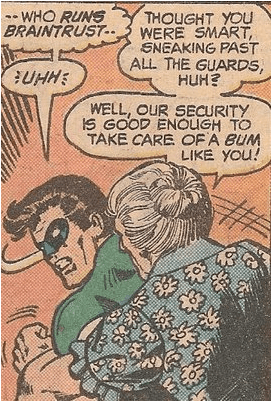
Is Your Brain Green?

green-lantern
Why Isn’t the Brain Green? asks Jon Gertner in the feature article of the “Green Issue” in this week’s New York Times Magazine. The issue is worth a visit alone for the striking photos, where the Momix Dance Troupe form vivid images of the head and the brain. But Green Lantern is going to come in handy.

So who wants to know why the brain isn’t green? CRED – Center for Research on Environmental Decisions – where they use behavioral research and decision science to understand “the green mind” (or lack thereof). As seems de rigeur today, any topic where we don’t act on the information available and seem to make irrational decisions is the target of this new decision science.

CRED has the primary objective of studying how perceptions of risk and uncertainty shape our responses to climate change and other weather phenomena like hurricanes and droughts. The goal… is to finance laboratory and field experiments in North America, South America, Europe and Africa and then place the findings within an environmental context.

So what are the problems? We’re bad at long-term decision making; we see environmental problems as far away from our everyday lives; we seem to have a “finite pool of worry” and make an occasional decision to help the environment while continuing on with our overall lifestyle.

Continue reading “Is Your Brain Green?”

Raising IQ: Nicholas Kristof Meets Richard Nisbett

intelligence-and-how-to-get-it
Nicholas Kristof has an op-ed today, How to Raise Our I.Q. He opens with a standard version of the individual meritocracy argument, that IQ is largely inherited:

Poor people have I.Q.’s significantly lower than those of rich people, and the awkward conventional wisdom has been that this is in large part a function of genetics. After all, a series of studies seemed to indicate that I.Q. is largely inherited. Identical twins raised apart, for example, have I.Q.’s that are remarkably similar. They are even closer on average than those of fraternal twins who grow up together.

If intelligence were deeply encoded in our genes, that would lead to the depressing conclusion that neither schooling nor antipoverty programs can accomplish much. Yet while this view of I.Q. as overwhelmingly inherited has been widely held, the evidence is growing that it is, at a practical level, profoundly wrong.

Kristof cites Richard Nisbett’s new book Intelligence and How to Get It: Why Schools and Cultures Count. I covered some of Nisbett’s work in the post IQ, Environment and Anthropology, and Jim Holt gave a strong review of the book recently in the NY Times. The publisher’s home page simply says that this book is a “bold refutation of the belief that genes determine intelligence.”

Continue reading “Raising IQ: Nicholas Kristof Meets Richard Nisbett”

Wednesday Round Up #59

Top

Tom Rees, The Problem with Studies on the Social Effects of Religion
Religion is often associated with positive effects – but correlation is not cause, what people say and do differ, and problems in defining “religion.” Nicely done.

Ritual Blogging, Week Five Recap
Great site providing summaries, powerpoints, links and discussion for an anthro class on Ritual in the Modern World. This week they covered political rituals, including some good YouTube clips.

Judith Harris & Jonah Lehrer, Do Parents Matter?
An interview at Sci Amer with the author of The Nurture Assumption, which argues that peers are more important than parents in shaping developmental outcomes. I’ve often wondered why anthropologists haven’t paid more attention to Harris’ work, it really is an argument for culture in one sense. Still, though Harris questions the role of parenting in good outcomes, she does seem to avoid the role that bad parenting can play in producing bad outcomes (e.g., family trauma).

SlowTV, The Brain: How It Can Change, Develop and Improve. Featuring Dr Norman Doidge
A video lecture by the author of The Brain That Changes Itself in Melbourne

Atul Gawande, Hellhole
“The United States holds tens of thousands of inmates in long-term solitary confinement. Is this torture?” The short answer is yes. A powerful piece from The New Yorker.

Anthro

Filip Spagnoli, Human Rights Facts (59): The Vicious Cycle of Poverty and Ill Health
Poverty traps, with the effects of poverty on health as one main engine – quite a good overview

Continue reading “Wednesday Round Up #59”