Wednesday Round Up #76

This week it’s the good stuff, then mind and anthro, and finally gaming.

Top of the List

Fresh Air, Journalist Reports On ‘Life, Death And The Taliban’
Really impressive interview with Charles Sennott, the executive editor of GlobalPost, which is running a series on the complex history and present role of the Taliban in Afghanistan. A lot of things he says sound grounded in anthropology. Here’s the link to GlobalPost’s Taliban series, which includes video and reporting.

Lorenz Khazaleh, Five Years Antropologi.Info
A great summary of what five years have meant for that blog, as well as how anthropology blogging has grown over that time.

Charukesi, Who Is a Foodie? Not Me…
No indeed. But a food voyeur. Most certainly. Some scrumptious photographs!

Michael Dove, Dreams from His Mother
The Yale anthropologist reflects on the work done by Obama’s mother, the anthropologist Ann Dunham Soetoro. For more on Ann Dunham and how Obama is actually a neuroanthropologist in disguise, see our long round up just after Obama’s inauguration.

The Economist, Amartya Sen on Justice: How to Do It Better
A review of Sen’s important new book The Idea of Justice. “In his study on how to create justice in a globalised world, Amartya Sen expounds on human aspiration and deprivation—and takes a swipe at John Rawls”

The Neurocritic
Just a lot of great material recently – from the clitoral homunculus to psychoanalytic explorations, serial killer movies, and zombie cupcakes

Mind & Brain

Kraeplin’s Grandchild, The Biopsychosocial Model Is Dead! Long Live to… to What?
Un analisis muy interesante, y si, en español

Continue reading “Wednesday Round Up #76”

Wednesday Round Up #75

Back from vacation – so better late than never. Had a great time camping, by the way.

Top of the List

Vaughan Bell, How Long Is a Severed Head Conscious For?
One of those morbid questions we often ask – well, here’s the answer.

Jerry Coyne, Creationism for Liberals
The dismantling of Robert Wright’s new book The Evolution of God over at The New Republic. Wright responds to Coyne here.

Clarence Gravlee, New TAPS Paper in Current Anthropology
Godoy et al. paper on changes in well-being over time in the Bolivian Amazon. Data come from the Tsimane’ Amazonian Panel Study (TAPS), which uses a longitudinal approach not often seen in anthropology. Plus get Lance’s forthcoming paper, Methods for collecting panel data.

Christopher Kuzawa & Elizabeth Sweet, Epigenetics and the Embodiment of Race: Developmental Origins of US Racial Disparities in Cardiovascular Health
Pdf of a 2009 article – “The model outlined here builds upon social constructivist perspectives to highlight an important set of mechanisms by which social influences can become embodied, having durable and even transgenerational influences.”

Ed Yong, Confirming Aesop – Rooks Use Stones to Raise the Level of Water in a Pitcher
And see the video too!

Anthropology

Mark Flinn, Why Words Can Hurt Us: Social Relationships, Stress and Health
Pdf of the very accessible chapter on stress in the recent volume Evolutionary Medicine and Health

Continue reading “Wednesday Round Up #75”

Wednesday Round Up #74

So this week it’s the food crisis, then neuroscience and anthropology, and finally language. Enjoy.

I will be on vacation next week, so won’t post the Wed round up until Saturday August 8th. So you’ll just have to wait a couple days while we’re camping.

Top of the List

Vaughan Bell, A War of Algorithms
Mind Hacks provides overview and commentary on the latest in artificial intelligence and the potential to wreak war and the need for limitations

Adam Henne, Whale Relations
Looks like a good new blog by an anthropology, Nature/Culture, with a focus on the environment and anthropology. I had wanted to discuss this recent NY Times magazine piece on whales. Adam did it for me.

Peter Deeley, The Religious Brain: Turning Ideas into Convictions
Scribd article looking at how cultural beliefs actually work their impact on specific people

Kay Redfield Jamison, The Importance of Restlessness and Jagged Edges
The psychologist and author of An Unquiet Mind shares her This I Believe: “I believe that curiosity, wonder, and passion are defining qualities of imaginative minds and great teachers; that restlessness and discontent are vital things; and that intense experience and suffering instruct us in ways less intense emotions can never do.”

Ed Yong, Your Brain on Oprah and Saddam (and what that says about Halle Berry and your grandmother)
Or even the researcher himself – he found a neuron that responded specifically to him during the research, despite having never met the volunteer previously. But really, the change is from the idea of a single neuron encoding singular info to groups of neurons encoding info through patterns of activity

The Food Crisis

-Many thanks to Craig Hadley for highlighting these selections-

Grain, The Other “Pandemic”
It’s not just the financial crisis and swine flu sweeping the world – the food crisis is killing a lot more people

Bapu Vaitla et al., Seasonal Hunger: A Neglected Problem with Proven Solutions
PLoS Medicine article about what we can do about the main cause of acute hunger and undernutrition, seasonal shortages due to dwindling stocks, high prices, or scarce jobs

Continue reading “Wednesday Round Up #74”

Public Anthropology by Biological Anthropologists

Skin A Natural History“Public anthropology” is often presented as primarily an effort of cultural anthropology. For example, the University of California Press Series in Public Anthropology focuses on ethnographies. Yet a broader public anthropology is inherent in its own description:

The California Series in Public Anthropology draws anthropologists to address major issues of our time in ways that readers beyond the discipline, find valuable. Many anthropologists write on narrow subjects in self-contained styles that only coteries of colleagues appreciate. The Series strives, instead, to analyze important public concerns in ways that help non-academic audiences to understand and address them.

Rob Borofsky echoes this broad conception when he writes, “Public anthropology seeks to address broad critical concerns in ways that others beyond the discipline are able to understand what anthropologists can offer to the re-framing and easing–if not necessarily always resolving–of present-day dilemmas.”

Biological anthropologists do public anthropology. They write for broad audiences and address social problems and public concerns. Their books move from the very body we live in to the importance of human variation, the origins of violence to assumptions about human nature and reproduction. Biological anthropologists have provided advice and information on caring for your child, looked at how our present-day environment can shape human health and behavior, and shown how to engage in primate conservation.

Here are those books, the ones that show public anthropology in action. The title links to the Amazon book listing. These books are recent, accessible, competitively priced, and compelling – all useful for increasing their public reach.

Public Anthropology Books by Biological Anthropologists

Sarah Blaffer Hrdy (2000), Mother Nature: Maternal Instincts and How They Shape the Human Species. Ballantine Books.
Hrdy “unblinkingly examines and illuminates such difficult subjects as control of reproductive rights, infanticide, ‘mother love,’ and maternal ambition with its ever-contested companions: child care and the limits of maternal responsibility.”
98% Chimp
Nina Jablonski (2008), Skin: A Natural History. University of California Press.
“This amply illustrated rhapsody to the body’s largest and most visible organ showcases skin’s versatility, importance in human biology and uniqueness… Penn State’s anthropology chair, Jablonski nimbly interprets scientific data for a lay audience, and her geeky love for her discipline is often infectious.”

Jonathan Marks (2005), What it Means to be 98% Chimpanzee: Apes, People, and their Genes. University of California Press.
“So why should one venture through the 307 remaining pages of this book, if the main message is obvious from the start? I can see two good reasons. First of all, because it is fun… The second reason is that the subject of this book is extraordinarily important. Many scientists and physicians deal daily, in one way or another, with human variation and its consequences. However, only seldom do we have the time to reflect on the assumptions underlying many concepts, even apparently simple ones, in this area.”

James J. McKenna (2007), Sleeping with Your Baby: A Parent’s Guide to Cosleeping. Platypus Media.
“Cosleeping is one of the most delicious experiences in parenting, and Dr. McKenna’s carefully researched and thoughtful advice separates the myths from the marvelous reality.”

Dale Peterson & Richard Wrangham (1997), Demonic Males: Apes and the Origins of Human Violence. Mariner Books.
“Contradicting the common belief that chimpanzees in the wild are gentle creatures… they suggest that chimpanzee-like violence preceded and paved the way for human warfare.”

Meredith Small (1999). Our Babies, Ourselves: How Biology and Culture Shape the Way We Parent. Anchor.
“How we raise our children differs greatly from society to society, with many cultures responding differently to such questions as how a parent should respond to a crying child, how often a baby should be nursed, and at what age a child should learn to sleep alone… [This book] will be especially meaningful to those swept up in the wild adventure of parenting.”

E.O. Smith (2002). When Culture and Biology Collide: Why We Are Stressed, Depressed and Self-Obsessed. Rutgers University Press.
“This book will be completely accessible to laypersons, and yet equally thought provoking for scientists.”

Karen Strier (1999), Faces in the Forest: The Endangered Muriqui Monkeys of Brazil. Harvard University Press.
This book “outlines the fight against extinction of the wooly spider monkey. Muriquies remain one of the most endangered primates, but the detailed profile drawn up by the author and her fellow researchers has provided crucial information in their fight for survival. In all areas Strier has carried out impressively thorough and precise research, outlined here in a very readable form, accessible to specialist and laymen alike.”

Other Recent Popular Books by Biological Anthropologists

Why limit ourselves to just eight? After all biological anthropologists have written many popular books. Here is a wider listing, ones that might not hew to a strict definition of “major issues” and “critical concerns” that comes with public anthropology. But these are certainly books that interest a broad public.

Continue reading “Public Anthropology by Biological Anthropologists”

Engaging & Dispatching Memetics

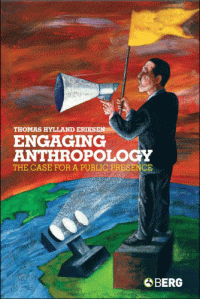
Engaging Anthropology
I am reading the book Engaging Anthropology: The Case for a Public Presence by the anthropologist Thomas Hylland Eriksen. Quite enjoying it – definitely recommended.

I’ve just finished his section on Memetics and the Anthropologists. He systematically dismantles meme theory from an anthropological point of view, just like Greg did in his post, We Hate Memes, Pass It On. (Greg’s version is snarkier…) Eriksen also ties in the popular success of meme theory to a consideration of how anthropology can gain public relevance. This description resonates with much that we do here on this site.

Memetics may be beyond salvation as a theoretical project. However, it raises a few questions which are just right for anthropology seen as an endeavour of public relevance. It sees human culture as part of nature yet rejects the simplifications of human sociobiology, and it asks highly pertinent questions about cultural transmission, cultural diffusion and cultural change. The notion of contagion is useful and has not been properly explored in cultural studies, including anthropology.

But – I repeat- without an understanding of the human subject, no advance will be made, and of course, context is everything. Curiously, in attempts at applying memetics, the biology itself seems to suffer. In Ingold’s words, the genotype exists ‘in the mind of the biologist’ (Ingolg 2000: 382). The ambition of offering a simple and straightforward analytic account of the human mind has led to an untenable abstraction (62-63).

Eriksen pushes us to make generalizations and to take cross-cultural analysis seriously, to examine these big questions of cultural change and diffusion. But he ties that into a grounded understanding of the person, the human subject. Those subjects, or people, are always found in specific contexts, and these local environments help shape culture and subjectivity (beyond the generalizations of, say, contagion). Biology comes in as a crucial mediator here, from helping to understand the contours of cultural change to being a crucial player in the relations of subject and environment. At least that is how I read it. Memetics fails because it is not anthropological, neither grappling with the rich tradition of research on cultural change and meaning nor with the actual realities of people and their lives.

Eriksen then relates his analysis of memetics and anthropology to a larger public project.

The lesson from the experiment of memetics is that we have to do better: those of us who feel that memetics is insufficient have to come up with a better alternative than merely stating that things are more complicated than this. Saying ‘things are more complicated’ is like having endless meetings to avoid making a controversial decision.

The anthropologist’s account of human nature has to be holist – it must include the recipe, the ingredients, the oven and the cook – and it must supersede the conventional culture/nature divide. Looking in the direction of biology, it is likely to find more by way of inspiration in ecology than genetics. It must also take human experience seriously as an area of enquiry. These general delineations notwithstanding, several paths are possible and might shed light on the human condition. The field is open: with a handful of exceptions, there have been few attempts since the Second World War to develop a theory of human nature which draws on biological knowledge without succumbing to the temptations of easy fixes (63).”

Just to be clear, by recipe, ingredients, oven and cook, Eriksen means DNA, development, the environment, and subjectivity (or an actor). So I would certainly agree with a holistic approach that supersedes the conventional culture/nature divide. In biology, I actually hope that both ecology and genetics play a role. But I would point out that neuroscience is actually the closest to many of the areas that interest him as an anthropologist – experience and behavior, interactions with the environment, possible biological dynamics that help shape culture, and so forth. In other words, neuroanthropology.

To be honest, neuroanthropology probably has a branding problem, rather like cognition and culture. The term doesn’t shout out “public relevance.” But as a site to explore the proper combination of recipes, ingredients and cooks, and to gain an online presence, well, it’s a good start. Next stop, a theory of human nature. Right?

In any case, here’s the Google Book link to Engaging Anthropology. The “Memetics and the Anthropologists” section starts on page 57. Just do a search for memetics; it looks like you can read the entire section online to get Eriksen’s excellent analysis of the weaknesses of memetics.

And for more on Thomas Hylland Eriksen, he is a professor at the University of Oslo. He also runs a rich website called Engaging with the World, where you can see how he’s put his words into practice.