Four Stones Worth

remote central has put up the latest Four Stone Hearth. Even on short notice (Tim took over for a blog that deleted itself), it’s a great version. Here are just a few highlights.

Puss ’N Boots slices his way through the evolution of mind and language.

If Inca neurosurgery is your thing, check out this nice square skull incision.

Mitochondrial Eve and Y-chromosome Adam get it on!

How about battle forks? Eat and fight at the same time! (Though I am personally more interested in the combo toothpick/earwax spoon.)

Neanderthals often get a bad wrap, but here’s the real deal about our bigger-brained cousins

The Swedes are swooning for their locked away booze

And finally, bite into some enamel chemistry—watch out, you were what you ate.

Wednesday Round Up #12

Drugs

Alexis Madrigal, Is Meth a ‘Smart Drug’?
Got to do my own promo… Wired is pretty cool

Not Exactly Rocket Science, Brain-enhancing Drugs Work by Focusing Brain Activity… For Better or Worse
A more brain-based take on the same thing: cognitive enhancers and context

Jonah Lehrer, The Hidden Cost of Smart Drugs
“Enhancement” and the loss of creativity

Vaughan Bell, How Neurotech Will Change the World, One Brain at a Time
“drugs and devices to cure diseases and optimise our brains”

Natasha Mitchell, Quitting the Habit: Neurobiology, Addiction and the Insidious Ciggie
The latest on smoking—quite a good show. Note that the transcript has lots of good links.

SparkNotes, Theories of Addiction
SparkNotes are study guides put together by Barnes & Noble. This one provides an overview of some basic psychobiological models.

Anthropology

Andy Coghlan, Religion a Figment of Human Imagination
Anthropologist Maurice Bloch argues that religion driven by imagination, not social cohesion

Scott London, The Ecology of Magic
Interview with David Abram, author of The Spell of the Sensuous

Scott Atran, The Religious Politics of Fictive Kinship
“friendship and others aspects of small group dynamics, especially acting together, trumping most everything else”

Heather Smith, Procrastinators without Borders
“Did perhaps just one anthropologist ever think to ask a penis-gourd-wearer if he wakes up some days and thinks he’s going to make a new penis gourd, but instead this happens and that happens, and making the new gourd just gets put off, along with everything else that he’s supposed to be doing, until he feels terrible and the only option seems to be to move to a place where no one notices that his gourd is outmoded?”

Continue reading “Wednesday Round Up #12”

Comfort Food and Social Stress

Comfort Food, for Monkeys is John Tierney’s article today, reporting on recent research by Mark Wilson and colleagues at Yerkes Primate Center about rhesus monkeys, sweet tooths, social stress and inequality. Familiar themes, all of them.

Normally, low-status monkeys eat roughly the same amount of bland monkey chow as dominant individuals. But add sweet banana-flavored pellets to the mix, and suddenly the equation changed: “While the dominant monkeys dabbled in the sweet, fatty pellets just during the daytime, the subordinate monkeys kept scarfing them down after dark.”

Tierney goes on to outline reasons why this scarfing vs. dabbling dynamic might emerge in socially complex species like rhesus monkeys. As Wilson et al. note in their paper, “this ethologically relevant model may help understand how psychosocial stress changes food preferences and consumption leading to obesity.”

Tierney describes research by Dallman et al., who have proposed that people can directly impact stress hormones through eating, largely by mediating anxiety: “[P]eople eat comfort food in an attempt to reduce the activity in the chronic stress-response network with its attendant anxiety.” So individuals with greater stress reactivity and negative mood tend to eat more in their stressed vs. control experimental paradigm.

As Tierney notes with a quip about a “stressed-out wage slave who has polished off a quart of Häagen-Dazs at midnight while contemplating the day’s humiliations,” inequality can bring on stress reactivity and negative mood (for more on that, see previous stress and inequality posts on Sapolsky and Blakey). In turn, inequality feeds into the obesity epidemic through both social and cultural dynamics.

But Tierney also knows that seeking food, not simply reactive eating, is key to overall weight gain. Continue reading “Comfort Food and Social Stress”

The Kingdom of Indy, Skullduggery and All

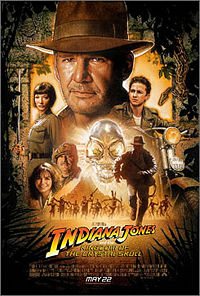
Meditations before May 22nd: Indiana Jones and the Kingdom of the Crystal Skull

My wife recently picked up the first three Indiana Jones movies at a garage sale, and my boys have loved watching them, discovering the movies that I remember fondly from my years growing up. Of late, anything—a piece of rope, a broken bead necklace—has become an instant stand-in for Jones’ whip in our house.

In the first movie, I recall so well how Indy fought all the Arabs, punching and whipping his way free as he searched for the kidnapped Marion. Then that deadly swordsman appeared, twirling his blades madly. Oh, the humor and perfection in that moment when Indy pulled out his gun and shot the bad guy. Harrison Ford actually came up with the idea when, bored after too many takes, he did just that. One of those cherished moments from my childhood movie memories.

As a recent NPR piece on Indiana Jones and archaeology put it, Dr. Jones is “handsome, and he can beat up most anybody. He’s definitely a stud — with tenure.” But is he saving history or stealing it?

The Story on Archaeology

Archaeologist Winifred Creamer makes no bones about it: “You could say Indiana Jones is the worst thing to happen to archaeology, because Indiana Jones has no respect for anybody and anything. Indiana Jones walks a fine line between what’s an archaeologist and what’s a professional looter.”

But Creamer also confesses that students love Indiana Jones. As one student puts it, “I thought it was damn cool. I wanted to do that… (Indy) does everything that all archaeologists would like to do. Go on crazy adventures, fight bad people, not steal stuff but save it from being destroyed by the bad guys.”

That becomes a hook for Creamer: “They come in thinking that they are going to talk about pyramids and gold and serious cool stuff. Instead, people want to talk about tree-ring dating and radiocarbon dating and the atmosphere, so some are really turned off by it. Others are intrigued by puzzling out an answer and the problem-solving aspect of it, and some of them stick around.”

Creamer notes that a “true archaeologist is more interested in the context” of the whole tomb, rather than destroying it to get one artifact. The tomb can tell us about life in a past culture—that is our true treasure. And that treasure comes through the gathering of data, not pieces to show off. Rather than tomb raiding, it’s painstaking excavations. This type of good science, coupled with modern-day anthropological comparisons, tells us a lot more than solving the mystery of one covenant on film.

Indy and Science

Love vs. the worst thing, destruction vs. truth—obviously anthropologists are ambivalent about Indiana Jones. The archaeologist Cornelius Holtorf writes in The New Scientist that “Indiana Jones Is No Bad Thing For Science.” This charismatic hero gives the field popularity. What other fields have such a great figure to attract interest? And, besides, just as with sci-fi movies and real space travel, audiences can distinguish between fact and fiction.

But as Holtorf also notes:

What weighs far more seriously is the criticism that elements of the film scripts communicate highly objectionable values. The adventures of Indiana Jones are premised on an imperial world in which western archaeologists routinely travel to the far corners of the globe in order to retrieve precious artefacts and save the world from Evil, giving the impression that the world is dependent on intervention from the west. Moreover, the films draw on a long cinematic tradition of portraying archaeology as the domain of white, heterosexual, able-bodied and comprehensively talented men who live though action-packed adventures in foreign countries.

Continue reading “The Kingdom of Indy, Skullduggery and All”

The Legend of the Crystal Skull

Indiana Jones and the Kingdom of the Crystal Skull comes out later this week; it’s expected to make more than $300 million dollars, or roughly the entire salary of the 6000 or so members of the American Anthropological Association this year. The archaeologists don’t know quite whether to lament or to cheer, for Indiana Jones brings a spotlight to antiquities at the same time Dr. Jones highlights grave robbing and a romanticized view of a very patient science.

Lucky I’m not an archaeologist! So I get to talk about the fun stuff, like the crystal skulls. Hopefully I can get to whips and fedoras later.

Do Those Crystal Skulls Actually Exist?

Yes! The magazine Archaeology gives us the low-down. The crystal skulls first appeared in the 19th century, with claims about their Mesoamerican origins. But as the archaeologist Jane MacLaren Walsh reports, not one skull has come from a documented excavation and their overall style has little to do with traditional meso-American skull motifs (think of the Mexican Day of the Dead, with skulls with a more rectangular style rather than the smooth, fairly accurate style of the crystal skulls).

Jane MacLaren Walsh does a stand-out job taking us through the social history of the crystal skulls, brought to some prominence by the Frenchman Eugene Boban, seller of antiquities first in Mexico, then Paris and finally New York.

But the legend really came to prominence with Mike Mitchell-Hedges, a British adventurer and author of Danger My Ally (that title says it all, doesn’t it?). As one Amazon reviewer puts it, “Take it for what it is—tall tales from an egomaniac.” The other one is more generous, obviously recognizing a kindred spirit: “Since childhood the kid showed signs of detesting the classroom and the office, he was obviously inclined to fulfill his life purpose through exploration of remote primeval places, as far as he could get from his native London, England.” Egomaniac or explorer, Mitchell-Hayes now has quite a fancy website to add to his legend.

The skull that Mitchell-Hedges allegedly found on one of his Central American adventures is one that generally gets people hot and bothered. As the Archaeology story relates, “Known as the Skull of Doom, the Skull of Love, or simply the Mitchell-Hedges Skull, it is said to emit blue lights from its eyes, and has reputedly crashed computer hard drives.”

The Local Connection

Mitchell-Hedges adopted daughter kept the Doom & Love Skull for sixty years, occasionally bringing it out for display. Being in northern Indiana, you don’t expect any tie-in to Indiana Jones and crystal skulls, but Anna, the daughter, passed away last year. Who ended up with the skull? Bill Homann, a man in Chesterton, Indiana, about an hour from where I live.

So, this infamous skull ends up, as the local television reporter puts it, “in Bill Homann’s living room in rural Chesterton.” Turns out, Bill and Anna knew each other: “She was my teacher and my best friend and we always had a great time; and she trusted me because she knows I believe what she believes.”

Homann of course believes the skull is the real deal, created between 17,000 and 50,000 years ago and used by the Mayans in ancient rituals (he might check those dates… not a lot of people in meso-America around that time). Its powers? “The crystal has a vibration and it does something to the human body.”

Are They Real?

Unfortunately for believers local and far away, the crystal skulls are fake. Studies done by Jane MacLaren Walsh, author of the Archaeology story, focused on the lapidary marks left over from skulls’ making. The grooves and perforations on the skull all indicate modern tools, for example, rotary tools to make the indent lines to mark the teeth. Still, I rather like how MacLaren Walsh’s adds some sound cultural reasoning on the topic, the Aztecs “displayed the skulls of sacrificial victims on racks.” It was about quantity, not quality—real victims, not crystal skulls.

World Music

NPR’s The World Cafe gets out “new and significant music and the artists who create it.” You can get livestreams and discover songs, as well as get recent sessions. The most recent is ‘Flowers’ for Kathleen Edwards.

BBC Music/World offers even greater range. DNA with DJ Edu is one of the most popular of all their World Shows.

National Geographic Music is also comprehensive, providing more information and background on particular countries and artists as well as the music. Here’s one from Sidestepper, a Colombian artist, who mixes cumbia, vallenato, and salsa.

Putumayo World Music provides collections of world music, often by themes. (Putumayo is, of course, located in Colombia.) They also have a weekly one-hour radio program.