Scientopia – A New Platform for Scholarly Blogging

Lots of people are pointing to the new collection of blogs over at Scientopia.org, which came to life in part due to the problems over at ScienceBlogs. Scientopia is ad-free, and also explicitly about science:

Scientopia is a collective of people who write about science because they love to do so. It is a community, held together by mutual respect and operated by consensus, in which people can write, educate, discuss, and learn about science and the process of doing science. In this we explore the interplay between scientific issues and other parts of our lives with the shared goal of making science more accessible.

Scientopia has global categories in Brain & Behavior and in Humanities & Social Sciences, as well as other ones like environment & biology, medicine & pharma, and information & communication. No way (yet, I am hoping) to go directly to those categories – they are simply collections of relevant pieces right there on the front page of Scientopia blogs.

I particularly wanted to do a shout-out to the blog The Urban Ethnographer. It’s fabulous to see anthropology right there in the middle of Scientopia. Krystal D’Costa’s most recent post is Meeting Montauk: The Summer Trade, which takes us out to the eastern tip of Long Island to examine tourism, fishing, and life in a beautiful little town.

On the brain side we’ve got some favorites who’ve migrated over from ScienceBlogs. So Scicurious has her own blog now, Neurotic Physiology, with her most recent post being the irresistible What Is Sweeter Than Cocaine? DrugMonkey is also there, and is looking at the recent debate on synthetic marijuana.

Child’s Play is all about development and cognition, and their latest post is Don’t Bite: A Cognitive Primer, which examines delay of gratification with a focus in this post on cognitive control and neural architecture.

That, and more, over at Scientopia.
Hard Drinkers, Meet Soft Science

By Mark Flanagan

Of the 23 million people who struggle with alcohol or drug abuse on a yearly basis, roughly 1.2 million regularly attend Alcoholics Anonymous (AA) meetings as a way to stop drinking. AA was the first 12-step program to be created. Founded on December 14, 1934 by Bill Wilson and Robert or “Dr. Bob” Smith, AA combines self-assessment, reconciliation, group therapy, and surrendering control to a “higher power” in a progressive plan consisting of 12 distinct steps to combat impulsive cravings to use.

Secret of AA: After 75 Years, We Don’t Know How It Works”, written by Brendan Koerner for Wired, does a thorough job explaining the history and approach of Alcoholics Anonymous in the United States. Koerner writes that, “There’s no doubt that when AA works, it can be transformative. But what aspect of the program deserves most of the credit?… Stunningly, even the most highly regarded AA experts have no idea.”

Koerner then examines how research in the behavioral sciences and neurology can provide insights to AA’s intermittent success. Here we learn that it’s not just the twelve steps but also the power of the group, from the commitment the individual feels to forming close relationships that can provide a sense of security to the opportunity to relearn how to connect to others without alcohol. Koerner also argues that the experience of public confession, both doing it and seeing it, helps individuals strengthen the regulatory powers of their prefrontal cortex, weakened after years of drinking.

However, in trying to account for the modest but significant beneficial effects AA can have for many individuals, Koerner leaves out important “soft sciences”, such as anthropology. Why do people attend AA? It’s not just to strengthen their prefrontal cortices.

In this post I will outline some societal forces that have led to AA’s popularity. I will also argue that the social sciences are integral for crafting new and effective addiction treatments. The ideas and data presented here come in large part from my comparative research on alcohol use and abuse among homeless men, college students, and veterans struggling with post-traumatic stress disorder.

Societal Forces at Play in Biomedicine

AA has been the subject of countless studies, yet reported success rates vary enormously: between 5 and 75 percent. This may be due to AA’s shunning of individual identification and the ease with which members enter and leave the program. However, several studies indicate that AA does not work for everyone and that, for most people, does not work at all.

While scientific support for AA or other 12-step programs is inconclusive, most medical practitioners strongly recommend it as a primary means to treat addiction. In Wired, addiction-medicine specialist Drew Pinsky states: “In my 20 years of treating addicts, I’ve never seen anything that comes close to the 12-steps. In my world, if someone says they don’t want to do the 12-steps, I know they aren’t going to get better.”

This contradiction between the little if any definitive scientific proof that AA reliably treats those suffering from addiction and the wide-spread endorsement of AA by medical and governmental officials raises an important sociological question:

Why do so many science-based medical providers recommend AA?

Continue reading “Hard Drinkers, Meet Soft Science”

Susan Blum, Plagiarism, and Anthropology

Susan Blum, my colleague at Notre Dame, is featured in a NY Times’ article today, Plagiarism Lines Blur for Students in Digital Age. The basic point of the article is that students, in the age of wholesale copying and pasting on the Internet, and a culture with changing notions of authorship, have trouble understanding the academic emphasis on doing one’s work (including writing one’s own words) and citing others for their ideas, data, and other types of work.

Ms. Blum argued that student writing exhibits some of the same qualities of pastiche that drive other creative endeavors today — TV shows that constantly reference other shows or rap music that samples from earlier songs.

In an interview, she said the idea of an author whose singular effort creates an original work is rooted in Enlightenment ideas of the individual. It is buttressed by the Western concept of intellectual property rights as secured by copyright law. But both traditions are being challenged.

“Our notion of authorship and originality was born, it flourished, and it may be waning,” Ms. Blum said.

She contends that undergraduates are less interested in cultivating a unique and authentic identity — as their 1960s counterparts were — than in trying on many different personas, which the Web enables with social networking.

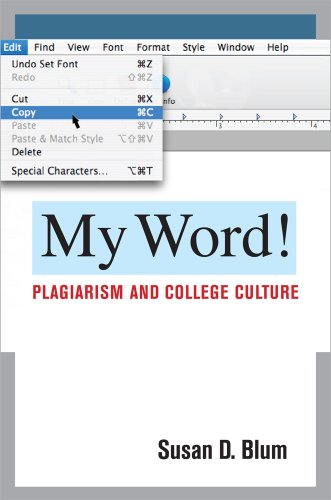
Based on her research with Notre Dame undergraduates, Blum published an enticing book in 2009, My Word!: Plagiarism and College.

Professors are reminded almost daily that many of today’s college students operate under an entirely new set of assumptions about originality and ethics. Practices that even a decade ago would have been regarded almost universally as academically dishonest are now commonplace. Is this development an indication of dramatic shifts in education and the larger culture? In a book that dismisses hand-wringing in favor of a rich account of how students actually think and act, Susan D. Blum discovers two cultures that exist, often uneasily, side by side in the classroom.

Relying extensively on interviews conducted by students with students, My Word! presents the voices of today’s young adults as they muse about their daily activities, their challenges, and the meanings of their college lives… Blum suggests, the real problem of academic dishonesty arises primarily from a lack of communication between two distinct cultures within the university setting. On one hand, professors and administrators regard plagiarism as a serious academic crime, an ethical transgression, even a sin against an ethos of individualism and originality. Students, on the other hand, revel in sharing, in multiplicity, in accomplishment at any cost.

Back in 2009, Susan wrote about her work in an article Academic Integrity and Student Plagiarism: a Question of Education, Not Ethics in the Chronicle of Higher Education. Susan outlined the two main approaches to preventing plagiarism, a moral one generally using honor codes and a disciplinary one requiring greater enforcement by faculty and staff.

Traditional efforts by administrators to prevent plagiarism fail for a number of reasons. For starters, students have only a vague sense of what is meant by the moral quality termed “academic integrity.” Also, rules about intellectual property are in flux.

In addition, our notion of the originality of utterance as the product of the unique, isolated, authentic self had its peak in the 1960s and 1970s. Students today have been immersed in a culture that revels in trying on different personae and sharing freely. There is no inviolable connection between words and the self that produces them. Students are not wedded to the integrity of their own writing and do not necessarily assume that others are either.

Moreover, students are mostly focused on success and achievement, a bottom-line mentality that has helped them gain admittance to the highly selective institutions that are, in fact, trying to enforce the norms of academic citation. If students pursued education for its own sake — as do most professors — they would try to produce academic work that increases learning and to model their behavior on their professors’. But many students don’t especially value the process of classroom learning — so, in fact, any process will do.

She outlines a series of practical steps to increase academic integrity by reducing plagiarism and improving students’ approach to citing others. She concludes:

Treating academic integrity as a constellation of skills, taught largely through the long apprenticeship of higher education, is the most promising approach for getting students to follow the rules of academic citation, and the one with the least likelihood of providing a shortcut. That means teaching students what academic integrity involves, why professors value it, and how exactly to carry it out.

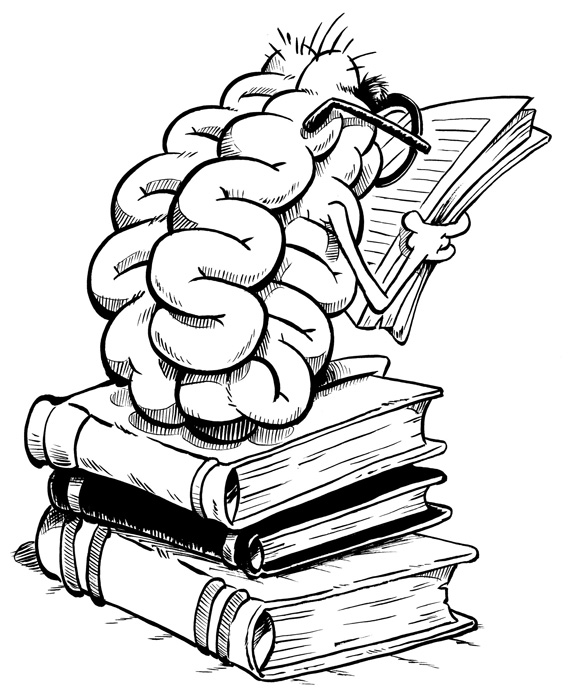
Writing: Brains, Science, and Words


As a follow-up to the Virginia Heffernan piece, here’s something in a rather different tone. As I was exploring the reactions to Heffernan’s take on science blogging (a take with numerous faults, yes, yes, but also some valid points), I came across two things that delighted me, as they actually focused on writing.

Livia Blackburne has an engaging blog over at A Brain Scientist’s Take on Writing. Her most recent post, The Power of Touch, moves from touch to the scaffolded mind and onto touch imagery, including coverage of recent experimental data. She’s also has a post on fMRI and reading, which she then uses to discuss how to think about narrative in novel ways. And there’s some good comments on that post as well.

Over at Not Exactly Rocket Science, Ed Yong started a post where science writers of all stripes have shared their getting-started stories in On the Origin of Science Writers. Ed, whom I admire for how he does science journalism, starts off with his, then Carl Zimmer follows with the next one, and from there you’ve got another 110 stories to explore.

For the anthropologists who might be feeling left out, I wrote a little (well, a lot!) about how we can reach a broader audience, and much of that has to do with the way we write. Some of the ideas are, I hope, equally relevant to science writing.