Wednesday Round Up #99

Dirk Hanson, The Addiction Inbox Top Ten
The most popular posts over at very well done The Addiction Inbox: The Science of Substance Abuse

Ethan Watters, How the US Exports Its Mental Illnesses
Another great piece by Watters over at New Scientist of the globalization of US mental health concepts (or ethnopsychologies). For more, see some good commentary over at Mind Hacks

Michiko Kakutani, A Rebel in Cyberspace, Fighting Collectivism
The artist and computer scientist Jaron Lanier fights against the hive mind and digital Maoism (i.e., the wisdom of the crowd) and the importance of developing a unique voice in his new book You Are Not A Gadget

Vaughan Bell, The Ominous Power of Confession
125 proven cases of wrongful conviction based on false confessions – Mind Hacks covers an excellent yet disturbing paper

Stephen Casper, Book Review: Warwick Anderson, The Collectors of Lost Souls: Turning Kuru Scientists into Whitemen
“This marvelous book deliberately forces us to re-imagine the meaning of sojourn, scientific discovery, colonialism, and sorcery, while at the same time providing us with an account of the discovery of Kuru, a lethal neurological disease, and the science that ultimately determined its etiology. In a narrative grounded in sources found in archives in Papua New Guinea, Australia, and the United States, and further developed through oral histories with scientists, anthropologists, and the Fore people, Anderson shows us that the prion – an infectious protein supposedly discovered in the laboratories of Britain and the United States – was a thing constructed first through colonial aspirations and global imaginations.”

Continue reading “Wednesday Round Up #99”

Complete this quote: “Before any attempt is made to hypnotize a Subject for the first time it is highly desirable that the Hypnotist…”

How would you complete the following quote from Eric Cuddon‘s 1938 book, Hypnosis: Its Meaning and Practice?

“Before any attempt is made to hypnotize a Subject for the first time it is highly desirable that the Hypnotist…”


Continue reading “Complete this quote: “Before any attempt is made to hypnotize a Subject for the first time it is highly desirable that the Hypnotist…””

Four Stone Hearth #84 is Gelada-ful

image from the BBC

The new, Four Stone Hearth #84! (Gratuitous Gelada Edition), is up at A Primate of Modern Aspect, and it’s especially Geladicious! If you don’t get it, you’re just going to have to go check it out, this itinerant web carnival of all things anthropological. (And, no, it’s not a reference to a delicious frozen dessert…)

I especially liked Eric Michael Johnson’s post, Bonobos and the Emergence of Culture, on Susan Savage-Rumbaugh’s TED lecture, Susan Savage-Rumbaugh on apes. It’s not a long comment, but check out the discussion as well. It’s really intriguing to watch the commenters struggle to dichotomize biology and culture when the bonobos are making a mangle of them. I do think Savage-Rumbaugh is over-invested in the argument that bonobos are specifically human-like (Comparison with Tasmanians? Ouch. But the bonobos are very cute when roasting marshmallows and learning to drive a golf cart). The fact that bonobos are ‘culture susceptible,’ shall we say, is sufficient to make a mess of biology v. culture and to highlight the way that the ‘extended mind’ concept can help us think about brain enculturation to build basic cognitive capacities. Johnson writes:

I challenge you to watch Kanzi build a fire and perform activities that require precise hand-eye coordination (including the making of stone tools) and conclude that this is a difference of kind rather than merely a difference of degree.

Also interesting is Zinjanthropus’s own post, So… Did knuckle walking evolve twice?, about a case of convergent evolution. Krystal D’Costa does a really nice ethnography of gold in the South Asian community, based in NYC: Sometimes All That Glitters Is Indeed Gold (JH3). And Beast Ape has a short but well cited piece on baboon fathers sorting out paternity of their female friends’ kids, Friendship, fatherhood, and MHC in baboons; it suggests baboon daddies are likely not able to sniff out their own offspring.

Wednesday Round Up #98

Enjoy another week, all mashed together once again.

3 Quarks Daily, Michael Moshen Performs the Triangle
An amazing display of skilled performance, integrating timing, music and throwing – definitely one I threw in here for Greg!

Robin Young, Rehab for Terrorists
NPR’s Here and Now speaks with the British journalist Owen Bennett-Jones, who has investigated the Saudi’s rehab program for terrorists. Striking to me both because of the dilemmas of this approach (or any like it) in a probabilistic age that still wants ideal absolutes, and also because of the striking difference in the portrayals of “terrorists” (see the NY Times’ recent piece, The Terrorist Mind) and how young men and women become involved and hence why rehab can work.

Institute of Psychiatry – King’s College, Post Doctoral Research Worker
Looking for a post-doc in neuroanthropology? King’s College in London’s Institute of Psychiatry wants you! The research is on cognitive models of dissociation and the subjective and neural correlates of automatic speech and writing.

Ray Tallis, You Won’t Find Consciousness in the Brain
“My argument is not about technical, probably temporary, limitations. It is about the deep philosophical confusion embedded in the assumption that if you can correlate neural activity with consciousness, then you have demonstrated they are one and the same thing, and that a physical science such as neurophysiology is able to show what consciousness truly is.”

John Cloud, Why Your DNA Isn’t Your Destiny
Epigenetics makes Time magazine! Hunger, abundance, and multi-generational effects in Sweden is the lead case study.

David Dobbs, Neuron Culture’s Top Five from December
Get the links to the posts on David’s Orchid and Dandelion series, which talks about genetic sensitivity and the environment – really looking forward to his book on the subject

Continue reading “Wednesday Round Up #98”

More on Americans exporting mental illness

My previous post, Exporting American mental illness, on Ethan Watters’ New York Times Magazine article, came together pretty quickly, in a few-hours’ rush of thinking, writing, and mistyping. Nevertheless, I’m glad I posted it because I really liked Watters’ original article, even though I took issues with attributing too much causal power to specialists’ knowledge about mental illness. I didn’t consider my original piece to be a ‘critique’ as I fully suspect many of my issues might have been addressed in the book-length version.

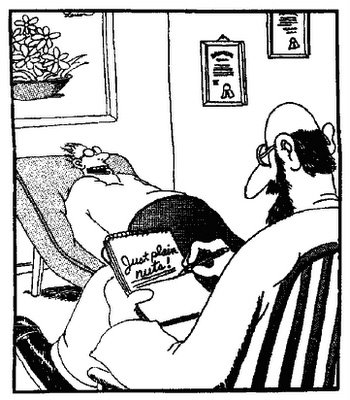
cartoon by Gary Larson

Over at Somatosophere, Eugene Raikhel has a great post on the original article. He’s very generous to my hurried effort but goes on to add in some really good discussion of multi-causal models in psychological anthropology and how difficult it actually is to think about complexity. He agrees with my brief piece (with one caveat that I would concede), but really goes on to take the discussion to a more sophisticated consideration of the question:

“How should anthropologists and cultural psychiatrists deal with this kind of complexity?” Is it enough to gesture toward complexity, calling it a “flow” or an “assemblage” and listing its various elements (as I’ve done above), or should we try to understand the various specific mechanisms through which what we often call macro-processes (like “globalization” or “industrialization”) shape the ways individuals experience and articulate their distress?

Raikhel goes on to discuss three different conceptual and concrete ways to try to link up these scattered forces into local explanations, drawing on Ian Hacking, Laurence Kirmayer and Norman Sartorius, and Tanya Luhrmann. All three are excellent examples of researchers doing the hard yards of making these links between macroscopic and psychological processes, between biology and culture on different levels. I won’t rewrite in less extensive form Raikhel’s excellent piece; just go to the original.

But I also want to point out the Raikhel, like me, really praises Watters’ original effort. Raikhel has a couple of key points of disagreement in the assumptions about modernity and stress and about the psychiatric ‘gray out’ that’s occurring with globalization, but he keeps these in perspective. I’m happy to criticize science journalists when they write stupid dreck, but the discussion of the Americanization of mental illness is quite thorough even though it’s reaching out to an audience that might not have run into this sort of anthropological analysis of psychiatry before; it’s a great piece to alert the public to the subtleties of human brain-culture-belief interactions (which we tend to call ‘neuroanthropology’ around here).

Exporting American mental illness

The New York Times Magazine has a great discussion of the effects of the exportation of American ideas about mental illness, titled appropriately, The Americanization of Mental Illness by Ethan Watters, based on his forthcoming book, Crazy Like Us: The Globalization of the American Psyche, coming out this month from Free Press. The article is quite good, offering some intriguing cases, such as the rise of virulent, American-style anorexia nervosa in Hong Kong, the effect of possession beliefs on communities’ reactions to schizophrenia, and how the narrative of mental illness as ‘brain disease’ might actually lead to great stigma as it spreads and replaces local understandings. The article is well worth a read, and I’m looking forward to the book.

graphic by Alex Trochut, NYTimes

The ethnographic record is full of conditions that didn’t make it into the most recent edition of the DSM — amok, nervios, koro, zar — you can check out Wikipedia or some other source on ‘culture bound syndromes,’ such as Introduction to Culture-Bound Syndromes in Psychiatric Times, to get a fuller discussion of some of these conditions. The Psychiatric Times piece suggests that there are at least 200 culture-bound syndromes.

One thing I really liked about the New York Times Magazine article, however (and by extension, Watters’ book, I suspect), is that the discussion of ‘culture-bound syndromes’ usually tends to treat other people’s syndromes as ‘culture-bound,’ Western psychological illnesses as not ‘culture-bound.’ Watters’ work points out that Western mental illness is both itself culture-bound and that persuading people to believe in Western-style mental illness can affect the way that psychic disorders manifest.

Continue reading “Exporting American mental illness”