Public Anthropology

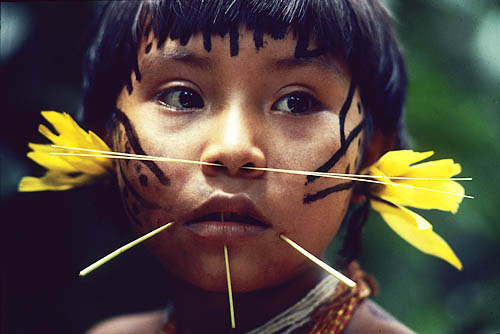
Yanomami Girl by Victor Englebert

Public anthropology happens when anthropologists engage with public issues and problems rather than just pursuing discipline-specific endeavors.

As Rob Borofsky writes in Public Anthropology – A Personal Perspective, this approach to anthropology addresses:

important social concerns in an engaging, non-academic manner. Public, in this sense, contrasted with traditional academic styles of presentation and definition of problems… The only way to be taken seriously by the broader public, I am suggesting, is to ask the questions readers beyond the academic pale ask, to answer the questions these readers long to know, to share experiences that add insight and meaning.

Rob Borofsky has been one of the leaders in public anthropology, having founded the Center for a Public Anthropology and serving as editor for the series in Public Anthropology at the University of California Press.

Many prominent books have come out of the UC Press series. Paul Farmer’s Pathologies of Power: Health, Human Rights, and the New War on the Poor is the best-known. Carolyn Nordstrom recently published Global Outlaws: Crime, Money, and Power in the Contemporary World (for a taste, see this video of Nordstrom “Fighting for a Healthy Global Economy”). Rob Borofsky himself put together Yanomami: The Fierce Controversy and What We Can Learn From It. The latest is Righteous Dope Fiend by Phillippe Bourgois.

Public Anthropology and the University of California Press host an annual competition for new manuscripts in public anthropology [this is actually the 2009 call here], one aimed at graduate students and the other for scholars more broadly. Here’s Cat Bolton, the latest graduate winner and an incoming faculty here at Notre Dame, encouraging you to submit:

Continue reading “Public Anthropology”

Four Stone 69

Kisokaido07_Konosu 69 Stations from Wikipedia
Wanna Be An Anthropologist is hosting the 69th edition of Four Stone Hearth, rounding up the best of anthro blogging over the past two weeks.

Ordinary ethnography (with video!), paleo-Indians and summer fieldwork, dredging for Neanderthals, internet controversies, linguistic anthro grad programs and more!

As for the image, it is taken from a series on the The Sixty-nine Stations of the Kiso Kaidō, based on the actual Japanese route of the 69 stations of the Nakasendō.

Link to the 69 Stone Hearth.

Wednesday Round Up #68

Besides what you expect, I’ve included a selection on health care reform at the end.

Top of the List

Lera Boroditsky, How Does Our Language Shape the Way We Think?
Testing how different languages literally shape the way people think. Great essay at Edge.

Adam Kirsh, Vistas of Perfection
A biography of James Agee. I was really struck by the description of Let Us Now Praise Famous Men, which seems like it could teach a lot to modern-day ethnographers

Peter Stromberg, Why You Can’t Help But Care about Brad and Angelina, Part III
Ah, the desire for fame. A good kick-off to Peter’s Sex, Drugs and Boredom series over at Psychology Today – an anthropologist invades some popular turf!

Jim Schnabel, Media Research: The Black Box
Assessing the effects of television on young children. Cartoons don’t help, but edutainment doesn’t seem to hurt. Vaughan Bell and David Dobbs provide reaction.

Julia Douthwaite, Trompe-l’œil: A Metaphysics of Observing
The Mysterious Urn in Paris and our developed ways of seeing. Revolution in Fiction also has a great student piece, Shards of History

Nature – Killers in Eden
Fascinating documentary on killer whales and whale hunters’ interactions, including long-term cooperative behavior, in Eden, Australia – a “remarkable and mysterious partnership” between orcas and humans

Neuro

Linda Nordling, Africa Calls on World’s Richest to Curb Brain Drain
One third of all African scientists live and work in developed countries

David DiSalvo, Can You Outsmart Your Genes? An Interview with Author Richard Nisbett
Taking on the “genes determine intelligence” argument – an intelligence optimist speaks

Continue reading “Wednesday Round Up #68”

Social Networking and Anthropology: Sites to Cites

Besides the growing number of anthropology blogs, there is an emerging Internet infrastructure aimed at uniting anthropologists to do better work, make connections, and have a wider impact. If you know of more, please leave a comment!

Open Anthropology Cooperative
A place to converse, connect, and make a future for anthropology. Plenty of interest groups, advice and current events. Already 800 members strong.

Twitter Group – Anthropology and Twitter – Anthropologies
Get your tweet on! You can also join WeFollow: Anthropology or become a member in the Anthropology Twibe

World Anthropologies Network
Also called La Red de Antropologías del Mundo – linking anthropologists together, particularly in the US and Latin American

Moving Anthropology Student Network
“Students and scholars from more than 80 different countries have already become members of the MASN-community.”

LiveJournal Anthropologist Community
A site to network, discuss and find answers to questions you might have

Indigenous Caribbean Network
Like it sounds – sign up to network and more

Directory of Open Access Journals – Anthropology
Get your open access (yes, free!) articles on!

Research Blogging – Anthropology
Posts on substantive research, using the Research Blogging label

WikiProject – Anthropology
A group dedicated to improving Wikipedia’s coverage of anthropology

Continue reading “Social Networking and Anthropology: Sites to Cites”

Vidéothèque: Videos on Cross-Cultural Health, Sickness and Healing

The Vidéothèque : Santé, Maladie, Malheur is an absolutely incredible video archive on medical anthropology, with a particular focus on sub-Saharan Africa. I started exploring it when it was mentioned as part of the trance video links, but it’s so rich it deserves its own post – well over 100 video clips that are freely available in Real Media packaging.

Alain Epelboin
Alain Epelboin

The collection has been put together by Alain Epelboin, who has also contributed the lion’s share of footage. Other film makers include Beatriz Soengas, Sylvie Heslot, Susanne Fürniss and Claire Lussiaa-Berdou. The collection is hosted through Réseau Académique Parisien.

Alain Epelboin is a doctor and anthropologist who runs the Labotoire Eco-anthropologie et Ethnobiologie, which is part of the Centre National de la Recherche Scientifique. You can see a video of Alain discussing his work, as well as this informative article – both in French, as are most of the videos.

Some of the videos you can see include Ebola in Congo, this narrated documentary on the Aka of the Central African Republic and the Congo, Traditional Medicine, Culture and AIDS, and Mort et naissance de Masiki.

And here’s the entire list of the Santé, Maladie, Malheur videos.

Trance Captured on Video

A great discussion on the Medical Anthropology listserve focused on good films for trance. I’ve provided the list below, complete with links to the films, extra notes in brackets, and some YouTube clips.

Joshua Moses asked:

Dear colleagues, I was wondering if people could recommend film footage of trance states of various kinds–rituals, dance, shamanic, church based etc.
The geographical region is not important. I would be grateful for you assistance. Thank you.

The Replies:

Sheila Cosminsky (Rutgers): A classic film on trance is Margaret Mead’s Trance and Dance in Bali, which shows dancers with knives under trance [also recommended by Beverly Bennett of Cultural Ideas].
Also, Jero on Jero, a Balinese Trance Seance Observed [also Balinese Trance Seance, included in the DVD, was recommended by Geraldine Moreno at Oregon].
Other films are: N/um Tchai: the Ceremonial Dance of the !Kung Bushmen, and Macumba, Trance, and Spirit Healing.

Michelle Ramirez (University of the Sciences in Philadelphia): There’s always the classic “Holy Ghost People” by Peter Adair, which shows folks in Appalachia (in what very much looks like trance-like states) handling snakes.
[You can also get this documentary in a series of six YouTube clips starting here; I’ve embedded below another clip that contains some of the most relevant footage]

Continue reading “Trance Captured on Video”