The first PhD in Neuroanthropology!

Congratulations goes to Juan Dominguez from Colombia who has spent the last seven years in Australia completing a Post-graduate diploma in Arts (Anthropology), Honours in Anthropology and the first ever PhD promoting neuroanthropology! I am sure that Juan would also like me to mention the role of his principal supervisor, Dr Douglas Lewis, who has also played a role in the formation and development of Neuroanthropology. (In fact, we only registered neuroanthropology.com three days before Dr Douglas Lewis attempted to do the same thing). Dr Lewis has been teaching a subject called “The Evolution of Consciousness” at Melbourne University for some years (he lectured me in the subject in 2005). His principal field-site is in Flores and will be publishing two books based on his fourteen years of research there (that may be an under-estimation because Dr Lewis has been working there since 1977). Those books will definately be worth keeping an eye out for!

On Saturday, 23rd August, Juan (from the department of Social and Environmental Enquiry) was presented his PhD by Associate Dean of the School, Associate Professor Mary Wlodek. Continue reading “The first PhD in Neuroanthropology!”

Nova: Ghost in Your Genes

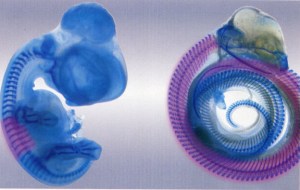
The vertebrae in which hoxc-6 is active (marked purple) in both a chick embryo and garter snake embryo.
Although the title of the special made me think of ‘Party in Your Pants’ (juvenile, I’m well aware), I thought I’d post a link to the website for the Nova special, ‘Ghost in Your Genes.’

The special explores epigenetics and the complex network of regulatory mechanisms that affect gene expression, including a nice little slideshow on Hox genes. We’ve explored the topic before here at Neuroanthropology (see Pharyngula on epigenetics) in part because a better understanding of the molecular mechanisms of organic development tends to undermine the overly simplistic notion that there are two forces shaping any organism — genes and environment or ‘nature’ and ‘nurture.’ With the epigenetic material, it’s painfully obvious that genes are not some kind of organic destiny writ in DNA, as some popular understandings tend to have it (and that popular understanding is often mobilized in simplistic accounts of subjects like behavioural genetics, as we will know).

We’ve already discussed some of the quirks about twins’ genes here (at Identical twins not… err… identical?), and there’s a nice example of genetically identical twin mice looking anything but identical (and having significant differences in health). The story, ‘A Tale of Two Mice,’ has a sobering subtext about the effects on gene expression of BPA (Bisphenol A), an organic chemical known to leach out of plastics (see Wikipedia for a brief overview of the issues). However, I’m still not convinced that calling this complex interaction ‘the epigenome’ or ‘the second genome’ is moving in the right direction. Even with this reservation, the visual aids for thinking about epigenetic processes are excellent.

Thanks to Dr. Jovan Maud (from Macquarie University and Culture Matters) for pointing this piece out to me. Unfortunately, I just gave my lecture on this stuff a week and a half ago — I’m afraid that I confused my audience a lot more than the people at Nova. It’s a nice site though for getting a bit of a feel for the sorts of factors that affect gene expression.

Credits
The brilliant graphic accompanied a reprint of Sean B. Carroll’s article, ‘The Origins of Form: Ancient genes, recycled and repurposed, control embryonic development in organisms of striking diversity,’ originally published in Natural History, November 2005. Carroll’s article can be accessed here, and it’s a great entry-level piece on hox genes and basic ‘evo-devo’ thought, but the author of Endless Forms Most Beautiful.

Video Games, Brain and Psychology Round Up

After earlier round-ups on video games (#1 on gaming in itself, as a social form; #2 on social science and game design), I am adding this third round up covering gaming and mind/brain research.

Together all three round ups provide the background for approaching video games through neuroanthropology. Ideally this background would then serve to inform specific research on gaming, which I have addressed previously in discussing avatars, MMORPGs, and Grand Theft Auto, probably my most synthetic piece.

To place that work in context, you can also check out the popular post One Day at Kotaku: Understanding Video Games and Other Modern Obsessions. See also: video games and the neuroanthropology of interaction and gaming and cultural perception.

This round-up draws more on published research than the previous two. At times the best I could provide is a link to an abstract; where possible, I have tracked down pdfs. And if there are other good papers out there that I don’t mention, please leave a comment!

Games and Neuroscience

Shawn Green and Daphne Bavelier, The Cognitive Neuroscience of Video Games
Pdf of a comprehensive chapter that appeared in the book Digital Media: Transformations in Human Communication

Klaus Mathiak & Rene Weber, Toward Brain Correlates of Natural Behavior: fMRI during Violent Video Games
“We propose that virtual environments can be used to study neuronal processes involved in semi-naturalistic behavior as determined by content analysis. Importantly, the activation pattern reflects brain-environment interactions rather than stimulus responses as observed in classical experimental designs.”

Niklas Ravaja et al., Spatial Presence and Emotions during Video Game Playing: Does It Matter with Whom You Play?
Yes it does—playing against another person is different than playing against a computer

CS Green & D. Bavelier, Action-Video-Game Experience Alters the Spatial Resolution of Vision
“Compared with nonplayers, action-video-game players could tolerate smaller target-distractor distances. Thus, the spatial resolution of visual processing is enhanced in this population. Critically, similar effects were observed in non-video-game players who were trained on an action video game; this result verifies a causative relationship between video-game play and augmented spatial resolution.” Gaming can also reduce gender differences in spatial cognition.

Fumiko Hoeft et al., Gender Differences in the Mesocorticolimbic System during Computer Game-play
“males showed greater activation and functional connectivity compared to females in the mesocorticolimbic system. These findings may be attributable to higher motivational states in males, as well as gender differences in reward prediction, learning reward values and cognitive state during computer video games”

MJ Koepp et al., Evidence for Striatal Dopamine Release during a Video Game
Pdf of well-received 1998 Nature paper on reward, dopamine and gaming. Slightly dated now with its view of reward and dopamine, but definitely a foundational piece.

Niklas Ravaja, The Psychophysiology of Video Gaming: Phasic Emotional Responses to Game Events
Ever wonder why it’s fun? Both positive and negative game events when players actively involved in playing elicited “positive emotional responses in terms of facial EMG activity” (pdf)

Games and Embodiment

James Paul Gee, Video Games and Embodiment
Recent article in Games and Culture laying out Gee’s view on gaming and human thinking as both “situated and embodied”.

Continue reading “Video Games, Brain and Psychology Round Up”

Video Game Round Up #2

I did a previous round up on gaming, which covered some basics on gaming, criticisms of the activity, some funny stuff, games as art, some anthropological work, and games and learning.

Here’s another round up, where I have focused on more traditional social science/anthropological themes, as well as related articles and blogging about game design.

Meaning

Sande Chen, Towards More Meaningful Games: A Multidisciplinary Approach
“how to ratchet up emotional intensity – through narrative design, visuals, and music – to create more meaningful games”

The Brainy Gamer, The Elusiveness of Meaning
“Ueda’s process begins with an image and grows from that place, informing the way the game plays, how it feels, and what it means… The meaning of the image is conveyed through a beautiful weave of gameplay and narrative.”

Kyle Stallock, Diablo Fans Petition Against III’s Artistic Direction
New game demo with brighter environments and more color creates a fan backlash: they want a visual style for Diable III “coherent with the universe it belongs to”. See the video report here

The Escapist, The Age of World Builders
“That’s when it really hit me: This wasn’t just some level in a game. This was my vacation home in a digital environment.”

Ian Bogost, The End of Gamers
Gaming matures as a medium, and takes myriad forms

Owen Good, Can a Game Be a Tearjerker?
A journalist asks, and online readers respond about their saddest gaming experiences.

The Brainy Gamer, Narrative Manifesto
Video games and delivering “genuinely interactive narrative experiences to the player”

Language

Brent Ellison, Defining Dialogue Systems
Dialogue as interaction, and how to build that into a game

Continue reading “Video Game Round Up #2”

US Presidential campaign wordpiles

What's on your mind?
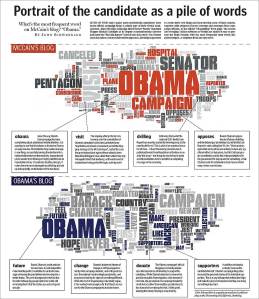
The Boston Globe did a ‘Wordpile’ analysis of both Sen. John McCain and Sen. Barack Obama’s websites and generated some fascinating graphics. Check out the original here. There’s lots one could say about these graphics — the Globe only highlights a few of the fascinating terms, and I’d want to try to chase down the context of a few that show up prominently because they look pretty ambiguous — but some factors stand out clear as day. The most obvious is that ‘Obama’ is the most mentioned word on both blogs. ‘Veeeery inturusting…’

The reason I bring this visual up though is that I found it a fascinating, graphically powerful way to present a basic qualitative-quantitative bit of research. Although I’m intrigued by research tools like nVivo and Atlas.ti, I sometimes wish that there were richer ways to present the data. This ‘Wordpile’ output is rich enough to put on a t-shirt! I’ll have to find some way to integrate it into my seminars on hybrid research methods.

And if anyone knows where I can lay my hands on the software or script to generate this sort of thing, please send along the link. A quick search didn’t give me anything, and I don’t want to sit in my office all Friday obsessing about this.

Les Perceptions Culturelles

Je voudrais parler de mes observations sur la vie en France et en Indonesie et expliquer pourquoi le fait d’avoir vecu un an en Indonesie m’a aidé a mieux comprendre le comportement des Parisiens.

Les Parisiens courent dans le metro, sont vite agressifs et s’enervent facilement. Par contre, les Indonesiens sont toujours des modeles de politesse et restent souriants en (presque) toutes circonstances. Les complications de la vie quotidienne sont acceptees comme inevitables et ne provoquent pas de colere. Ce n’est pas convenable de critiquer son prochain, la critique est mal vue et mal recue. Cette absence d’esprit critique suggere une contribution de la resignation et n’est que partiellement due aux conditions economiques. A mon avie, cette mentalité augmente aussi ces conditions economiques.

Je realise qu’on ne peut pas comparer une culture a une autre par des generalites mais il est parfois difficile de les eviter; en fait le terme “culture” est, lui-meme, une generalité. Bien sur tous les Indonesiens ne sont pas paresseux et tous les Parisiens ne sont pas “stressés”. Mais, lorsqu’on a l’occasion de vivre dans un certain milieu et de se conformer aux usages et habitudes locales de cette societe, on s’apercoit que certaines de ces coutumes sont considerees comme un trait specifique par une autre societe. Une analyse plus approfondie mêne a la notion de “caracteres nationaux”. Si on interroge un nombre de personnes qui ont voyagé dans le Metro Parisien et dans un “Angkot” a Sumatra, la similarité des remarques et observations conduit naturellement a une generalisation.

C’est a Paris que j’ai decouvert et apprecie l’aspect positif de la culture de la critique. C’est regrettable, bien sur, de voir la tension arterielle monter a cause de problemes auxquels on a, peut-etre, donné une importance exagerée, mais cette reaction est associée a la volonté de faire face a ces problemes et de les resoudre. De ce point de vue, l’apparente (ou reelle?) indifference de l’Indonesien aux vicissitudes de la vie quotidienne suggere une sorte de resignation qui tend a faire accepter les problemes comme inevitables et insolubles.

Quel est le comportement a choisir? Il n’y a probablement pas de réponse valide car le comportement de l’individu est conformé a celui de la societé dans laquelle il a evolué, de ses lois, ses coutumes, ses religions, son environnement etc, etc…

Lorsqu’un individu est introduit dans une societé de differente culture, l’assimilation est tres souvent achevée en une ou deux generations. Cette assimilation est probablement catalysée par le desir  “d’appartenance”.

En depit des differences caracteristiques separant les deux cultures ,je pense qu’ on peut detecter dans chacune un desir d’ameliorer  ses structures sociales et un certain sens de l’esthetique revelé par ses industries et ses arts.